

Hezbollah chief who was killed days after taking up post laid to rest in south Lebanon hometown
Advertisement
Read this article for free:
or
Already have an account? Log in here »
To continue reading, please subscribe:
Monthly Digital Subscription
$1 per week for 24 weeks*
- Enjoy unlimited reading on winnipegfreepress.com
- Read the E-Edition, our digital replica newspaper
- Access News Break, our award-winning app
- Play interactive puzzles
*Billed as $4.00 plus GST every four weeks. After 24 weeks, price increases to the regular rate of $19.95 plus GST every four weeks. Offer available to new and qualified returning subscribers only. Cancel any time.
Monthly Digital Subscription
$4.99/week*
- Enjoy unlimited reading on winnipegfreepress.com
- Read the E-Edition, our digital replica newspaper
- Access News Break, our award-winning app
- Play interactive puzzles
*Billed as $19.95 plus GST every four weeks. Cancel any time.
To continue reading, please subscribe:
Add Free Press access to your Brandon Sun subscription for only an additional
$1 for the first 4 weeks*
*Your next subscription payment will increase by $1.00 and you will be charged $16.99 plus GST for four weeks. After four weeks, your payment will increase to $23.99 plus GST every four weeks.
Read unlimited articles for free today:
or
Already have an account? Log in here »
Hey there, time traveller!
This article was published 24/02/2025 (395 days ago), so information in it may no longer be current.
BEIRUT (AP) — The late leader of Lebanon’s Hezbollah group who was killed in an Israeli airstrike days after he took the post was laid to rest in his southern hometown Monday, a day after his cousin and predecessor was buried in Beirut.
Hashem Safieddine, who was about 60, was killed in early October in a series of Israeli airstrikes in a southern suburb of Beirut at the height of the Israel-Hezbollah war. He was killed days after his cousin and predecessor Hassan Nasrallah was killed in Israeli airstrikes south of Beirut.
Following Nasrallah’s death on Sept. 27, Safieddine was secretly named Hezbollah’s secretary-general but was killed just days later. The two men were buried at a secret location as they were both killed during the 14-month Israel-Hezbollah war and their bodies exhumed for their funerals and reburial.
Thousands of people marched behind Safieddine’s coffin that was draped with Hezbollah’s yellow flag in the southern village of Deir Qanoun An-Nahr while his black turban was placed on top.
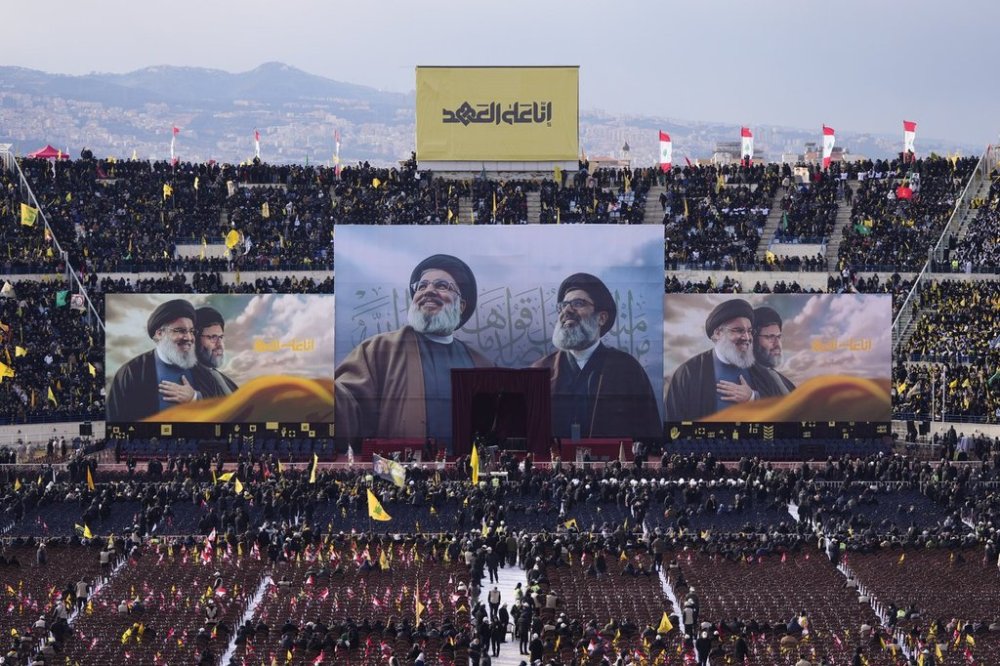
On Sunday, hundreds of thousands of people attended the funeral of Nasrallah and Safieddine in Beirut in a show of strength by the Iran-backed group that suffered major losses during its war with Israel. Four Israeli warplanes flew at low altitude twice during the funeral in Beirut on Sunday, once when the coffins were brought into the stadium, where the funeral was held, and a second time when Hezbollah’s current leader Naim Kassem was giving a speech.
Nasrallah was buried in a Beirut suburb Sunday evening, while Safieddine’s body was taken to his hometown in south Lebanon for Monday’s funeral.
Nasrallah and Safieddine were founding members of Hezbollah and enjoyed wide influence among Iran-backed Yemeni, Iraqi and Palestinian groups.
A familiar face in Lebanon, Safieddine was a member of Hezbollah’s decision-making Shura Council and its Jihad Council, which acts as its military command. He also headed its Executive Council, which runs schools and social programs.
Safieddine was close to Iran. His son, Rida, is married to Zeinab Soleimani, the daughter of Gen. Qassem Soleimani, head of Iran’s elite Quds Force, who was killed in a U.S. airstrike in Iraq in 2020.
Safieddine’s brother, Abdallah, is Hezbollah’s point man in Tehran, a crucial role in the organization given that Iran is its main backer, providing it with weapons and money.
During the Israel-Hezbollah war that broke out a day after the Hamas attack on southern Israel on Oct. 7, 2023, Israel killed some of Hezbollah’s top political and military chiefs. The war, that left more than 4,000 dead in Lebanon and dozens in Israel, ended on Nov. 27 when a U.S.-brokered ceasefire went into effect.
Last week, Israel withdrew its troops from much of south Lebanon but kept five posts inside the country in what the Lebanese government considers a violation of the ceasefire. As part of the deal, Hezbollah should now have an armed presence along the border with Israel.