

Bosnian Serb lawmakers bar joint institutions after a court convicted president and tensions soar
Advertisement
Read this article for free:
or
Already have an account? Log in here »
To continue reading, please subscribe:
Digital Subscription
One year of digital access for only $1.44 a week*
- Enjoy unlimited reading on winnipegfreepress.com
- Read the E-Edition, our digital replica newspaper
- Access News Break, our award-winning app
- Play interactive puzzles
*Billed as $5.77 plus GST every four weeks. After 52 weeks, price increases to the regular rate of $19.95 plus GST every four weeks. Offer available to new and qualified returning subscribers only. Cancel any time.
To continue reading, please subscribe:
Add Free Press access to your Brandon Sun subscription for only an additional
$1 for the first 4 weeks*
- Enjoy unlimited reading on winnipegfreepress.com
- Read the E-Edition, our digital replica newspaper
- Access News Break, our award-winning app
- Play interactive puzzles
*Your next Brandon Sun subscription payment will increase by $1.00 and you will be charged $17.95 plus GST for four weeks. After four weeks, your payment will increase to $24.95 plus GST every four weeks.
Read unlimited articles for free today:
or
Already have an account? Log in here »
Hey there, time traveller!
This article was published 27/02/2025 (606 days ago), so information in it may no longer be current.
SARAJEVO, Bosnia-Herzegovina (AP) — Bosnian Serb lawmakers on Thursday passed a set of laws barring central Bosnian judiciary and police from their entity in Bosnia, sending tensions soaring in the troubled Balkan country after a court convicted the pro-Russia Bosnian Serb president and banned him from politics.
Milorad Dodik, the president of the Serb-dominated half of Bosnia called Republika Srpska, was sentenced on Wednesday to a year in prison and was banned from engaging in politics for six years for disobeying orders from the top international official in Bosnia.
The separatist Bosnian Serb leader has described the conviction as an attack on all the Serb people in Bosnia and their mini-state formed after a 1992-95 war. He has announced “radical measures” in response, including eventual secession of the territory from Bosnia.
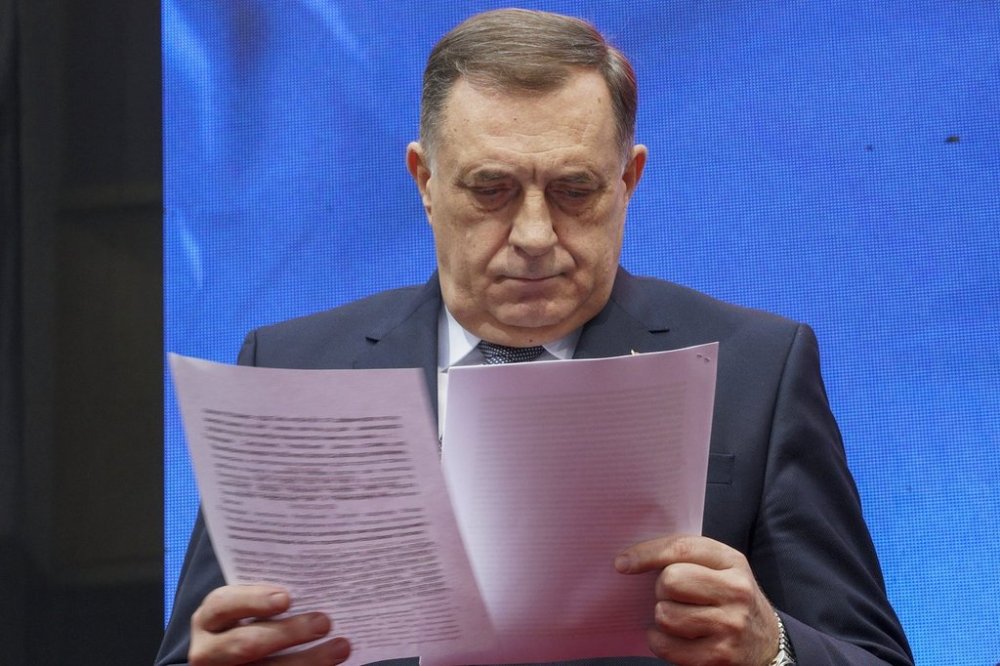
The laws approved in the Bosnian Serb assembly on Thursday rejected the authority of the Bosnian prosecutors, the country’s central court and its security agency in a blow to the fragile unity of the country Bosnia consists of the Serb-run and a Bosniak-Croat part tied together by joint state institutions.
The laws were passed with 49 votes in favor in the 83-member assembly. Critics have warned it was against Bosnia’s constitution and would lead to tensions in the country where the ethnic conflict killed 100,000 people and displaced millions three decades ago.
The war in Bosnia ended with a U.S-brokered peace accord in 1995. The deal established the two entities which have wide autonomies but kept a joint army, top judiciary and tax administration. Bosnia also has a rotating three-member presidency made up of Bosniak, Serb and Croat members.
The Dayton accords also envisaged that the international envoy overseeing peace has the authority to change laws and impose decisions in Bosnia.
Dodik has repeatedly called for the separation of the Serb-run half of Bosnia to join with neighboring Serbia, which prompted the former U.S. administration to impose sanctions against him and his close allies. Dodik has had Russia’s backing for his policies.
During the debate in the assembly, Dodik insisted that “this is not a secession” of Republika Srpska, but that the Serb mini-state was seeking to restore elements of autonomy envisaged in the Dayton peace accords and which he claimed had been taken away from the entity.
“There is no reason to stop, we are changing what has been artificially imposed,” he said. “We have been preparing for this for years.”
The war in Bosnia erupted when the country’s Serbs rebelled against independence from the former Yugoslavia and moved to form a mini-state of their own with the aim of uniting it with Serbia.