

Why Trump’s joint remarks to Congress won’t be a ‘State of the Union’ address
Advertisement
Read this article for free:
or
Already have an account? Log in here »
To continue reading, please subscribe:

Digital Subscription
One year of digital access for only $205*
- Enjoy unlimited reading on winnipegfreepress.com
- Read the E-Edition, our digital replica newspaper
- Access News Break, our award-winning app
- Play interactive puzzles
*First annual payment billed as $205.00 + GST for one year. This annual subscription will automatically renew at $233.00 + GST every 52 weeks (10% off the regular annual price of $259.35). Offer available to new and qualified returning subscribers only. Cancel any time.
To continue reading, please subscribe:
Add Free Press access to your Brandon Sun subscription for only an additional
$1 for the first 4 weeks*
- Enjoy unlimited reading on winnipegfreepress.com
- Read the E-Edition, our digital replica newspaper
- Access News Break, our award-winning app
- Play interactive puzzles
*Your next Brandon Sun subscription payment will increase by $1.00 and you will be charged $17.95 plus GST for four weeks. After four weeks, your payment will increase to $24.95 plus GST every four weeks.
Read unlimited articles for free today:
or
Already have an account? Log in here »
Hey there, time traveller!
This article was published 03/03/2025 (565 days ago), so information in it may no longer be current.
WASHINGTON (AP) — President Donald Trump on Tuesday night will stand at the front of the U.S. House chamber to address a joint session of Congress, the first of his second term in office.
It looks like the State of the Union, and will be carried on live television, just like those annual addresses are. But it’s called something else: a joint address to Congress. And it has its origins in the first term of President Ronald Reagan.
The U.S. Constitution requires that the president updates Congress and recommends policies, although the founding document doesn’t specify precisely when that address should take place.
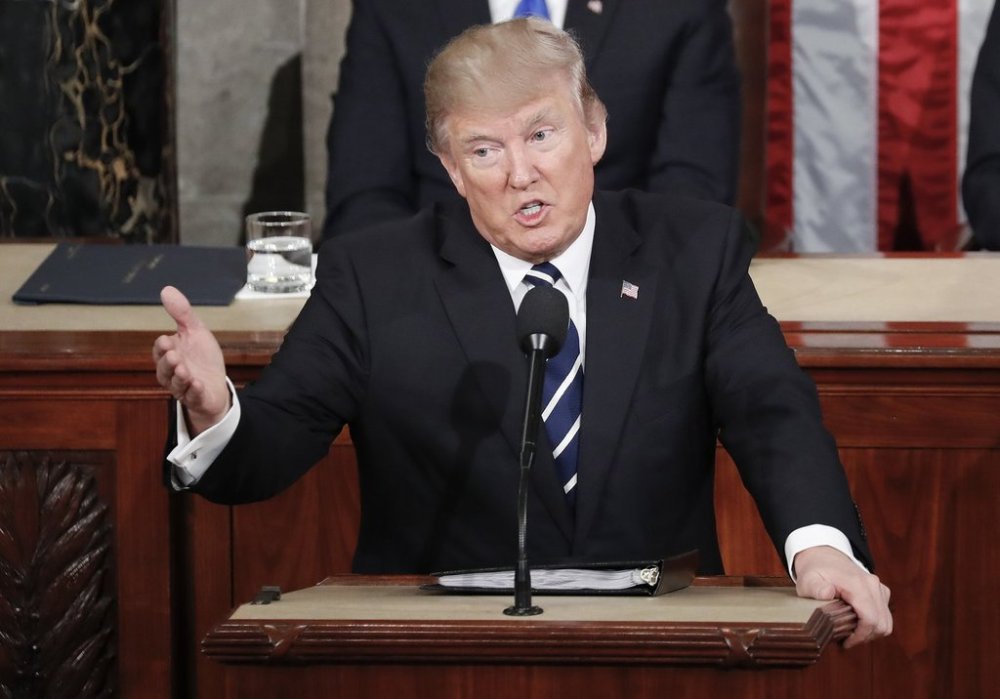
Usually, presidents will deliver those remarks in January or February, reflecting on events of the previous year and outlining their policy priorities for the coming one. The message used to be known as “the President’s Annual Message to Congress.” In 1934, President Franklin D. Roosevelt began referring to it as the “Annual Message to Congress on the State of the Union.”
Shortly after he was sworn in for his first term in 1981, Reagan addressed a joint session of Congress, remarks that were called “Address Before a Joint Session of the Congress on the Program for Economic Recovery,” according to The American Presidency Project, at the University of California at Santa Barbara.
Presidents George H.W. Bush and Bill Clinton followed suit in their own first years in office, with 1989 and 1993 messages both entitled “Administration Goals.” In 2001, President George W. Bush’s speech was his “Budget Message.”
According to the American Presidency Project, the impacts of these first-year speeches should be considered to have the same heft as the State of the Union addresses that follow in subsequent years. And, just like the State of the Union address, the opposing party to the one that occupies the White House gives a brief speech in response, which, like the president’s remarks, is televised. This year’s will be delivered by Democratic Sen. Elissa Slotkin of Michigan.
___
Kinnard can be reached at http://x.com/MegKinnardAP.
Advertisement Advertise With Us