

Secrets, spy tools and a 110-year-old lemon are on show in an exhibition from Britain’s MI5
Advertisement
Read this article for free:
or
Already have an account? Log in here »
To continue reading, please subscribe:

Digital Subscription
One year of digital access for only $205*
- Enjoy unlimited reading on winnipegfreepress.com
- Read the E-Edition, our digital replica newspaper
- Access News Break, our award-winning app
- Play interactive puzzles
*First annual payment billed as $205.00 + GST for one year. This annual subscription will automatically renew at $233.00 + GST every 52 weeks (10% off the regular annual price of $259.35). Offer available to new and qualified returning subscribers only. Cancel any time.
To continue reading, please subscribe:
Add Free Press access to your Brandon Sun subscription for only an additional
$1 for the first 4 weeks*
- Enjoy unlimited reading on winnipegfreepress.com
- Read the E-Edition, our digital replica newspaper
- Access News Break, our award-winning app
- Play interactive puzzles
*Your next Brandon Sun subscription payment will increase by $1.00 and you will be charged $17.95 plus GST for four weeks. After four weeks, your payment will increase to $24.95 plus GST every four weeks.
Read unlimited articles for free today:
or
Already have an account? Log in here »
Hey there, time traveller!
This article was published 01/04/2025 (543 days ago), so information in it may no longer be current.
LONDON (AP) — A desiccated 110-year-old lemon that played a key role in espionage history is one of the star attractions of a London exhibition drawn from the files of MI5, Britain’s domestic intelligence agency.
Compact spy cameras, microdots in a talcum powder tin and a briefcase abandoned by fleeing Soviet spy Guy Burgess are also part of the show at Britain’s National Archives, which charts the history of a secretive agency that is – slowly – becoming more open.
MI5 Director General Ken McCallum told journalists at a preview on Tuesday that the organization’s work “is often different from fiction, whether that fiction is George Smiley or Jackson Lamb” – the brilliant spymaster of John le Carré’s novels and the slovenly supervisor of MI5 rejects in Mick Herron’s “Slow Horses” series.
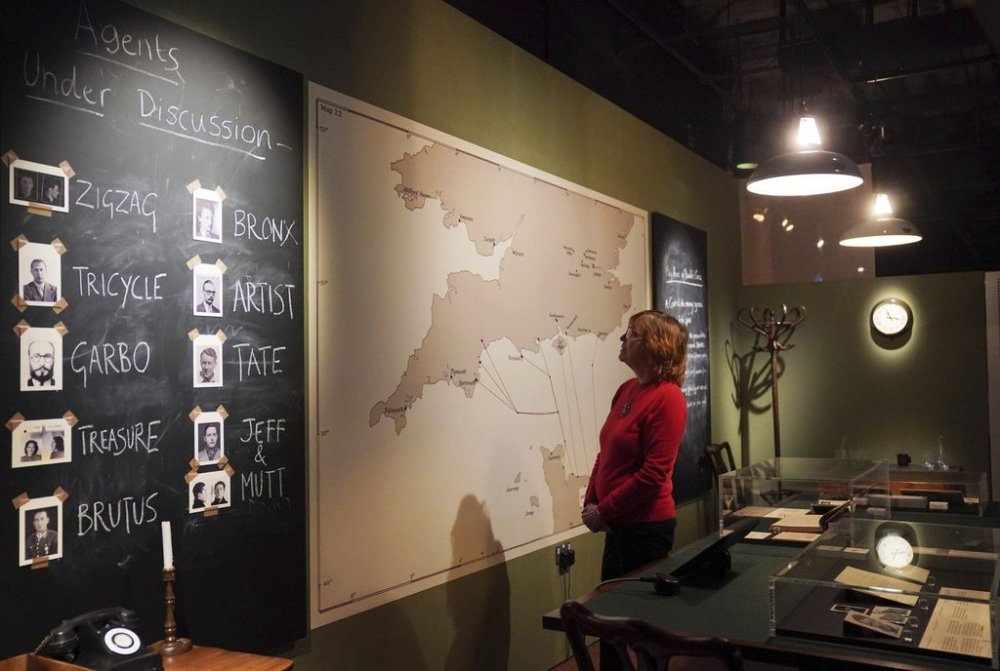
Many stories told in the exhibition, however, would not be out of place in a thriller.
The lemon, now black and shriveled, helped convict Karl Muller, a German spy in Britain during World War I. It was found by police in his dressing-table drawer, along with another in his overcoat pocket. Evidence at his secret trial showed their juice had been used to write invisible-ink letters detailing British troop movements.
Muller was executed by firing squad at the Tower of London in 1915.
In a coda that would not be out of place in “Slow Horses,” MI5 pretended Muller was still alive and wrote to his German handlers to ask for more money.
“The Germans duly sent more funds and MI5 used the funds to purchase a car,” exhibition curator Mark Dunton said. “And they christened the car ‘The Muller.’
“They then were reprimanded by the Treasury for unauthorized use of expenditure,” he added.
The show includes declassified records held by the National Archives and items loaned from the secret museum inside Thames House, MI5’s London headquarters.
It charts the changing role of an agency that was founded in 1909 as the Secret Service Bureau with an initial staff of two officers.
There are records of its World War II successes, when the agency used captured Nazi agents to send disinformation back to Germany, deceiving Adolf Hitler about the location of the looming Allied invasion in 1944.
Failures include the years-long betrayal of the upper-crust “Cambridge Spies,” whose members spilled secrets to the Soviet Union from the heart of the U.K. intelligence establishment. Recently declassified MI5 documents on display include the 1963 confession of Cambridge spy Kim Philby, who denied treachery for years before he was exposed and fled to Moscow.
The exhibition also reveals changing attitudes, not least to women. The exhibition includes a 1945 report by spymaster Maxwell Knight discussing whether women could make good agents.
“It is frequently alleged that women are less discreet than men,” he noted, but declared that it was not so, saying that in “hundreds of cases of ‘loose talk’” most of the offenders were men.
There are admissions of past mistakes. The exhibition notes that MI5 was slow to recognize the threat from fascism in the 1930s, and later spent too much time spying on the small Communist Party of Great Britain. MI5 didn’t need to break into the party’s offices – it had a key, which is on display.
There are only a few items from the past few decades, showing how MI5’s focus has shifted from counterespionage to counterterrorism. Displays include a mortar shell fired by the Irish Republican Army at 10 Downing St. in 1991 while Prime Minister John Major was holding a Cabinet meeting.
MI5 only began releasing records to the U.K.’s public archives in 1997, generally 50 years after the events have passed. Even now, it controls what to release and what to keep secret.
“It would be a mistake to assume everything is in the exhibition,” said author Ben Macintyre, whose books on the history of intelligence include “Operation Mincemeat” and “Agent Zigzag.” But he said it still marks “a real sea-change in official secrecy.”
“A generation ago, this stuff was totally secret,” he said. “We weren’t even allowed to know that MI5 existed.”
___
“MI5: Official Secrets” opens Saturday and runs through Sept. 28 at the National Archives in London. Admission is free.