

Rival leaders of split Cyprus make inroads to work together but rift remains
Advertisement
Read this article for free:
or
Already have an account? Log in here »
To continue reading, please subscribe:

Digital Subscription
One year of digital access for only $205*
- Enjoy unlimited reading on winnipegfreepress.com
- Read the E-Edition, our digital replica newspaper
- Access News Break, our award-winning app
- Play interactive puzzles
*First annual payment billed as $205.00 + GST for one year. This annual subscription will automatically renew at $233.00 + GST every 52 weeks (10% off the regular annual price of $259.35). Offer available to new and qualified returning subscribers only. Cancel any time.
To continue reading, please subscribe:
Add Free Press access to your Brandon Sun subscription for only an additional
$1 for the first 4 weeks*
- Enjoy unlimited reading on winnipegfreepress.com
- Read the E-Edition, our digital replica newspaper
- Access News Break, our award-winning app
- Play interactive puzzles
*Your next Brandon Sun subscription payment will increase by $1.00 and you will be charged $17.95 plus GST for four weeks. After four weeks, your payment will increase to $24.95 plus GST every four weeks.
Read unlimited articles for free today:
or
Already have an account? Log in here »
Hey there, time traveller!
This article was published 02/04/2025 (514 days ago), so information in it may no longer be current.
NICOSIA, Cyprus (AP) — The rival leaders of ethnically divided Cyprus made some progress Wednesday on fostering trust between their conflict-riven Greek and Turkish speaking communities, agreeing to delve deeper into the dangers posed by minefields and working together on environmental initiatives.
But the two sides still have a long way to go to formally restart moribund peace talks, with both leaders alluding to the ongoing fundamental rift on the kind of a peace deal each side expects.
In a joint statement following the United Nations-hosted meeting, Ersin Tatar, the leader of the breakaway Turkish Cypriots and Nikos Christodoulides, the island’s Greek Cypriot President, said they also agreed on restoring neglected cemeteries and setting up a joint group of young people from both sides of the divide to discuss issues relevant to them.
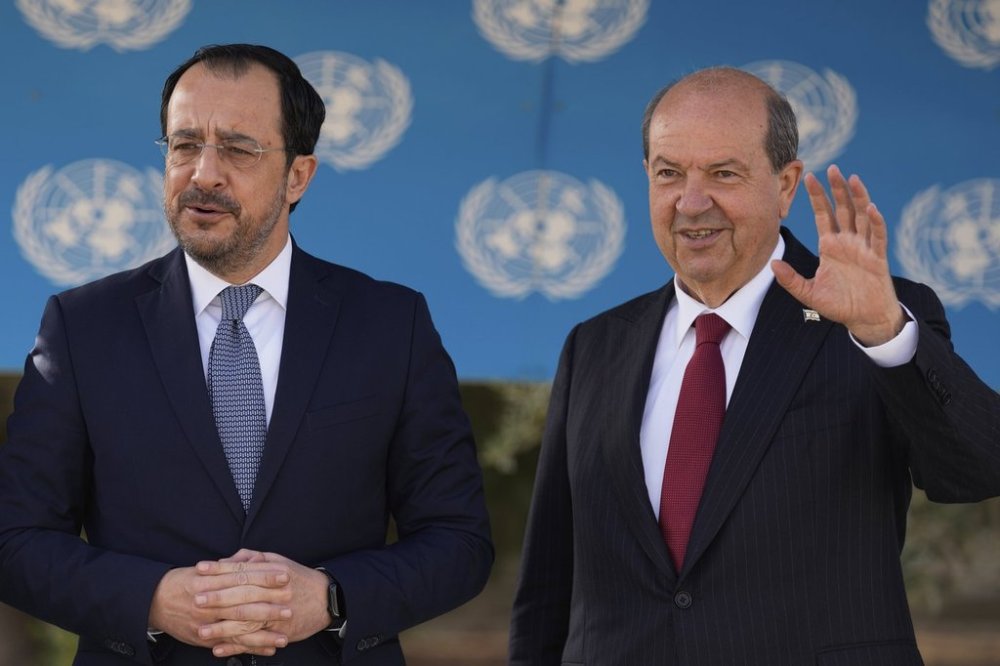
The measures echoed those the two leaders agreed to pursue in a meeting with U.N. Secretary-General Antonio Guterres in Geneva last month that aimed to breathe new life into a peace process on hiatus for nearly eight years. Guterres said he will appoint an envoy tasked with getting formal peace talks restarted.
The Mediterranean island was divided when Turkey invaded the northern part in 1974 following a failed coup by supporters of a union with Greece. Only Turkey recognizes a Turkish Cypriot declaration of independence, and has more than 35,000 troops in the island’s northern third.
Although Cyprus joined the European Union in 2004, only the Greek Cypriot south, where the internationally recognized government is seated, enjoys full membership benefits.
There was no agreement Wednesday on two key trust-building initiatives: building solar energy parks inside sections of a 180 km (120 mile) long U.N. buffer zone cutting across the island, and adding to the nine existing crossing points along that dividing line.
Tatar said that he’s hopeful “in time we will be able to achieve” progress.
“My friend Nikos, he’s got his own principles, I want our principles. What is important is to exchange and be positive so that we can achieve things together,” Tatar said.
Christodoulides suggested Tatar was using the issue of solar energy parks to promote his vision of a partitioned Cyprus. The leaders agreed to meet again later this month.
The leaders’ remarks pointed to the wide gulf between how the two sides envision a future peace settlement.
Tatar and Turkey insist a two-state deal is now the only way to resolve one of the world’s most intractable disputes since the “old” model — a federation made up of Greek and Turkish speaking zones — is no longer viable after decades of failure.
Greek Cypriots say any deal that entrenches the island’s partition is a non-starter as it contravenes long-held U.N. resolutions endorsing a federation.
They also reject a Turkish and Turkish Cypriot demand for a permanent Turkish troop presence and military intervention rights under any accord, as well as giving the minority Turkish Cypriots veto power over all federal-level government decisions.