

What to know about the severe storms and flash flooding hitting parts of the US
Advertisement
Read this article for free:
or
Already have an account? Log in here »
To continue reading, please subscribe:
Monthly Digital Subscription
$1 per week for 24 weeks*
- Enjoy unlimited reading on winnipegfreepress.com
- Read the E-Edition, our digital replica newspaper
- Access News Break, our award-winning app
- Play interactive puzzles
*Billed as $4.00 plus GST every four weeks. After 24 weeks, price increases to the regular rate of $19.95 plus GST every four weeks. Offer available to new and qualified returning subscribers only. Cancel any time.
Monthly Digital Subscription
$4.99/week*
- Enjoy unlimited reading on winnipegfreepress.com
- Read the E-Edition, our digital replica newspaper
- Access News Break, our award-winning app
- Play interactive puzzles
*Billed as $19.95 plus GST every four weeks. Cancel any time.
To continue reading, please subscribe:
Add Free Press access to your Brandon Sun subscription for only an additional
$1 for the first 4 weeks*
*Your next subscription payment will increase by $1.00 and you will be charged $16.99 plus GST for four weeks. After four weeks, your payment will increase to $23.99 plus GST every four weeks.
Read unlimited articles for free today:
or
Already have an account? Log in here »
Hey there, time traveller!
This article was published 03/04/2025 (358 days ago), so information in it may no longer be current.
LITTLE ROCK, Ark. (AP) — Parts of the South and Midwest, still reeling from violent storms, tornadoes and flooding that have killed at least eight people this week, faced an ongoing threat of catastrophic flooding Friday that forecasters said would stretch into the weekend.
Severe thunderstorms threatened a swath of the country with a population of 2.3 million people from northeast Texas through Arkansas and into southeast Missouri.
What has happened?
In Kentucky, continued storms inundated roads and a mudslide blocked a busy highway on the outskirts of Louisville. A 9-year-old boy was killed, swept away as he walked to a school bus stop.
The downtown area of Hopkinsville, Kentucky — a city of 31,000 residents 72 miles (116 kilometers) northwest of Nashville, Tennessee — was submerged.
The first wave of storms killed at least five people in Tennessee and one each in Missouri and Indiana on Wednesday and Thursday.
Tennessee Gov. Bill Lee called the devastation in his state “enormous” and said it was too early to know whether there were more deaths as searches continued.
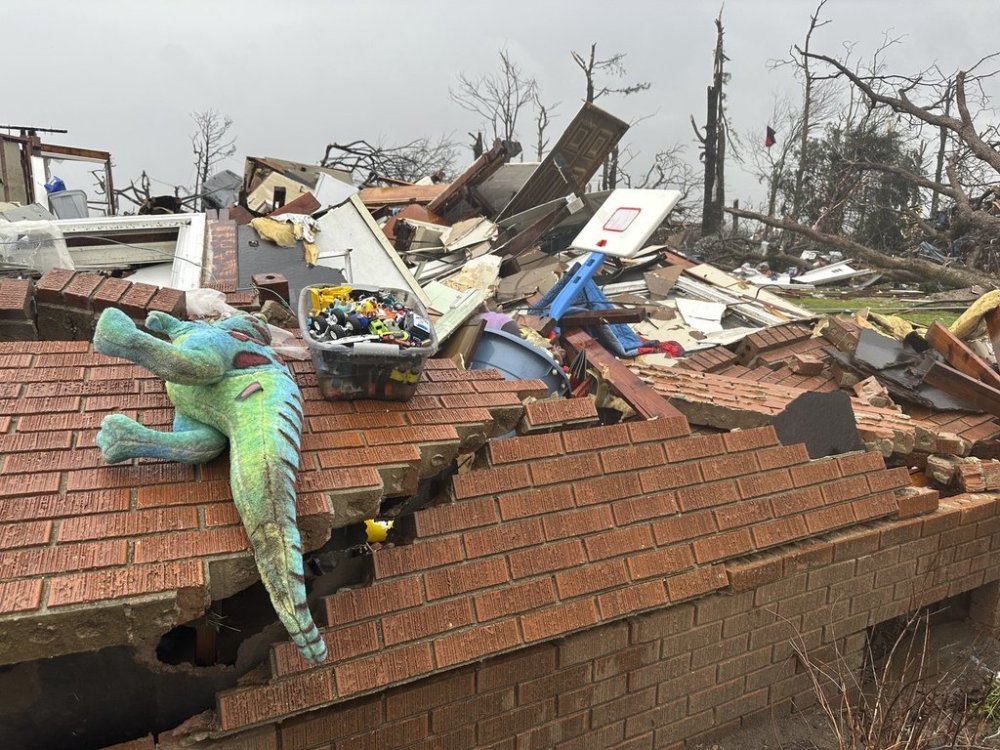
There was massive destruction in Lake City in eastern Arkansas, where homes were flattened and cars were flipped and tossed into trees.
At least 318 tornado warnings have been issued by the National Weather Service since this week’s tornado outbreak began early Wednesday, and that was likely to grow. It has already eclipsed the 300 tornado warnings issued during last month’s deadly outbreak in Arkansas, Mississippi, Missouri and other states.
Not all tornado warnings involve an actual tornado, and it was too early to know how many were actually produced by the current outbreak.
The severe weather hit at a time when nearly half the National Weather Service’s forecast offices have 20% vacancy rates — twice that of a decade ago — according to data obtained by The Associated Press.
What’s causing this wave of storms?
Forecasters attributed the violent weather to warm temperatures, an unstable atmosphere, strong wind shear and abundant moisture streaming from the Gulf.
The prolonged deluge, which could dump more than a foot (30 centimeters) of rain over a four-day period, “is an event that happens once in a generation to once in a lifetime,” the National Weather Service said.
What’s next?
Private forecasting company AccuWeather said northeastern Arkansas, southeastern Missouri, southern Illinois, western Kentucky and northwestern Tennessee needed to prepare for a catastrophic risk from flash flooding.
“This is a rare and dangerous atmospheric setup,” said Jonathan Porter, AccuWeather chief meteorologist.
Forecasters have also warned of major disruptions to shipping and supply chains. Shipping giant FedEx, for example, has a massive facility in the danger area, in Memphis Tennessee. Barge transportation on the lower Mississippi River could also be affected.
Water rescue teams and sandbags were being set up across the region in anticipation of flooding, and authorities warned people to take the threat of rising water seriously.
“We need everyone to understand that all water poses risk right now and to take every precaution,” Kentucky Gov. Andy Beshear said.
___
Associated Press writers George Walker IV in Selmer, Tennessee; John Seewer in Toledo, Ohio; Jeff Martin in Atlanta; Adrian Sainz in Memphis, Tennessee; Jonathan Mattise in Nashville, Tennessee, Seth Borenstein in Washington; and Bruce Schreiner in Shelbyville, Kentucky, contributed.