

Columbia University activist Mahmoud Khalil can be deported, immigration judge rules
Advertisement
Read this article for free:
or
Already have an account? Log in here »
To continue reading, please subscribe:

Digital Subscription
One year of digital access for only $205*
- Enjoy unlimited reading on winnipegfreepress.com
- Read the E-Edition, our digital replica newspaper
- Access News Break, our award-winning app
- Play interactive puzzles
*First annual payment billed as $205.00 + GST for one year. This annual subscription will automatically renew at $233.00 + GST every 52 weeks (10% off the regular annual price of $259.35). Offer available to new and qualified returning subscribers only. Cancel any time.
To continue reading, please subscribe:
Add Free Press access to your Brandon Sun subscription for only an additional
$1 for the first 4 weeks*
- Enjoy unlimited reading on winnipegfreepress.com
- Read the E-Edition, our digital replica newspaper
- Access News Break, our award-winning app
- Play interactive puzzles
*Your next Brandon Sun subscription payment will increase by $1.00 and you will be charged $17.95 plus GST for four weeks. After four weeks, your payment will increase to $24.95 plus GST every four weeks.
Read unlimited articles for free today:
or
Already have an account? Log in here »
Hey there, time traveller!
This article was published 11/04/2025 (498 days ago), so information in it may no longer be current.
JENA, La. (AP) — Columbia University graduate student Mahmoud Khalil can be forced out of the country as a national security risk, an immigration judge in Louisiana ruled Friday after lawyers argued the legality of deporting the activist who participated in pro-Palestinian demonstrations.
The government’s contention that Khalil’s presence in the U.S. posed “potentially serious foreign policy consequences” satisfied requirements for deportation, Immigration Judge Jamee E. Comans said at a hearing in Jena.
Comans said the government had “established by clear and convincing evidence that he is removable.”
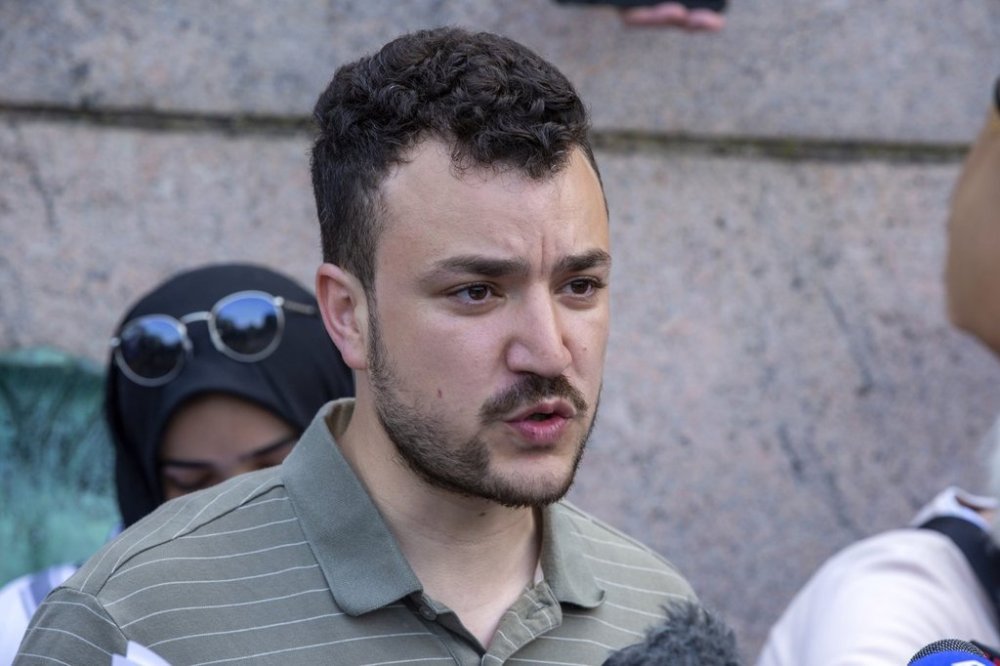
After the immigration court hearing, Khalil attorney Marc Van Der Hout told a New Jersey federal judge that Khalil will appeal to the Board of Immigration Appeals within weeks.
“So nothing is going to happen quickly,” he said.
Addressing the judge at the end of the immigration hearing, Khalil recalled her saying at a hearing earlier in the week that “there’s nothing more important to this court than due process rights and fundamental fairness.”
“Clearly what we witnessed today, neither of these principles were present today or in this whole process,” he added. “This is exactly why the Trump administration has sent me to the court, 1,000 miles away from my family.”
Van Der Hout, also criticized the hearing’s fairness.
“Today, we saw our worst fears play out: Mahmoud was subject to a charade of due process, a flagrant violation of his right to a fair hearing, and a weaponization of immigration law to suppress dissent,” Van Der Hout said in a statement.
Khalil, a legal U.S. resident, was detained by federal immigration agents March 8 in the lobby of his university-owned apartment, the first arrest under President Donald Trump’s promised crackdown on students who joined campus protests against the war in Gaza.
Within a day, he was flown across the country to an immigration detention center in Jena, far from his attorneys and wife, a U.S. citizen due to give birth soon.
Khalil’s lawyers have challenged the legality of his detention, saying the Trump administration is trying to block free speech protected by the First Amendment.
Secretary of State Marco Rubio has cited a rarely used statute to justify Khalil’s deportation, which gives him power to deport those who pose “potentially serious adverse foreign policy consequences for the United States.”
At Friday’s hearing, Van Der Hout told the judge that the government’s submissions to the court prove the attempt to deport his client “has nothing to do with foreign policy” and said the government is trying to deport him for protected speech.
Khalil, a Palestinian born and raised in Syria after his grandparents were forcibly removed from their ancestral home in Tiberias, isn’t accused of breaking any laws during the protests at Columbia.
The government, however, has said noncitizens who participate in such demonstrations should be expelled from the country for expressing views that the administration considers to be antisemitic and “pro-Hamas,” referring to the Palestinian militant group that attacked Israel on Oct. 7, 2023.
Khalil, a 30-year-old international affairs graduate student, had served as a negotiator and spokesperson for student activists at Columbia University who took over a campus lawn last spring to protest Israel’s military campaign in Gaza.
The university summoned police to dismantle the encampment after a small group of protesters seized an administration building. Khalil is not accused of participating in the building occupation and wasn’t among those arrested.
But images of his maskless face at protests and his willingness to share his name with reporters have drawn scorn from those who viewed the protesters and their demands as antisemitic. The White House accused Khalil of “siding with terrorists” but has yet to cite any support for the claim.
Federal judges in New York and New Jersey have ordered the government not to deport Khalil while his case plays out in multiple courts.
The Trump administration has said it is taking at least $400 million in federal funding away from research programs at Columbia and its medical center to punish it for not adequately fighting what it considers to be antisemitism on campus.
Some Jewish students and faculty complained about being harassed during the demonstrations or ostracized because of their faith or their support of Israel.
Immigration authorities have cracked down on other critics of Israel on college campuses, arresting a Georgetown University scholar who had spoken out on social media about the Israel-Gaza war, canceling the student visas of some protesters and deporting a Brown University professor who they said had attended the Lebanon funeral of a leader of Hezbollah, another militant group that has fought with Israel.
___
Brumback reported from Atlanta. Associated Press reporter Larry Neumeister in New York contributed.