

At least 50 people killed in east Congo as government and Rwanda-backed rebels trade blame
Advertisement
Read this article for free:
or
Already have an account? Log in here »
To continue reading, please subscribe:
Digital Subscription
One year of digital access for only $1.44 a week*
- Enjoy unlimited reading on winnipegfreepress.com
- Read the E-Edition, our digital replica newspaper
- Access News Break, our award-winning app
- Play interactive puzzles
*Billed as $5.77 plus GST every four weeks. After 52 weeks, price increases to the regular rate of $19.95 plus GST every four weeks. Offer available to new and qualified returning subscribers only. Cancel any time.
To continue reading, please subscribe:
Add Free Press access to your Brandon Sun subscription for only an additional
$1 for the first 4 weeks*
- Enjoy unlimited reading on winnipegfreepress.com
- Read the E-Edition, our digital replica newspaper
- Access News Break, our award-winning app
- Play interactive puzzles
*Your next Brandon Sun subscription payment will increase by $1.00 and you will be charged $17.95 plus GST for four weeks. After four weeks, your payment will increase to $24.95 plus GST every four weeks.
Read unlimited articles for free today:
or
Already have an account? Log in here »
Hey there, time traveller!
This article was published 13/04/2025 (553 days ago), so information in it may no longer be current.
GOMA, Congo (AP) — At least 50 people were killed in weekend attacks in Congo’s conflict-battered east, authorities said Saturday. The government traded blame with Rwanda-backed rebels over who was responsible for the violence that quickly escalated the conflict in the region.
The renewed violence that residents reported in and around the region’s largest city of Goma — which the M23 rebels control — was the biggest threat yet to ongoing peace efforts by both the Gulf Arab state of Qatar and African nations in the conflict that has raised fears of regional warfare.
Goma resident Amboma Safari recounted how his family of four spent the night under their bed as they heard gunfire and bomb blasts through Friday night. “We saw corpses of soldiers, but we don’t know which group they are from,” Safari said.
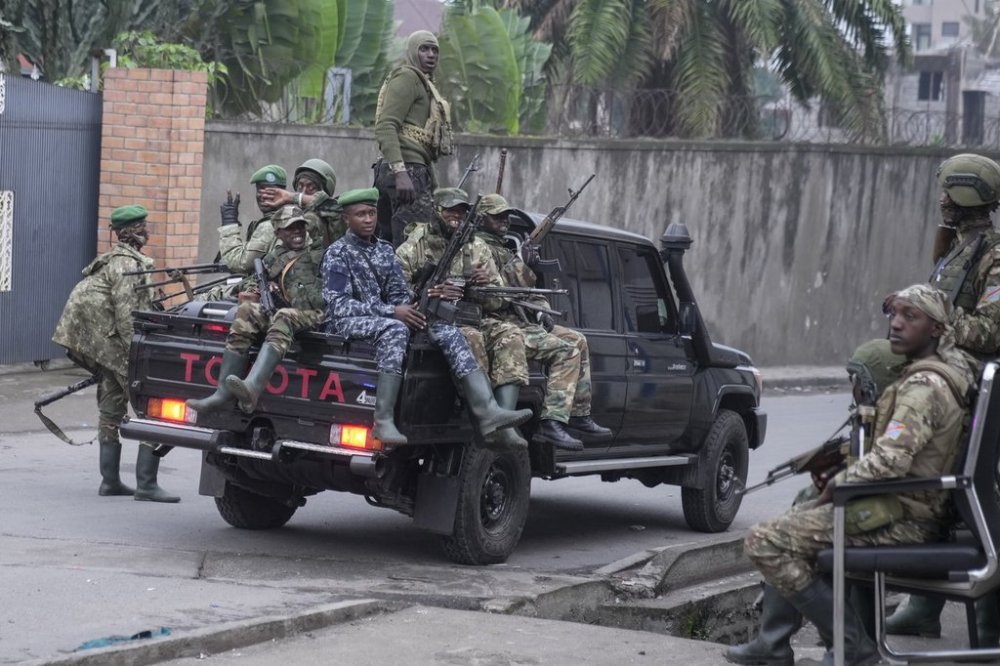
In the second city of Bukavu, which the M23 also controls, dozens of the armed Wazalendo local militia members who fight alongside Congolese forces marched for a few hours towards the local airport as they appeared to stage a challenge against the rebels.
The group, which later retreated, declared a ceasefire on Sunday to give ongoing peace talks “a chance.”
The decades-long conflict between Congo and the M23 rebels escalated in January, when the rebels made an unprecedented advance and seized the strategic eastern Congolese city of Goma, followed by the town of Bukavu in February. The latest fighting has killed some 3,000 people and worsened what was already one of the world’s largest humanitarian crises, with around 7 million people displaced.
In a statement, Congo’s Ministry of Interior said 52 people were killed between Friday and Saturday, including a person shot dead at Goma’s Kyeshero Hospital. The ministry blamed the attack on M23.
M23 spokesperson Lawrence Kanyuka blamed Congolese forces and their allies for the attacks. Kanyuka said in a statement that Congo’s joint operations with local militias and southern African troops “directly threaten the stability and security of civilians” in the region.
The group said it has been compelled to “reconsider its position to prioritize the security” of the people in the area, suggesting the crisis could worsen.
Christian Kalamo, a civil society leader in the North Kivu province that includes Goma, said at least one body was seen on the streets on Saturday.
“It is difficult to know if it is the Wazalendo, the FARDC (Congolese forces) or the M23″ that carried out the attacks, Kalamo said. “Now, we don’t know what will happen, and we live with fear in our stomachs, thinking that the war will resume.”
——
Kamale reported from Kinshasa, Congo. Associated Press journalist Janvier Barhahiga in Bukavu, Congo contributed.