

Washington lawmakers pass rent-control bill, approve unemployment for striking workers
Advertisement
Read this article for free:
or
Already have an account? Log in here »
To continue reading, please subscribe:
Monthly Digital Subscription
$1 per week for 24 weeks*
- Enjoy unlimited reading on winnipegfreepress.com
- Read the E-Edition, our digital replica newspaper
- Access News Break, our award-winning app
- Play interactive puzzles
*Billed as $4.00 plus GST every four weeks. After 24 weeks, price increases to the regular rate of $19.95 plus GST every four weeks. Offer available to new and qualified returning subscribers only. Cancel any time.
Monthly Digital Subscription
$4.99/week*
- Enjoy unlimited reading on winnipegfreepress.com
- Read the E-Edition, our digital replica newspaper
- Access News Break, our award-winning app
- Play interactive puzzles
*Billed as $19.95 plus GST every four weeks. Cancel any time.
To continue reading, please subscribe:
Add Free Press access to your Brandon Sun subscription for only an additional
$1 for the first 4 weeks*
*Your next subscription payment will increase by $1.00 and you will be charged $16.99 plus GST for four weeks. After four weeks, your payment will increase to $23.99 plus GST every four weeks.
Read unlimited articles for free today:
or
Already have an account? Log in here »
Hey there, time traveller!
This article was published 29/04/2025 (332 days ago), so information in it may no longer be current.
In the final days of the Washington legislative session, lawmakers hashed out agreements to approve a bill that sets limits on rent increases and a measure that gives striking workers unemployment benefits. The two bills await decisions by Gov. Bob Ferguson, a Democrat.
If signed into law, the rent stabilization bill would be among the first in the nation, adding Washington to states like Oregon and California that have sought new ways to curb homelessness. Washington joined Oregon in efforts to give striking workers unemployment payments, following recent walkouts by Boeing factory workers, hospital nurses and teachers in the Pacific Northwest.
Washington passed its bill on a 27-21 vote with some changes, while Oregon lawmakers continue to discuss the plan. The bill started with a 12-week cap on unemployment benefits. That was cut to four weeks in the House before the conference committee reached a compromise of six weeks.
Democratic state Sen. Marcus Riccelli, who sponsored Washington’s bill, said it will level the playing field for workers, even with the shorter benefits period.
“A strike is a last resort, but the bill gives striking workers the ability to afford basic needs like food and housing,” Riccelli told The Associated Press on Tuesday. “The whole thing for me is when there’s not a safety net, they face tremendous pressure to end the strike quickly.”
The Employment Security Department must report strike data to the Legislature starting in 2026, so they can assess impacts, Riccelli said. The bill sunsets on Jan. 1, 2036.
Only two states, New York and New Jersey, give striking workers unemployment benefits. Senate Democrats in Connecticut have revived legislation that would provide financial help for striking workers after the governor vetoed a similar measure last year.
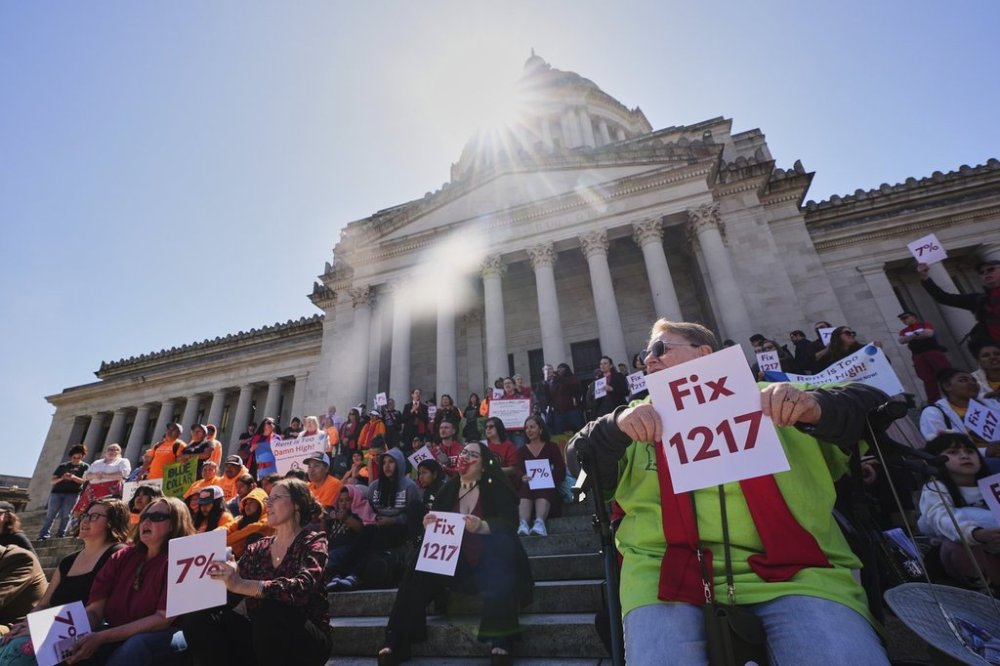
Washington’s rent-control bill made it through both houses, but two unexpected amendments added on the Senate floor sent House Bill 1217 into a conference committee. Those amendments increased the cap from 7% to 10% plus inflation and exempted single-family homes.
Opponents of the bill warned that developers would leave the state if it became law and argued that similar policies in Oregon and California only added to those states’ financial burdens instead of slowing the homeless crisis.
Oregon passed a rent-control bill in 2019, and lawmakers updated the measure to cap rent increases at either 7% plus the annual 12-month average change in the consumer price index for the U.S. West, or 10% — whichever is lower.
The Washington legislature’s conference committee managed to get the cap down a bit, to 7% plus inflation or 10% — whichever is lower. They also restored protections for the 38% of renters who live in single-family homes. The rent-increase cap for manufactured homes remains at 5%.
Lawmakers approved the plan Sunday on a 54-44 vote, with five Democrats joining the Republican opposition.
Michele Thomas, director of policy for Low Income Housing Alliance, said the policy was hard-fought and she was happy the state made a step toward better protections for tenants.
“Excessive rent increases threaten nearly 1 million renter households in our state with displacement and homelessness, as rents continue to rise,” she said. “This bill will help keep people in their homes as we continue to fight for stronger protections and for more affordable housing for our communities.”