

Philippines signs military pact with New Zealand to widen alliances while facing an assertive China
Advertisement
Read this article for free:
or
Already have an account? Log in here »
To continue reading, please subscribe:

Digital Subscription
One year of digital access for only $205*
- Enjoy unlimited reading on winnipegfreepress.com
- Read the E-Edition, our digital replica newspaper
- Access News Break, our award-winning app
- Play interactive puzzles
*First annual payment billed as $205.00 + GST for one year. This annual subscription will automatically renew at $233.00 + GST every 52 weeks (10% off the regular annual price of $259.35). Offer available to new and qualified returning subscribers only. Cancel any time.
To continue reading, please subscribe:
Add Free Press access to your Brandon Sun subscription for only an additional
$1 for the first 4 weeks*
- Enjoy unlimited reading on winnipegfreepress.com
- Read the E-Edition, our digital replica newspaper
- Access News Break, our award-winning app
- Play interactive puzzles
*Your next Brandon Sun subscription payment will increase by $1.00 and you will be charged $17.95 plus GST for four weeks. After four weeks, your payment will increase to $24.95 plus GST every four weeks.
Read unlimited articles for free today:
or
Already have an account? Log in here »
Hey there, time traveller!
This article was published 30/04/2025 (527 days ago), so information in it may no longer be current.
MANILA, Philippines (AP) — The Philippines signed a military pact with New Zealand Wednesday, allowing their forces to hold joint exercises as Manila continues to build security alliances as it faces an increasingly aggressive China in the disputed South China Sea.
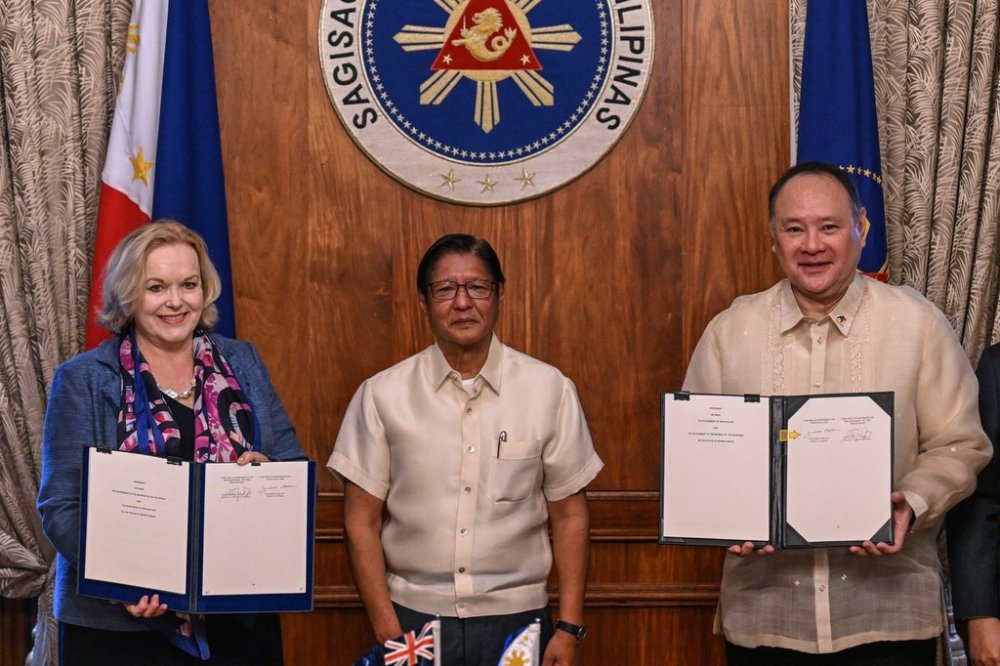
Philippine President Ferdinand Marcos Jr. witnessed the ceremony in Manila, where Defense Secretary Gilberto Teodoro Jr and and his New Zealand counterpart, Judith Collins, inked the Status of Visiting Forces Agreement.
The treaty sets the legal framework to allow military engagements of both countries, including joint drills in each other’s territory and other cooperative activities. It has been approved by New Zealand officials, but still needs to be ratified by the Philippine Senate for it to take effect.
China has frowned on the security alliances being pursued by the Philippines, one of the staunchest allies of the United States in Asia, under Marcos.
When the Philippines signed a similar agreement with Japan in July, China’s Foreign Ministry said the region did not need “military blocs, let alone small groupings that instigate bloc confrontations or a new Cold War.”
Philippine officials said then that China has no business meddling with their domestic affairs.
“These partnerships have become very important in the face of all that is happening,” Marcos said during Wednesday’s ceremony.
Ahead of the signing, Collins said in a statement that “we are committed to reinvigorating our security relationships, to playing our part and working with regional partners such as the Philippines to uphold the international rules-based order.”
Teodoro told The Associated Press in an interview last month that the Philippines would continue to build security alliances with other friendly countries to deter China’s aggression.
China’s hostile actions, Teodoro said, should be regarded as a global threat because they could eventually restrict movement in the South China Sea, a key global trade route crucial for global supply chains.
China claims virtually the entire South China Sea and has deployed coast guard and navy fleets and suspected militia ships to guard what it says is its territory and airspace. It has used water cannons and dangerous blocking maneuvers against Philippine coast guard and fisheries vessels in the disputed waters, causing collisions and injuries on a number of occasions.
Vietnam, Malaysia, Brunei and Taiwan also lay claims that clash with China’s, but territorial confrontations have particularly flared between Beijing and Manila in the last two years.
The Philippines has visiting forces agreements with the U.S. and Australia, which has been participating in large-scale combat exercises between American and Filipino forces that include live-fire exercises in or near the South China Sea and in northern Philippine islands just a sea border away from southern Taiwan.
The agreement signed with Japan has been ratified by the Philippine Senate and is expected to be approved by the Japanese legislature in the next few months. Canada and the Philippines have also concluded talks for such a pact, which is expected to be signed “very soon,” Teodoro said in a news conference with Collins.
French and Philippine officials have been separately holding initial talks also for a visiting forces agreement ahead of formal negotiations.