

US and Philippine forces cancel ship-sinking drill after World War II-era target prematurely sinks
Advertisement
Read this article for free:
or
Already have an account? Log in here »
To continue reading, please subscribe:
Monthly Digital Subscription
$1 per week for 24 weeks*
- Enjoy unlimited reading on winnipegfreepress.com
- Read the E-Edition, our digital replica newspaper
- Access News Break, our award-winning app
- Play interactive puzzles
*Billed as $4.00 plus GST every four weeks. After 24 weeks, price increases to the regular rate of $19.95 plus GST every four weeks. Offer available to new and qualified returning subscribers only. Cancel any time.
Monthly Digital Subscription
$4.99/week*
- Enjoy unlimited reading on winnipegfreepress.com
- Read the E-Edition, our digital replica newspaper
- Access News Break, our award-winning app
- Play interactive puzzles
*Billed as $19.95 plus GST every four weeks. Cancel any time.
To continue reading, please subscribe:
Add Free Press access to your Brandon Sun subscription for only an additional
$1 for the first 4 weeks*
- Enjoy unlimited reading on winnipegfreepress.com
- Read the E-Edition, our digital replica newspaper
- Access News Break, our award-winning app
- Play interactive puzzles
*Your next Brandon Sun subscription payment will increase by $1.00 and you will be charged $17.95 plus GST for four weeks. After four weeks, your payment will increase to $24.95 plus GST every four weeks.
Read unlimited articles for free today:
or
Already have an account? Log in here »
Hey there, time traveller!
This article was published 05/05/2025 (372 days ago), so information in it may no longer be current.
MANILA, Philippines (AP) — A World War II-era Philippine navy ship to be used as a target in a combat exercise by American and the Philippine forces accidentally sank Monday hours before the mock assault, prompting the drill to be cancelled, U.S. and Philippine military officials said.
The BRP Miguel Malvar, which was decommissioned by the Philippine navy in 2021, took on water while being towed in rough waters facing the disputed South China Sea and sank about 30 nautical miles (55 kilometers) off the western Philippine province of Zambales. Nobody was onboard when the ship listed then sank, the Philippine military said.
American and Philippine forces would proceed with other live-fire maneuvers off Zambales on Monday despite the premature sinking of the Malvar. The ship was built as a patrol vessel for the U.S. Navy in the 1940s and was transferred to Vietnam’s navy before the Philippine military acquired it, Philippine navy Capt. John Percie Alcos said.
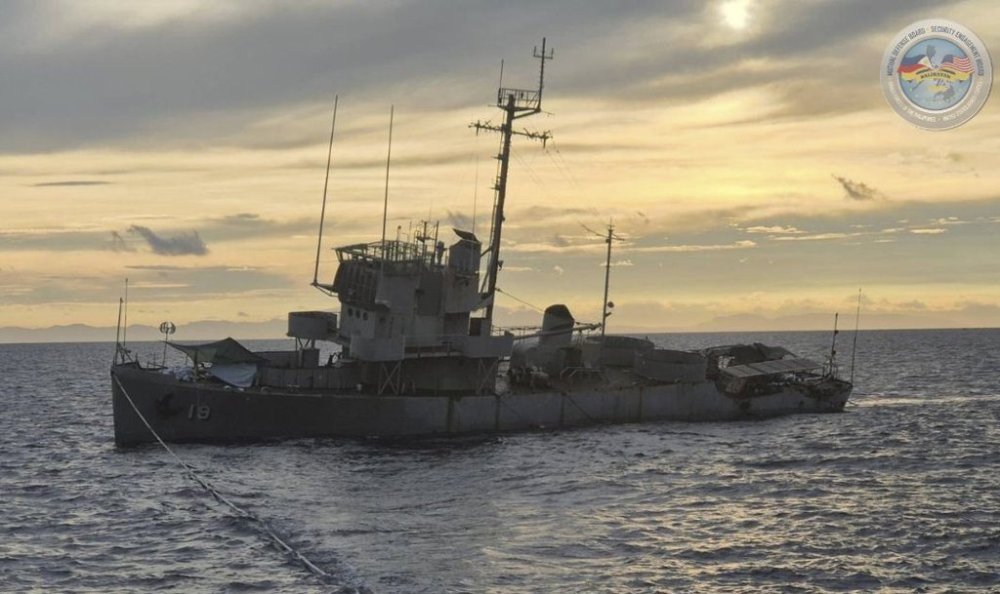
“It’s an 80-year-old dilapidated ship and it wasn’t able to withstand the rough seas,” Philippine Lt. Col. John Paul Salgado told The Associated Press.
The ship-sinking exercise was planned in an offshore area facing the hotly disputed Scarborough Shoal, which has been closely guarded by the Chinese coast guard, navy and suspected militia ships.
The Philippines also claims the fishing atoll, which lies about 220 kilometers (137 miles) west of Zambales. Chinese and the Philippine forces have had increasingly hostile confrontations in the waters and airspace of Scarborough in recent years.
The cancelled ship-sinking drill would have been the third to be staged by the treaty allies in recent years. It was supposed to be one of the highlights of largescale annual military exercises by the United States and the Philippines from April 21 to May 9 with about 14,000 U.S. and Filipino forces participants.
Called Balikatan, Tagalog for shoulder-to-shoulder, the combat drills have increasingly focused on the defense of Philippine sovereignty in the face of China’s growing aggression in the South China Sea, which Beijing claims virtually in its entirety.
Mock battle scenes which have been staged so far, including the retaking of an island from hostile forces, have reflected assurances by the Trump administration, including by Defense Secretary Pete Hegseth, that the U.S. would abide by its treaty commitment to defend the Philippines in case Filipino forces come under an armed attack, including in the South China Sea.
On Sunday, U.S., Australian and Philippine forces practiced retaking an island from hostile forces in the coastal town of Balabac in western Palawan province, which faces the South China Sea.
Japanese forces and British marines joined as observers of the combat exercise, which “showcased the growing interoperability and cohesion among partner nations in maintaining regional security,” Salgado said.
“What we have seen since Trump returned to the White House is a remarkable level of continuity in the US-Philippines alliance not only in joint military drills, but also on American statements that the alliance is ‘ironclad,’ said Derek Grossman, a senior defense analyst at RAND Corporation.
“The Trump administration is trying to keep the pressure on China through its support to the Philippines,” Grossman said, but added that it’s unclear “just how sustainable this commitment will be given that the Trump administration seems less hawkish on China than its predecessors.”
China has vehemently opposed such exercises involving U.S. forces in or near the South China Sea or Taiwan, the island democracy, which Beijing claims as a province and has threatened to annex by force if necessary.
U.S. and Philippine military officials, however, have insisted that the combat exercises were not designed with China in mind but serve as a deterrence to acts of aggression in the region.