

Japan’s agriculture minister resigns after a rice gaffe causes political fallout
Advertisement
Read this article for free:
or
Already have an account? Log in here »
To continue reading, please subscribe:

Digital Subscription
One year of digital access for only $205*
- Enjoy unlimited reading on winnipegfreepress.com
- Read the E-Edition, our digital replica newspaper
- Access News Break, our award-winning app
- Play interactive puzzles
*First annual payment billed as $205.00 + GST for one year. This annual subscription will automatically renew at $233.00 + GST every 52 weeks (10% off the regular annual price of $259.35). Offer available to new and qualified returning subscribers only. Cancel any time.
To continue reading, please subscribe:
Add Free Press access to your Brandon Sun subscription for only an additional
$1 for the first 4 weeks*
- Enjoy unlimited reading on winnipegfreepress.com
- Read the E-Edition, our digital replica newspaper
- Access News Break, our award-winning app
- Play interactive puzzles
*Your next Brandon Sun subscription payment will increase by $1.00 and you will be charged $17.95 plus GST for four weeks. After four weeks, your payment will increase to $24.95 plus GST every four weeks.
Read unlimited articles for free today:
or
Already have an account? Log in here »
Hey there, time traveller!
This article was published 20/05/2025 (501 days ago), so information in it may no longer be current.
TOKYO (AP) — Japan’s agriculture minister was forced to resign Wednesday because of political fallout over his recent comments that he “never had to buy rice” because he got it from supporters as a gift. The resignation comes as the public struggles with record high prices of the country’s traditional staple food.
Taku Eto’s comment, which many Japanese saw as out of touch with economic realities, came at a seminar Sunday for the Liberal Democratic Party, which leads a struggling minority government. The gaffe could be further trouble for the party before a national election in July. A major loss could mean a new government or could mean Prime Minister Shigeru Ishiba would have to step down.
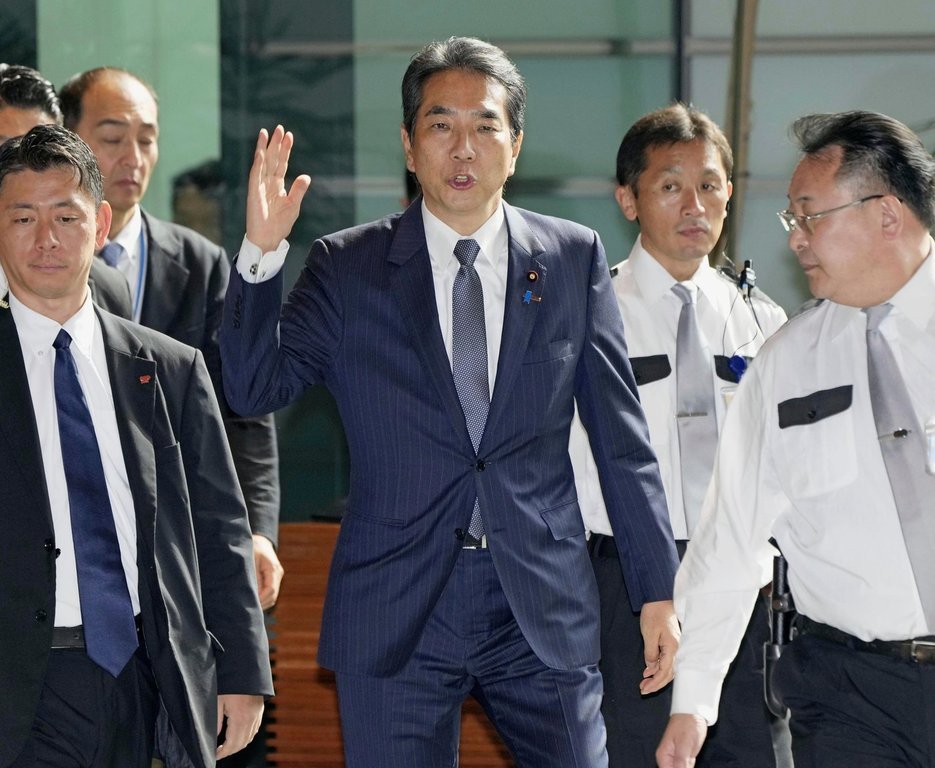
“I made an extremely inappropriate remark at a time when consumers are struggling with soaring rice prices,” Eto told reporters after submitting his resignation at the prime minister’s office. He was the first minister to resign under Ishiba’s leadership that began October.
The government has released tons of rice from its emergency stockpile in recent months, but the latest agricultural ministry statistics show little impact from the move. Some supermarkets have started selling cheaper imported rice.
Eto also sought to clarify the comments that got him in trouble. He said he does actually buy white rice himself and was not living on rice given as gifts. He said the gift comment referred to brown rice, which he wants people to become interested in because it can reach market faster.
Ishiba appointed popular former Environment Minister Shinjiro Koizumi, the son of a former prime minister, to lead the ministry, noting his experience in agriculture and fisheries policies and enthusiasm for reforms.
Koizumi told reporters Ishiba instructed him to do everything to stabilize the rice supply and prices to address consumer concern.
“I was told to put rice before anything,” Koizumi told reporters. “At this difficult time, I will do my utmost to speedily tackle the high rice prices that people feel and worry about in their everyday lives.” He said he shares consumers’ concerns as he feeds his children packaged instant rice sometimes.
Ishiba, also a former farm minister, said he wants to strengthen Japan’s food security and self-sufficiency. He has proposed agricultural reforms, including increased rice production and possible exports, though critics say he should urgently fix the ongoing rice problem first.
Noting the rice situation, Ishiba said he suspects the rice price surge is “not a temporary but a structural problem.”
“It may not be easy to find an answer,” he said, but repeated his pledge to do the utmost to ease consumers’ difficulties and to reform rice policies.
Koizumi said the measures so far have proved ineffective and that he will speed the effort as soon as he formally takes office later Wednesday. He stressed the need to reform Japanese rice policy, which has focused on powerful organizations that represent farmers, to focus more on the benefit of consumers.
Japanese rice demand has decreased over recent decades as people’s diets have diversified, but rice remains a staple food and an integral part of Japanese culture and history.
“Rice is the staple food for the Japanese. When its prices are rising every week, (Eto’s) resignation is only natural,” said Shizuko Oshima, 73.
The shortfall started last August with panic buying following a government caution over preparedness for a major earthquake. The supply pressure eased after the autumn harvest, but a shortage and price increases hit again early this year.
Officials have blamed the supply shortage on poor harvests because of hot weather in 2023 and higher fertilizer and other production costs, but some experts blame the government’s long-term rice production policy.
The unprecedented release from emergency rice stockpiles was seen in part as an attempt to figure out distribution problems. The government has denied there is now a rice shortage, but officials say it’s a mystery why rice is not reaching consumers as expected. Some experts say the rice shortage could be serious but it’s difficult to trace rice as its distribution route has become so complex since the end of government control in 1995.
___
AP video journalist Mayuko Ono contributed to this report.