

Louisiana Republicans reject bill that would address split jury verdicts, a Jim Crow-era practice
Advertisement
Read this article for free:
or
Already have an account? Log in here »
To continue reading, please subscribe:
Monthly Digital Subscription
$1 per week for 24 weeks*
- Enjoy unlimited reading on winnipegfreepress.com
- Read the E-Edition, our digital replica newspaper
- Access News Break, our award-winning app
- Play interactive puzzles
*Billed as $4.00 plus GST every four weeks. After 24 weeks, price increases to the regular rate of $19.95 plus GST every four weeks. Offer available to new and qualified returning subscribers only. Cancel any time.
Monthly Digital Subscription
$4.99/week*
- Enjoy unlimited reading on winnipegfreepress.com
- Read the E-Edition, our digital replica newspaper
- Access News Break, our award-winning app
- Play interactive puzzles
*Billed as $19.95 plus GST every four weeks. Cancel any time.
To continue reading, please subscribe:
Add Free Press access to your Brandon Sun subscription for only an additional
$1 for the first 4 weeks*
*Your next subscription payment will increase by $1.00 and you will be charged $16.99 plus GST for four weeks. After four weeks, your payment will increase to $23.99 plus GST every four weeks.
Read unlimited articles for free today:
or
Already have an account? Log in here »
Hey there, time traveller!
This article was published 21/05/2025 (313 days ago), so information in it may no longer be current.
BATON ROUGE, La. (AP) — A Louisiana bill that would have carved out a path for incarcerated people convicted by now-banned split juries the opportunity to ask for a new trial was rejected by Republican state senators on Wednesday, likely killing the measure.
An estimated 1,000 people behind bars in the Deep South state were convicted by non-unanimous juries, a practice rooted in racism from the era of “Jim Crow” laws and deemed unconstitutional by the U.S. Supreme Court in 2020. Advocates say it is past time for Louisiana to right a wrong and to give those people a chance at a fair trial.
Proponents of the bill pointed to multiple examples of innocent people — since exonerated — who were wrongfully convicted by split juries and spent decades in prison. Supporters said the measure could have created a way for any other possibly innocent people behind bars who had been convicted by non-unanimous juries to seek another chance for a fair trial.
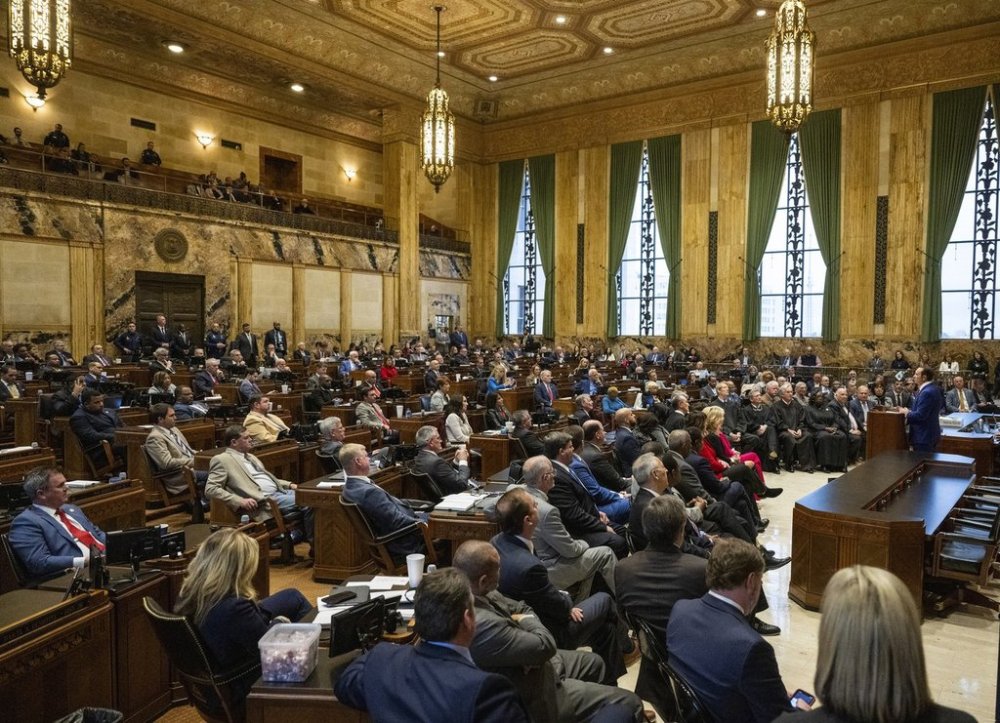
The bill would have added non-unanimous verdicts to a list of claims for which an inmate can seek a retrial. Proponents reiterated that the legislation would only have created the opportunity to do so and that it would not have automatically granted a retrial or release.
During debate in the state Senate on Wednesday, Republican lawmakers raised concerns about overburdening courts and district attorneys with additional trials. Proponents said whether a new trial is granted is ultimately at the discretion of district attorneys.
Opponents also raised concerns about the cases being decades-old with some witnesses possibly dead or evidence lost. Supporters countered that old cases are tried all the time and that transcripts of testimony from the original trials could be used.
“This is about what’s right, not about what’s easy or convenient,” Sen. Royce Duplessis, the New Orleans Democrat who authored the bill, said to his colleagues.
Louisiana adopted the practice of split jury convictions in 1898 during a constitutional convention that was fueled by efforts to maintain white supremacy after the Civil War. Diluting the voice of Black jurors allowed the often-white majority to determine the outcome.
Louisiana voters did not get rid of the practice until 2018, two years before the Supreme Court ruled that it was a violation of the 6th Amendment’s guarantee of the right to an impartial jury.
At the time, Louisiana and Oregon were the only states that allowed split decisions — 10-2 or 11-1 jury votes — to result in convictions. The Oregon Supreme Court granted new trials to hundreds of people. But Louisiana’s Supreme Court rejected arguments to apply the ruling retroactively.
“If we choose to vote down this bill we’re saying that justice has an expiration date,” Duplessis said. “We have an opportunity in Louisiana to remove this stain, because right now we are the only ones wearing it.”
The bill failed on a vote of 9-26, along party lines. Given the overwhelming lack of support for the bill in the Senate and that there is only a month left in this year’s Legislative Session, the measure currently has no viable path forward and is likely dead.