

Namibia holds its first genocide remembrance day to mark mass killings by colonial ruler Germany
Advertisement
Read this article for free:
or
Already have an account? Log in here »
To continue reading, please subscribe:

Digital Subscription
One year of digital access for only $205*
- Enjoy unlimited reading on winnipegfreepress.com
- Read the E-Edition, our digital replica newspaper
- Access News Break, our award-winning app
- Play interactive puzzles
*First annual payment billed as $205.00 + GST for one year. This annual subscription will automatically renew at $233.00 + GST every 52 weeks (10% off the regular annual price of $259.35). Offer available to new and qualified returning subscribers only. Cancel any time.
To continue reading, please subscribe:
Add Free Press access to your Brandon Sun subscription for only an additional
$1 for the first 4 weeks*
- Enjoy unlimited reading on winnipegfreepress.com
- Read the E-Edition, our digital replica newspaper
- Access News Break, our award-winning app
- Play interactive puzzles
*Your next Brandon Sun subscription payment will increase by $1.00 and you will be charged $17.95 plus GST for four weeks. After four weeks, your payment will increase to $24.95 plus GST every four weeks.
Read unlimited articles for free today:
or
Already have an account? Log in here »
Hey there, time traveller!
This article was published 28/05/2025 (502 days ago), so information in it may no longer be current.
WINDHOEK, Namibia (AP) — Namibia marked the mass killings of Indigenous people in the early 20th century by former colonial ruler Germany with its first genocide remembrance day on Wednesday.
The day was declared a national holiday last year by the government and was commemorated for the first time with a ceremony in the gardens of the national Parliament in the capital, Windhoek.
Between 1904 and 1908, tens of thousands of Herero and Nama people were massacred or forced into concentration camps and starved by German colonial forces under the command of Gen. Lothar von Trotha, in what was then German South West Africa.
Germany formally recognized the atrocities as a genocide in 2021 and agreed to pay Namibia 1.1 billion euros ($1.3 billion) over the course of 30 years to fund various projects. Namibia has rejected that and is pushing for more money and formal reparations for the massacres.
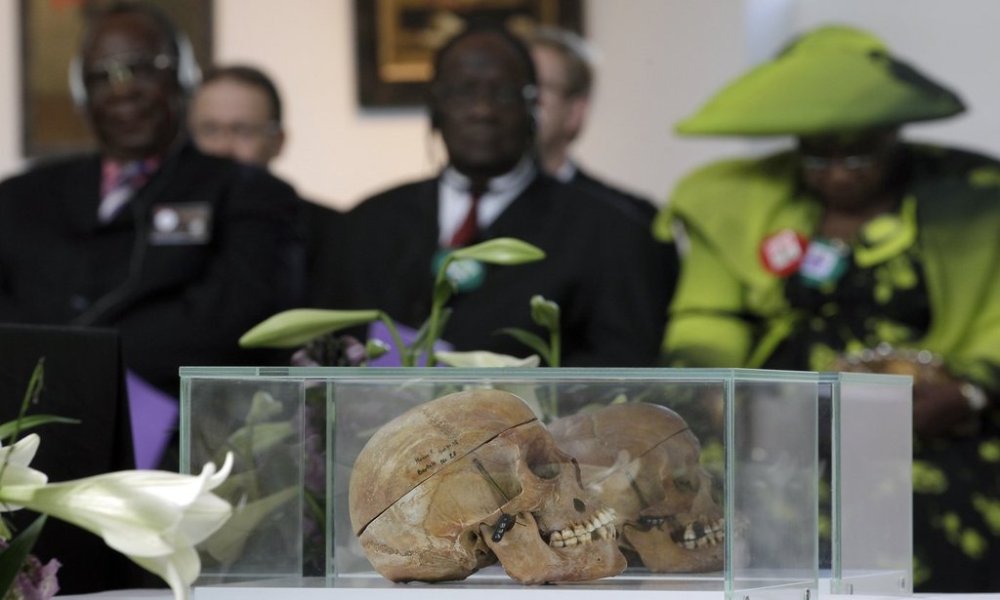
“Many people from the two communities were forced into concentration camps where they were starved to death and their skulls were taken to Germany for so-called scientific research,” Namibian President Netumbo Nandi-Ndaitwah said at Wednesday’s ceremony. “These horrendous acts are now part of our collective history of resistance and resilience.”
The killings of Herero and Nama men, women and children have been recognized as the first genocide of the 20th century. Historians say von Trotha, who was sent to German South West Africa to put down an uprising by the Herero people, instructed his troops to wipe out the entire tribe. They say that the majority of the Herero people, about 65,000, were killed as were at least 10,000 Nama.
Symbolic candles were lit at Wednesday’s remembrance ceremony, which was also attended by leaders and descendants of the Herero and Nama people. Namibia chose May 28 as the day to mark the genocide because it was the date Germany finally gave the order to close down the concentration camps.
Germany was the colonial ruler of Namibia from 1884 until 1915, when it gave up the territory to South Africa. Namibia finally gained independence from South Africa in 1990.
There have been calls by the affected communities in Namibia for years for the government to declare a remembrance day in honour of those who died.
Talks between Germany and Namibia over finding a suitable settlement for Germany’s role in the genocide have been going on for a decade. In 2018, Germany also returned more than a dozen skulls and other human remains that were taken from Namibia for pseudo-scientific racial experiments. They had been stored in German hospitals, museums and universities for decades.
___
AP Africa news: https://apnews.com/hub/africa