

Rescued giant moths emerge from cocoons in Mexico’s sprawling capital
Advertisement
Read this article for free:
or
Already have an account? Log in here »
To continue reading, please subscribe:

Digital Subscription
One year of digital access for only $205*
- Enjoy unlimited reading on winnipegfreepress.com
- Read the E-Edition, our digital replica newspaper
- Access News Break, our award-winning app
- Play interactive puzzles
*First annual payment billed as $205.00 + GST for one year. This annual subscription will automatically renew at $233.00 + GST every 52 weeks (10% off the regular annual price of $259.35). Offer available to new and qualified returning subscribers only. Cancel any time.
To continue reading, please subscribe:
Add Free Press access to your Brandon Sun subscription for only an additional
$1 for the first 4 weeks*
- Enjoy unlimited reading on winnipegfreepress.com
- Read the E-Edition, our digital replica newspaper
- Access News Break, our award-winning app
- Play interactive puzzles
*Your next Brandon Sun subscription payment will increase by $1.00 and you will be charged $17.95 plus GST for four weeks. After four weeks, your payment will increase to $24.95 plus GST every four weeks.
Read unlimited articles for free today:
or
Already have an account? Log in here »
Hey there, time traveller!
This article was published 29/05/2025 (465 days ago), so information in it may no longer be current.
MEXICO CITY (AP) — Two moths the size of a hand, their wings patterned with brown and pink around four translucent sections, mate for hours hanging from a line alongside cocoons like the ones they emerged from just hours earlier.
“When I get here and find this, I jump with delight,” said María Eugenia Díaz Batres, who has been caring for insects at the Museum of Natural History and Environmental Culture in Mexico City for nearly six decades.
The mating pair of “four mirrors” moths as they’re popularly known in Mexico, or scientifically as Rothschildia orizaba, are evidence that the museum’s efforts to save some 2,600 cocoons rescued from an empty lot were worth the trouble.
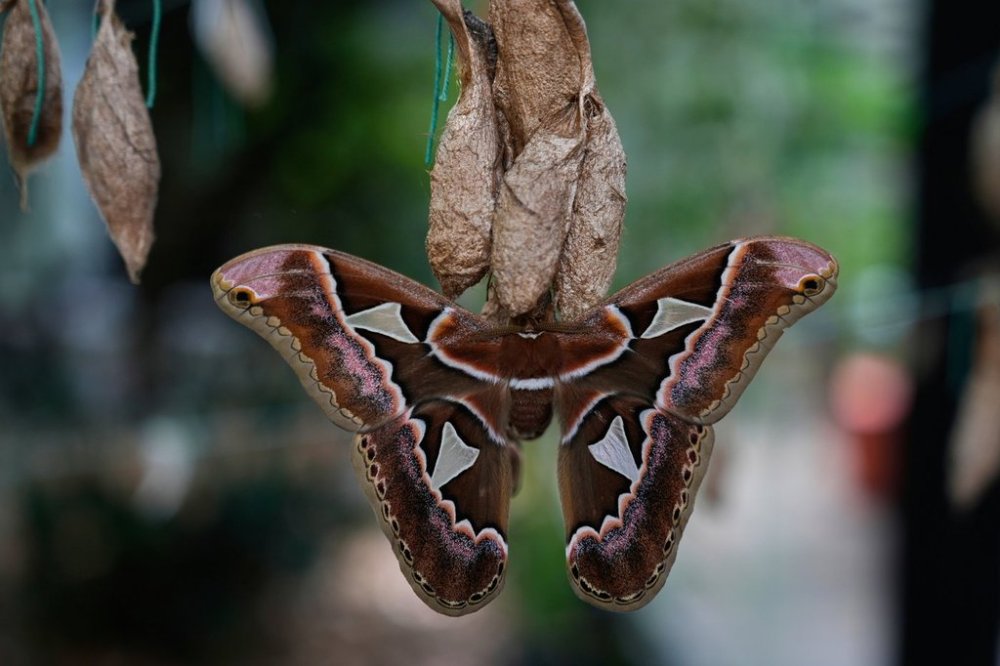
The moths, whose numbers have fallen in Mexico City due to urbanization, have cultural relevance in Mexico.
“The Aztecs called them the ‘butterfly of obsidian knives,’ Itzpapalotl,” Díaz Batres said. “And in northern Mexico they’d fill many of these cocoons with little stones and put them on their ankles for dances.”
These cocoons arrived at the museum in late December.
“They gave them to us in a bag and in a box, all squeezed together with branches and leaves, so my first mission was to take them out, clean them,” Díaz Batres said.
Mercedes Jiménez, director of the museum in the capital’s Chapultepec park, said that’s when the real adventure began since they had never received anything like this before.
Díaz Batres had the cocoons hung in any place she thought they might do well, including her office where they hang from lines crisscrossing above her table. It has allowed her to watch each stage of their development closely.
The moths only survive for a week or two as adults, but they give Díaz Batres tremendous satisfaction, especially when she arrives at her office and new moths “are at the door, on the computer.”
So she tries to help them “complete their mission” and little by little their species recovers.