

After 60 years, the search for a missing plane in Lake Superior remains fruitless
Advertisement
Read this article for free:
or
Already have an account? Log in here »
To continue reading, please subscribe:
Monthly Digital Subscription
$1 per week for 24 weeks*
- Enjoy unlimited reading on winnipegfreepress.com
- Read the E-Edition, our digital replica newspaper
- Access News Break, our award-winning app
- Play interactive puzzles
*Billed as $4.00 plus GST every four weeks. After 24 weeks, price increases to the regular rate of $19.95 plus GST every four weeks. Offer available to new and qualified returning subscribers only. Cancel any time.
Monthly Digital Subscription
$4.99/week*
- Enjoy unlimited reading on winnipegfreepress.com
- Read the E-Edition, our digital replica newspaper
- Access News Break, our award-winning app
- Play interactive puzzles
*Billed as $19.95 plus GST every four weeks. Cancel any time.
To continue reading, please subscribe:
Add Free Press access to your Brandon Sun subscription for only an additional
$1 for the first 4 weeks*
*Your next subscription payment will increase by $1.00 and you will be charged $16.99 plus GST for four weeks. After four weeks, your payment will increase to $23.99 plus GST every four weeks.
Read unlimited articles for free today:
or
Already have an account? Log in here »
Hey there, time traveller!
This article was published 03/06/2025 (296 days ago), so information in it may no longer be current.
Experts searching for plane wreckage in Michigan’s Lake Superior found logs and rocks on the bottom but no debris from an aircraft that crashed nearly 60 years ago carrying three people on a scientific assignment.
A team from Michigan Technological University returned last week by boat to get closer to 16 targets that appeared on sonar last fall, more than 200 feet (61 meters) below the surface of the vast lake. The crew used side-scan sonar and other remote technology.
“We did not locate any sign of the wreckage of the missing aircraft,” said Travis White, a research engineer at the Great Lakes Research Center at Michigan Tech. “However, we did validate our technical approach, as we found physical objects in each target location.”
The Beechcraft plane carrying pilot Robert Carew, co-pilot Gordon Jones and graduate student Velayudh Krishna Menon left Madison, Wisconsin, for Lake Superior on Oct. 23, 1968. They were collecting data on temperature and other lake conditions for the National Center for Atmospheric Research.
Seat cushions and pieces of stray metal have washed ashore over the years along the Keweenaw Peninsula. But the wreckage and the remains of the men have never been found.
“We’re probably not going to find a fully intact airplane,” said Wayne Lusardi, state maritime archaeologist.
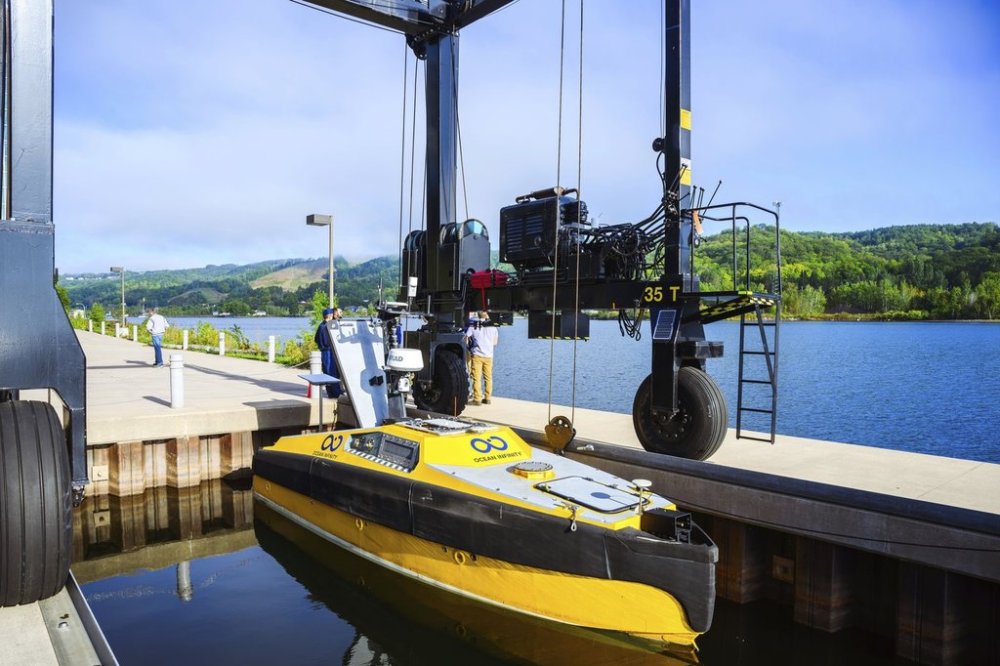
An autonomous vessel was launched last September, recording sonar readings and other data. After studying those findings over the winter, White, Lusardi and others returned to Lake Superior.
“Unfortunately, the targets turned out to be mostly natural: large sunken trees, logs, rocks,” White said by email.
Metal cans on the lake bottom, believed to be 75 years old, give “hope that the plane wreckage may be reasonably well-preserved and not buried,” he said.
White said the next challenge will be how to continue the work.
“We may attempt a crowdfunding model to see if we can raise some funds for future mapping activities that could help us locate the plane or other historic wrecks,” he said.
The initial search last fall was organized by the Smart Ships Coalition, a group of more than 60 universities, government agencies, companies and international organizations interested in maritime autonomous technologies.