

Judge largely denies request to block restrictions on getting measures on Florida’s ballot
Advertisement
Read this article for free:
or
Already have an account? Log in here »
To continue reading, please subscribe:
Monthly Digital Subscription
$1 per week for 24 weeks*
- Enjoy unlimited reading on winnipegfreepress.com
- Read the E-Edition, our digital replica newspaper
- Access News Break, our award-winning app
- Play interactive puzzles
*Billed as $4.00 plus GST every four weeks. After 24 weeks, price increases to the regular rate of $19.95 plus GST every four weeks. Offer available to new and qualified returning subscribers only. Cancel any time.
Monthly Digital Subscription
$4.99/week*
- Enjoy unlimited reading on winnipegfreepress.com
- Read the E-Edition, our digital replica newspaper
- Access News Break, our award-winning app
- Play interactive puzzles
*Billed as $19.95 plus GST every four weeks. Cancel any time.
To continue reading, please subscribe:
Add Free Press access to your Brandon Sun subscription for only an additional
$1 for the first 4 weeks*
*Your next subscription payment will increase by $1.00 and you will be charged $16.99 plus GST for four weeks. After four weeks, your payment will increase to $23.99 plus GST every four weeks.
Read unlimited articles for free today:
or
Already have an account? Log in here »
Hey there, time traveller!
This article was published 04/06/2025 (295 days ago), so information in it may no longer be current.
TALLAHASSEE, Fla. (AP) — A federal judge has largely denied requests by grassroots campaigners to block portions of a new Florida law that restricts the state’s citizen-driven process for getting constitutional amendments on the ballot.
Organizers of separate campaigns to expand Medicaid and legalize recreational marijuana had urged U.S. District Mark Walker to block implementation of parts of the law, arguing that the new requirements violate their First Amendment rights. But in an order issued Wednesday, Walker granted a narrow injunction, barring state officials from enforcing one section of the law criminalizing ballot petition fraud against one campaign staffer.
The order means that at least for now, the campaigns will largely have to operate under the new restrictions as they try to gather enough signatures to qualify for the 2026 ballot.
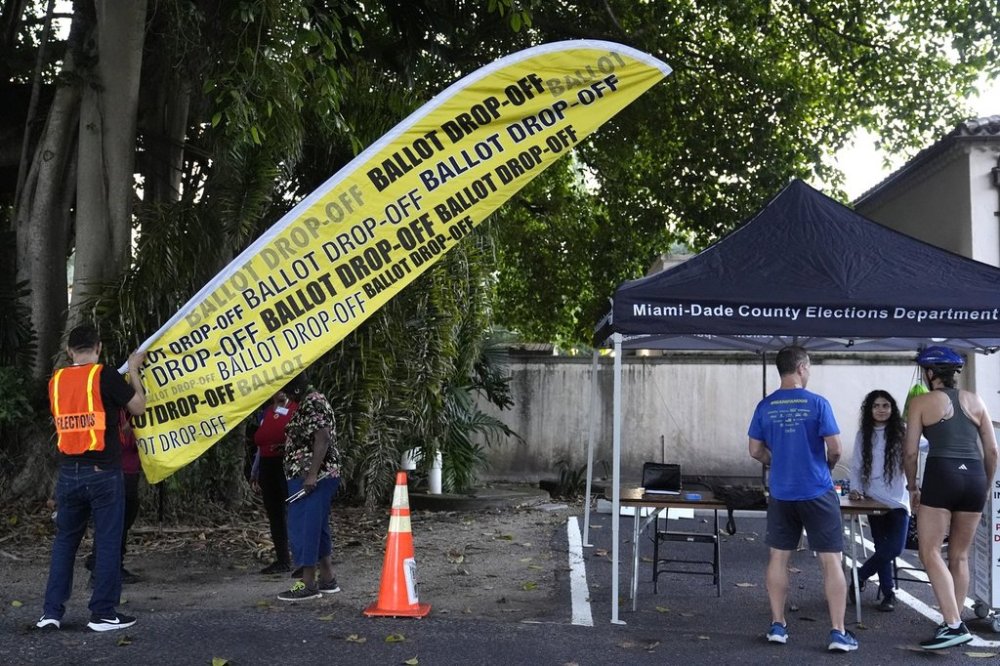
Legislatures in dozens of states have advanced bills recently to crack down on the public’s ability to put measures up for a vote, according to the Ballot Initiative Strategy Center. Voting rights advocates say the trend betrays the promise of direct democracy.
Under Florida’s new law, an individual could be charged with a felony if they collect more than 25 signed ballot petitions, other than their own or those of immediate family members, and don’t register with the state as a petition circulator. The law signed last month by Republican Gov. Ron DeSantis also gives campaigns just 10 days instead of the previous 30 to return signed petition forms to local elections officials. Petitioners could also face stiff fines if they don’t return the petitions on time, or send them to the wrong county.
Lawmakers argue that the new restrictions are needed to reform a process they claim has been tainted by fraud. The Republican-controlled Legislature pushed the changes months after a majority of Florida voters supported ballot initiatives to protect abortion rights and legalize recreational marijuana, though the measures fell short of the 60% needed to pass.
Attorneys for the campaigns Florida Decides Healthcare and Smart & Safe Florida have argued the new law makes gathering enough petitions from voters prohibitively expensive and effectively impossible.
In his order, Walker wrote that the new provisions have caused “an immediate reduction in protected speech” by constraining the campaigns’ ability to collect petitions — and volunteers’ willingness to help. But Walker said the campaigners didn’t prove that their free speech rights had been “severely burdened.”
“Instead, the record shows that these provisions simply make the process of getting their proposed initiatives on the ballot more expensive and less efficient for Plaintiffs,” Walker wrote.
But there are still free speech concerns to address as the lawsuit moves forward, Walker noted: “this Court is not suggesting that Plaintiffs are not likely to succeed on their First Amendment challenges to the new deadline and associated fines.”
In a statement, Mitch Emerson, the executive director for Florida Decides Healthcare, said he remains optimistic for the legal challenge ahead.
“While the Court did not grant every part of our motion for preliminary relief, this is far from the final word,” Emerson said.
A spokesperson for Florida Attorney General James Uthmeier didn’t immediately respond to a request for comment.
___ Kate Payne is a corps member for The Associated Press/Report for America Statehouse News Initiative. Report for America is a nonprofit national service program that places journalists in local newsrooms to report on undercovered issues.