

More bodies of executed civil war-era prisoners uncovered under Greek city park
Advertisement
Read this article for free:
or
Already have an account? Log in here »
To continue reading, please subscribe:

Digital Subscription
One year of digital access for only $205*
- Enjoy unlimited reading on winnipegfreepress.com
- Read the E-Edition, our digital replica newspaper
- Access News Break, our award-winning app
- Play interactive puzzles
*First annual payment billed as $205.00 + GST for one year. This annual subscription will automatically renew at $233.00 + GST every 52 weeks (10% off the regular annual price of $259.35). Offer available to new and qualified returning subscribers only. Cancel any time.
To continue reading, please subscribe:
Add Free Press access to your Brandon Sun subscription for only an additional
$1 for the first 4 weeks*
- Enjoy unlimited reading on winnipegfreepress.com
- Read the E-Edition, our digital replica newspaper
- Access News Break, our award-winning app
- Play interactive puzzles
*Your next Brandon Sun subscription payment will increase by $1.00 and you will be charged $17.95 plus GST for four weeks. After four weeks, your payment will increase to $24.95 plus GST every four weeks.
Read unlimited articles for free today:
or
Already have an account? Log in here »
Hey there, time traveller!
This article was published 07/06/2025 (481 days ago), so information in it may no longer be current.
THESSALONIKI, Greece (AP) — Another series of unmarked graves — this one containing 14 individuals from Greece’s civil war era — have been dug up in a park in a suburb near the northern Greek city of Thessaloniki, local officials said Saturday.
As in the previous tight cluster of unmarked burial pits excavated earlier this year in Neapolis-Sykies, the bodies belong to prisoners who were held in a nearby Byzantine fortress. The prisoners, alleged communists and sympathizers, were executed between 1946 and 1953, according to historians.
The Yedi Kule castle, also known by its Greek name Eptapyrgio (“seven towers”) was a prison where communist sympathizers were tortured and executed during Greece’s 1946-49 Civil War and immediately afterward.
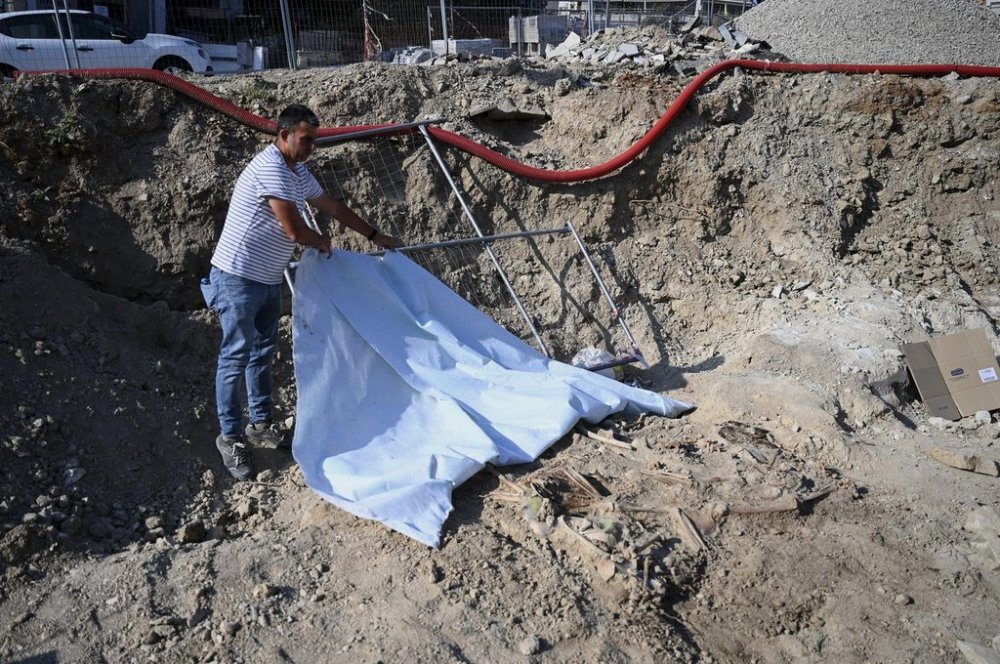
The burial pits were uncovered on the site of a municipal park undergoing renovation, including the installation of new benches. The graves were not far beneath the surface, Haris Charismiadis, the supervising engineer of the park project, told The Associated Press.
The renovation project is not currently a priority for local mayor Simos Daniilidis. “We insisted on continuing the digging for the graves,” he said. Charismiadis, who said most of the current batch of bodies were found during the past week, is certain there are more people buried nearby, including, probably, under the tarmac of streets adjacent to the park. An archaeologist is assisting in the digging.
In contrast with the 33 bodies found earlier this year, which were lying side by side, the recently found bodies are jumbled, as if thrown randomly, and hastily, in a heap. Torsos and heads are separated.
When Yedi Kule prisoners were executed, their families were often not notified and they didn’t get to retrieve their bodies. Some found out about the fate of their loved ones from newspapers — one family happened upon the news while on the bus they had taken to the prison to bring their relative a fresh change of clothes.
Relatives of the executed have clamored for DNA tests to be done to ascertain the identity of the found bodies. Testing has not begun yet.