

Utility workers uncover 1,000-year-old pre-Inca mummy in Peru’s capital
Advertisement
Read this article for free:
or
Already have an account? Log in here »
To continue reading, please subscribe:

Digital Subscription
One year of digital access for only $205*
- Enjoy unlimited reading on winnipegfreepress.com
- Read the E-Edition, our digital replica newspaper
- Access News Break, our award-winning app
- Play interactive puzzles
*First annual payment billed as $205.00 + GST for one year. This annual subscription will automatically renew at $233.00 + GST every 52 weeks (10% off the regular annual price of $259.35). Offer available to new and qualified returning subscribers only. Cancel any time.
To continue reading, please subscribe:
Add Free Press access to your Brandon Sun subscription for only an additional
$1 for the first 4 weeks*
- Enjoy unlimited reading on winnipegfreepress.com
- Read the E-Edition, our digital replica newspaper
- Access News Break, our award-winning app
- Play interactive puzzles
*Your next Brandon Sun subscription payment will increase by $1.00 and you will be charged $17.95 plus GST for four weeks. After four weeks, your payment will increase to $24.95 plus GST every four weeks.
Read unlimited articles for free today:
or
Already have an account? Log in here »
Hey there, time traveller!
This article was published 18/06/2025 (427 days ago), so information in it may no longer be current.
LIMA, Peru (AP) — Utility workers excavating trenches to expand the network of natural gas pipelines in Peru’s capital have uncovered a pre-Inca mummy approximately 1,000 years old, barely half a meter (20 inches) from the surface.
The mummy had gone unnoticed despite urban development in a district of Lima where former agricultural fields have been converted into working-class neighborhoods in recent decades. Jose Aliaga, an archaeologist with utility Cálidda, on Wednesday said the unearthed mummy, found in a seated position and covered by a bundle, still has dark brown hair.
“We found remains and evidence that there could be a pre-Hispanic burial,” Aliaga said. He said workers made the discovery last week.
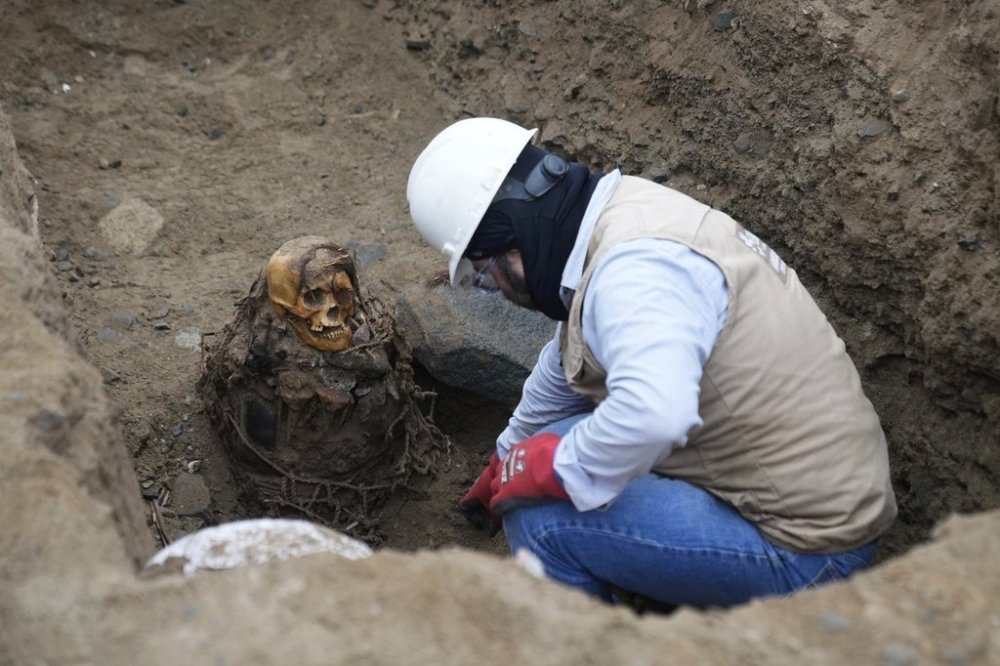
Lima, located in a valley irrigated by three rivers fed from the Andes, housed human civilizations thousands of years before the Spanish arrived in 1535. Now home to 10 million people, the city has more than 400 archaeological sites, most of which are intertwined with the current urban fabric.
“It is very common to find archaeological remains on the Peruvian coast, including Lima, mainly funerary elements: tombs, burials, and, among these, mummified individuals,” said Pieter Van Dalen, dean of the College of Archaeologists of Peru.
Van Dalen, who is not involved in the discovery, said mummies on the Peruvian coast are usually found mummified naturally, generally in desert areas, with the skin dehydrated by the summer heat. He explained that other unearthed remains have been found to have undergone mummification procedures for cultural reasons and are usually discovered in a seated position with their hands covering their faces.
Jesús Bahamonde, director of the archaeological monitoring plan of metropolitan Lima at Cálidda, said the mummy found last week would have belonged to a society of fishermen of the Chancay culture, which flourished between 1,000 and 1,470 AD.