

Japan’s minority government faces a tough test in the upper house election
Advertisement
Read this article for free:
or
Already have an account? Log in here »
To continue reading, please subscribe:
Monthly Digital Subscription
$1 per week for 24 weeks*
- Enjoy unlimited reading on winnipegfreepress.com
- Read the E-Edition, our digital replica newspaper
- Access News Break, our award-winning app
- Play interactive puzzles
*Billed as $4.00 plus GST every four weeks. After 24 weeks, price increases to the regular rate of $19.95 plus GST every four weeks. Offer available to new and qualified returning subscribers only. Cancel any time.
Monthly Digital Subscription
$4.99/week*
- Enjoy unlimited reading on winnipegfreepress.com
- Read the E-Edition, our digital replica newspaper
- Access News Break, our award-winning app
- Play interactive puzzles
*Billed as $19.95 plus GST every four weeks. Cancel any time.
To continue reading, please subscribe:
Add Free Press access to your Brandon Sun subscription for only an additional
$1 for the first 4 weeks*
*Your next subscription payment will increase by $1.00 and you will be charged $16.99 plus GST for four weeks. After four weeks, your payment will increase to $23.99 plus GST every four weeks.
Read unlimited articles for free today:
or
Already have an account? Log in here »
Hey there, time traveller!
This article was published 02/07/2025 (269 days ago), so information in it may no longer be current.
TOKYO (AP) — Japan’s Prime Minister Shigeru Ishiba faces a tough test in an upper house election later this month as his minority government struggles after its major defeat in last year’s snap election.
Ishiba has survived so far, though he had to make some concessions to the opposition — an unusual step for the Liberal Democratic Party that has dominated Japan’s postwar politics.
Official campaigning begins Thursday for the July 20 vote for the upper house, the less powerful of Japan’s two parliamentary chambers.
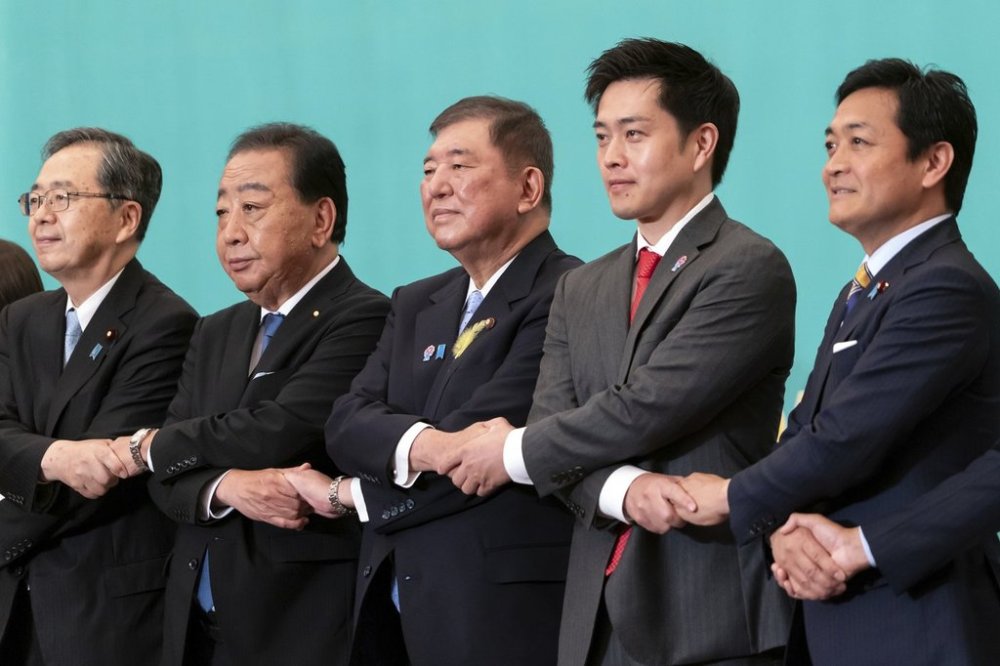
Ishiba has modest goals for the election and the opposition is divided, so the outcome is unlikely to force an immediate change of government. But it will be a tough test on Ishiba’s handling of economic woes at home and global challenges such as U.S. President Donald Trump’s tariff war.
“I will defend Japan’s national interest at all cost,” Ishiba said Wednesday, reiterating his determination to not make any concession on safety or other areas in the tariff negotiations despite Trump’s new threat. “Japan has its own national interest and I will do my utmost to protect it.”
Ishiba sets a modest goal: a majority
Ishiba’s goal is a simple majority. Half of the 248 seats for six-year terms in the upper house are being decided, and the LDP and its junior coalition partner Komeito would need to win 50 combined. That’s on top of their 75 seats that are not being contested in this election.
That would be a retreat from their current number of 141 seats. “It won’t be easy. But in this difficult situation, it is a must-attain goal,” Ishiba said Wednesday, without saying how he would take responsibility if he doesn’t meet his goal.
A poor result in the upper house election would not immediately cause a change of government but could trigger a LDP leadership change or regrouping of a governing coalition.
Fractured opposition
The LDP was defeated in the previous election largely because many of its usual supporters voted for centrist to conservative opposition groups to punish the governing party over its corruption scandals. The main opposition Constitutional Democratic Party of Japan, or CDPJ, and the surging Democratic Party for the People, or DPP, as well as an emerging right-wing populist Sanseito have significantly gained ground.
But the opposition groups are too fractured to find a common platform to gain voter support as a viable alternative.
When Ishiba lost big in October, there was speculation of a trilateral coalition government with the DPP or another conservative Japan Innovation Party, but they have cooperated only on certain legislation. A loss of majority in the upper house by Ishiba’s party could reignite momentum for coalition regroupings.
Opposition CDPJ leader Yoshihiko Noda has said a loss of majority in both houses would help opposition parties to push policies blocked by the LDP, such as consumption tax cuts.
Rice, price woes and Trump
Measures to mitigate soaring prices, dwindling wages and burdens of social security payment are the top focus of frustrated voters hit by economic woes.
Ishiba’s handling of the recent rice panic will be tested. Rice prices have doubled since last year due to supply shortages, complex distribution systems and other reasons related to Japan’s farming policies, adding to consumer concern and frustration.
The rice crisis cost Ishiba’s government one farm minister, but the replacement, Shinjiro Koizumi, took rapid and bold measures including the unprecedented release of emergency reserves that brought the staple back to normal prices, just in time for the election.
In another setback, Trump complained about little progress in trade negotiations with Ishiba’s government, saying Japan is not only not buying automobiles, but is also not buying enough U.S. rice despite its rice shortage.
While NATO leaders recently adopted a massive hike in defense spending after pressure from Trump, Ishiba said Japan should make its own decision on any such spending.
Ishiba’s party adopted a campaign platform that included cash payouts to cushion the impact of inflation and dwindling wages, which opposition parties criticized as pork. The main opposition CDPJ calls for increased welfare spending, while DPP focuses on wage increase.
Ishiba also needs to offset consumer worries over uncertainty in the Middle East and its impact on energy costs.