

Former Colombian president Alvaro Uribe makes closing statements in witness tampering trial
Advertisement
Read this article for free:
or
Already have an account? Log in here »
To continue reading, please subscribe:
Monthly Digital Subscription
$1 per week for 24 weeks*
- Enjoy unlimited reading on winnipegfreepress.com
- Read the E-Edition, our digital replica newspaper
- Access News Break, our award-winning app
- Play interactive puzzles
*Billed as $4.00 plus GST every four weeks. After 24 weeks, price increases to the regular rate of $19.95 plus GST every four weeks. Offer available to new and qualified returning subscribers only. Cancel any time.
Monthly Digital Subscription
$4.99/week*
- Enjoy unlimited reading on winnipegfreepress.com
- Read the E-Edition, our digital replica newspaper
- Access News Break, our award-winning app
- Play interactive puzzles
*Billed as $19.95 plus GST every four weeks. Cancel any time.
To continue reading, please subscribe:
Add Free Press access to your Brandon Sun subscription for only an additional
$1 for the first 4 weeks*
*Your next subscription payment will increase by $1.00 and you will be charged $16.99 plus GST for four weeks. After four weeks, your payment will increase to $23.99 plus GST every four weeks.
Read unlimited articles for free today:
or
Already have an account? Log in here »
Hey there, time traveller!
This article was published 07/07/2025 (262 days ago), so information in it may no longer be current.
BOGOTA, Colombia (AP) — Former Colombian president Alvaro Uribe began his closing statement Monday in a high profile trial in which he is charged with bribery and witness tampering that could lead to a 12-year prison sentence.
Uribe was Colombia’s president from 2002 to 2010 and is still one of the nation’s most influential politicians. He is accused of working with a lawyer to bribe and intimidate former members of paramilitary groups to change the statements they provided to left-wing Sen. Ivan Cepeda. Cepeda had accused the former president of forming a paramilitary group in the early 1990s and was leading an investigation. Uribe has long denied any ties to illegal armed groups.
It is the first criminal trial of a former president in Colombia’s history.
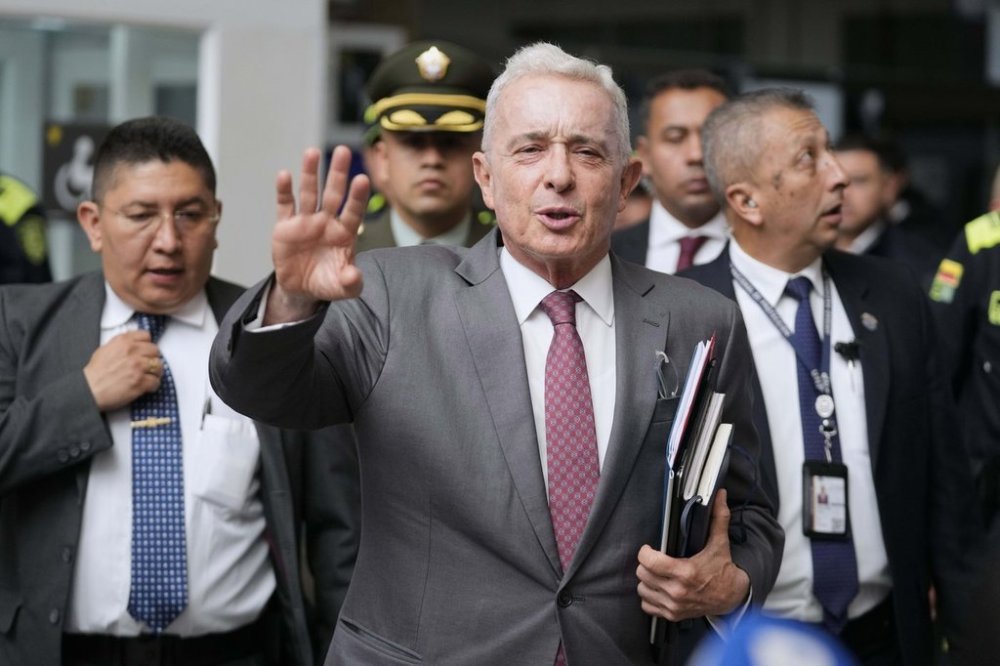
On Monday, Uribe told a court in Bogota that he had been “framed” by a former paramilitary leader who is now in prison. The former president said he is fighting the accusations against him to absolve himself and restore his reputation and that of his family.
The case against Uribe dates back to 2012, when the former president sued Cepeda for libel in the Supreme Court, the entity charged with investigating elected officials. But in a surprising turn of events, the court dismissed charges against Cepeda and launched an investigation into Uribe’s activities in 2018.
The probe of Uribe was delayed multiple times by prosecutors who said there was not enough evidence against the former president to file charges, but investigations have proceeded more swiftly under the government of President Gustavo Petro, the leftist leader who was elected into office in 2022.
Uribe was formally charged last year, and his trial began in February. The judge overseeing the case now has until the first week of October to deliver a verdict.
Uribe was a close ally of the United States during his presidency, and is widely admired by conservatives in Colombia who credit him with turning the country around at a time when rebel groups dominated large swathes of the country and kidnapped civilians with impunity.
But critics of Uribe accuse his government of turning a blind eye to human rights abuses and of supporting paramilitary groups that helped the army to push left- wing rebels into remote corners of the country.
According to a truth commission created in 2017, more than 6,400 civilians were executed by the Colombian military and identified as members of rebel groups by soldiers seeking promotions during the conflict, in a phenomenon that peaked during the Uribe administration.
During Uribe’s presidency, Colombia worked closely with the U.S. to tackle the illegal cocaine trade, which has long funded rebel groups in Colombia, with significant reductions of Colombia’s coca crop. Coca cultivation has skyrocketed under subsequent administrations, and is now four times higher than when Uribe left office in 2010.
The Uribe administration also conducted key strikes on rebel leaders hiding out in jungle camps that eventually forced leaders of the Revolutionary Armed Forces of Colombia into peace negotiations that led to the group’s disarmament in 2016.