

South Korean court approves new arrest of former President Yoon Suk Yeol over martial law decree
Advertisement
Read this article for free:
or
Already have an account? Log in here »
To continue reading, please subscribe:

Digital Subscription
One year of digital access for only $205*
- Enjoy unlimited reading on winnipegfreepress.com
- Read the E-Edition, our digital replica newspaper
- Access News Break, our award-winning app
- Play interactive puzzles
*First annual payment billed as $205.00 + GST for one year. This annual subscription will automatically renew at $233.00 + GST every 52 weeks (10% off the regular annual price of $259.35). Offer available to new and qualified returning subscribers only. Cancel any time.
To continue reading, please subscribe:
Add Free Press access to your Brandon Sun subscription for only an additional
$1 for the first 4 weeks*
- Enjoy unlimited reading on winnipegfreepress.com
- Read the E-Edition, our digital replica newspaper
- Access News Break, our award-winning app
- Play interactive puzzles
*Your next Brandon Sun subscription payment will increase by $1.00 and you will be charged $17.95 plus GST for four weeks. After four weeks, your payment will increase to $24.95 plus GST every four weeks.
Read unlimited articles for free today:
or
Already have an account? Log in here »
Hey there, time traveller!
This article was published 09/07/2025 (447 days ago), so information in it may no longer be current.
SEOUL, South Korea (AP) — A South Korean court early Thursday approved the new arrest of former President Yoon Suk Yeol on charges related to his brief imposition of martial law in December, accepting a special prosecutor’s claim that he poses a risk of destroying evidence.
The arrest warrant issued by the Seoul Central District Court sent Yoon back to a detention center near the capital, four months after his release in March, when the same court overturned his January arrest and allowed him to stand trial for rebellion without being held in custody.
His criminal case is being handled by a team of investigators under special prosecutor Cho Eun-suk who are pursuing additional charges over Yoon’s authoritarian push, including obstructing official duties, abuse of power and falsifying official documents.
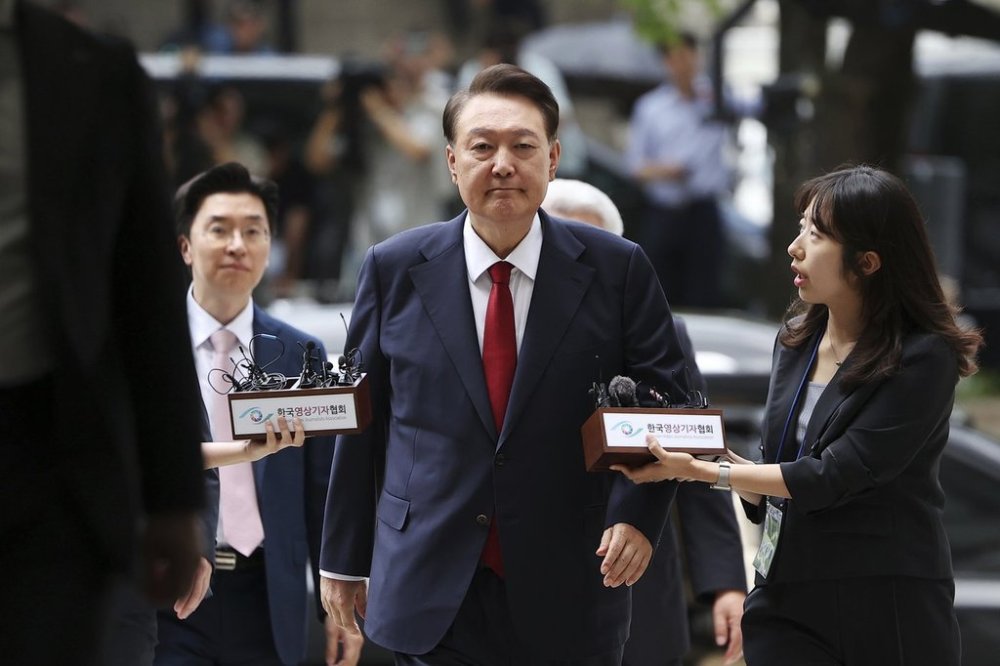
Cho’s team questioned him twice before submitting a request for his arrest warrant to the court on Sunday.
Yoon’s lawyers had described the arrest request as excessive and unsubstantiated. They didn’t immediately react to the court’s decision to approve the arrest of Yoon , who was formally removed from office in April after the Constitutional Court upheld his impeachment.
Yoon didn’t respond to questions by reporters after arriving at the court on Wednesday afternoon for a hearing to review the special prosecutor’s request. After the hearing lasting about seven hours, Yoon was taken to the detention center to await the court’s decision.
Yoon’s new arrest could mark the beginning of an extended period in custody, potentially lasting months or longer. Yoon can be initially detained at the center for up to 20 days, while the special prosecutor will aim to indict him on additional charges.
If Yoon is indicted on new charges, that could keep him under arrest for up to six months until an initial court ruling. If that court convicts him and issues a prison term, Yoon would serve that sentence as the case possibly moves up to higher courts.
Park Ji-young, a senior investigator on Cho’s team, said they plan to question Yoon again Friday. Yoon was absent from a Thursday hearing at the Seoul court over his earlier indictment on rebellion charges, and his lawyers offered no immediate explanation for his absence.
The former conservative leader described his martial law imposition on Dec. 3 as a necessary step to quash his “anti-state” liberal opponents, accusing them of using their legislative majority to obstruct his agenda. But Yoon’s decree lasted only hours, after a quorum of lawmakers broke through a blockade of heavily armed soldiers at the National Assembly and voted to lift the measure.
Yoon was impeached by lawmakers Dec. 14 and indicted Jan. 26 by public prosecutors who accused him of masterminding an attempted rebellion, describing his power grab as an illegal attempt to seize the legislature and election offices and detain political opponents.
The charges are punishable by the death penalty or life imprisonment.
Yoon also faces accusations of enforcing martial law without following required legal procedure, such as deliberation by a formal Cabinet meeting, and of unlawfully deploying the presidential security forces like a private army to block an initial attempt by law enforcement to detain him at his residence in early January.
His liberal rival and current President Lee Jae Myung, who won the June snap election to replace him, last month approved legislation to launch sweeping special investigations into Yoon’s martial law debacle and other criminal allegations involving his wife and administration.