

Taiwan’s president watches live-fire drills with new US-made tanks
Advertisement
Read this article for free:
or
Already have an account? Log in here »
To continue reading, please subscribe:

Digital Subscription
One year of digital access for only $205*
- Enjoy unlimited reading on winnipegfreepress.com
- Read the E-Edition, our digital replica newspaper
- Access News Break, our award-winning app
- Play interactive puzzles
*First annual payment billed as $205.00 + GST for one year. This annual subscription will automatically renew at $233.00 + GST every 52 weeks (10% off the regular annual price of $259.35). Offer available to new and qualified returning subscribers only. Cancel any time.
To continue reading, please subscribe:
Add Free Press access to your Brandon Sun subscription for only an additional
$1 for the first 4 weeks*
- Enjoy unlimited reading on winnipegfreepress.com
- Read the E-Edition, our digital replica newspaper
- Access News Break, our award-winning app
- Play interactive puzzles
*Your next Brandon Sun subscription payment will increase by $1.00 and you will be charged $17.95 plus GST for four weeks. After four weeks, your payment will increase to $24.95 plus GST every four weeks.
Read unlimited articles for free today:
or
Already have an account? Log in here »
Hey there, time traveller!
This article was published 10/07/2025 (433 days ago), so information in it may no longer be current.
HSINCHU, Taiwan (AP) — Taiwanese President Lai Ching-te watched live-fire drills with U.S.-made Abrams M1A2T tanks Thursday, as part of major annual exercises aimed at boosting the island’s ability to fend off threats from China.
Four of the tanks fired individually, in pairs and as a group at a testing ground south of Taipei on the second day of the Han Kuang exercises that this year are the longest ever at 10 days. The tanks fire both while on the move and in a stationary position and at both stationary and moving targets, achieving 100% accuracy, according to the army.
Taiwan has contracted to buy 108 of the latest-model tanks from the U.S. for $1.45 billion, allowing it to retire its aged tanks and significantly boosting defenses, especially for the northern part of the island, where most of its high-tech industries are based.
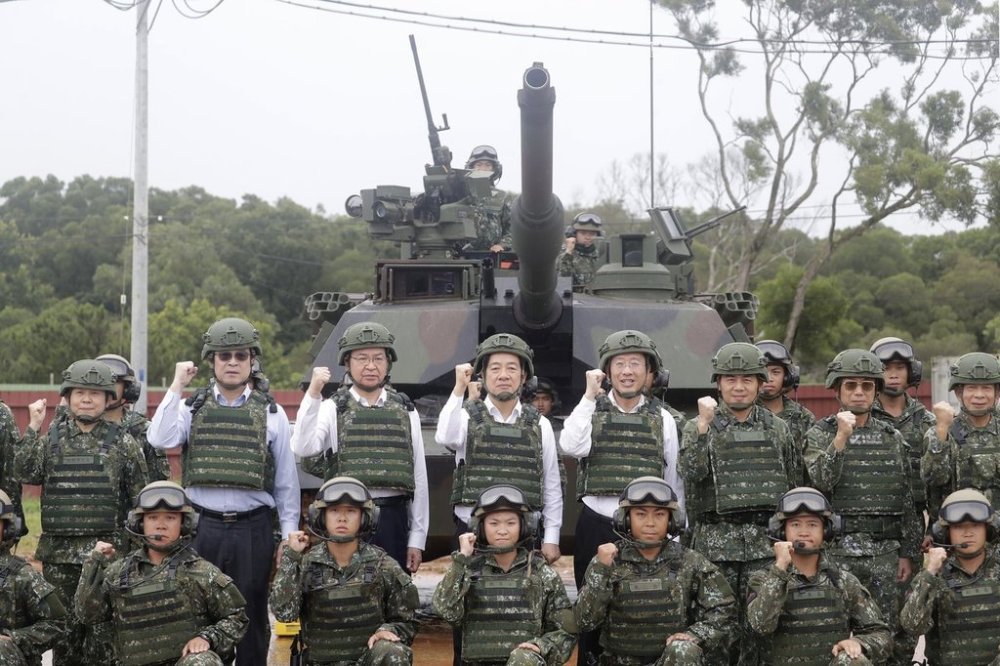
They are part of far-reaching upgrades to Taiwan’s arsenal and training practices, with F-16V jet fighters, HIMARS missile defenses and stealthy unmanned vehicles now entering use.
Lai said this year’s Han Kuang exercises were being conducted on the basis of “large-scale, realistic combat drills.”
“When out military has greater strength, the nation, society, and people will be safer. Once our country becomes secure, the Indo-Pacific region will be more peaceful and stable,” the president told troops and reporters at the base in Hsinchu county.
China considers Taiwan a renegade province and threatens to use force to bring it under control. The ruling Communist Party’s military branch, the People’s Liberation Army, sends ships, balloons and military ships into waters near Taiwan on a near-daily basis.
The U.S. is Taiwan’s largest supplier of imported defensive weaponry and is bound by law to consider threats to the island a matter of “major concern,” although it remains deliberately unclear as to whether it would deploy forces to counter a Chinese attack.
Taiwan is also stepping up civilian participation in national defense and Thursday evacuated a food mart and moved customers to a bomb shelter equipped with medical and other facilities. Tanks were also dispatched to one of Taiwan’s international airports in the center of the capital Taipei to guard against an imaginary Chinese air landing operation.
In its unusual fashion, Beijing has derided the war exercises as a farce that will have no effect on its determination to take over the island, whose population overwhelmingly rejects unification with China.
Taiwan earlier in the week accused China’s coast guard and maritime militia of harassing Taiwanese boats near Taiwan-held islands off the Chinese coast and on Wednesday sanctioned eight Taiwanese companies it said were aiding Taiwan’s defense industry.
Taiwan responded that the move aligned perfectly with the military’s efforts to purge any Chinese elements from its supply chains.
___
Bodeen reported from Taipei, Taiwan.