

A bull moose is blocking a New York mountain trail. Wildlife researchers don’t know why
Advertisement
Read this article for free:
or
Already have an account? Log in here »
To continue reading, please subscribe:

Digital Subscription
One year of digital access for only $205*
- Enjoy unlimited reading on winnipegfreepress.com
- Read the E-Edition, our digital replica newspaper
- Access News Break, our award-winning app
- Play interactive puzzles
*First annual payment billed as $205.00 + GST for one year. This annual subscription will automatically renew at $233.00 + GST every 52 weeks (10% off the regular annual price of $259.35). Offer available to new and qualified returning subscribers only. Cancel any time.
To continue reading, please subscribe:
Add Free Press access to your Brandon Sun subscription for only an additional
$1 for the first 4 weeks*
- Enjoy unlimited reading on winnipegfreepress.com
- Read the E-Edition, our digital replica newspaper
- Access News Break, our award-winning app
- Play interactive puzzles
*Your next Brandon Sun subscription payment will increase by $1.00 and you will be charged $17.95 plus GST for four weeks. After four weeks, your payment will increase to $24.95 plus GST every four weeks.
Read unlimited articles for free today:
or
Already have an account? Log in here »
Hey there, time traveller!
This article was published 24/07/2025 (394 days ago), so information in it may no longer be current.
A big bull moose has spent the summer lingering around a popular Adirondack mountain hiking trail, prompting New York state wildlife officials to close the path as they monitor the potentially ailing animal.
The Goodman Mountain trail in the Horseshoe Lake Wild Forest has been temporarily closed since June 6 due to the oddly behaving animal. The moose is staying on or around the trail near the summit, sometimes sitting and sometimes foraging in a small area, according to the Department of Environmental Conservation.
Attempts to coax the moose from the trial have failed.
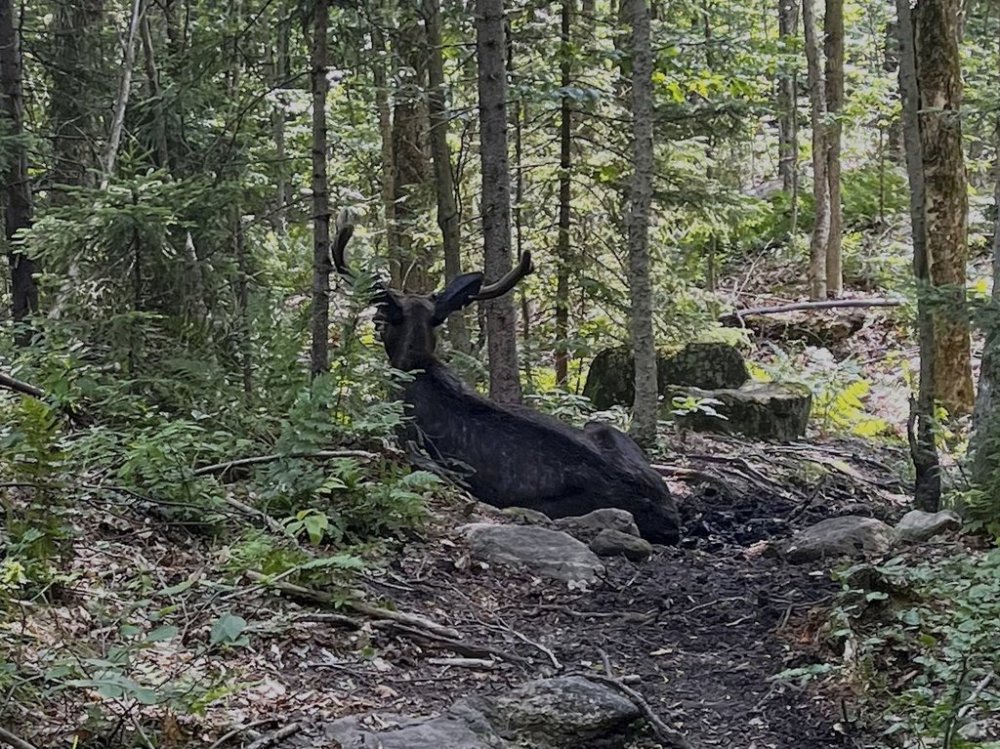
“This is very unusual behavior,” agency research scientist Dave Kramer said Thursday. “Typically at this time of year, moose will have moved down into the lower elevations where they’re primarily browsing on aquatic vegetation.”
Kramer estimates the moose stands about 6 feet (1.8 meters) tall at the shoulder and weighs 900 pounds (408 kilograms) or more. The spread of its antlers indicate it might be around four years old.
And it’s a mystery why the moose won’t move on.
The agency has said an “underlying illness influencing behavior” was suspected. Moose are susceptible to a couple of different parasites that can lead to their deaths.
Wildlife staffers were recently able to get close enough to observe the moose’s behavior but did not find obvious signs of disease.
“Although the moose does appear a little thinner than we would expect this time of year,” Kramer said, adding that it is difficult to make conclusive diagnoses of animals in the wild.
The moose has not shown signs of aggression. But the trail in the town of Tupper Lake remains closed in part over concerns that the large animal could pose a danger to people if approached too closely.
The state is keeping tabs on the moose with three trail cameras, and wildlife staffers make regular treks up the mountain.
“His body condition hasn’t deteriorated to a point where we’re concerned that he’s struggling,” Kramer said. “So right now we’re just kind of monitoring periodically and assessing each time.”
New York state is on the southern edge of moose range. The state’s population was wiped out in the 1800s but has gradually grown from animals that wandered in from other northern states and Canada starting around 1980. There might be roughly 700 moose in the Adirondack region.
Conservation officers in January saved a bull moose that fell through the ice of Lake Abanakee elsewhere in the Adirondacks.