

Mexico City marks 700 years since its founding by Indigenous people
Advertisement
Read this article for free:
or
Already have an account? Log in here »
To continue reading, please subscribe:
Digital Subscription
One year of digital access for only $1.44 a week*
- Enjoy unlimited reading on winnipegfreepress.com
- Read the E-Edition, our digital replica newspaper
- Access News Break, our award-winning app
- Play interactive puzzles
*Billed as $5.77 plus GST every four weeks. After 52 weeks, price increases to the regular rate of $19.95 plus GST every four weeks. Offer available to new and qualified returning subscribers only. Cancel any time.
To continue reading, please subscribe:
Add Free Press access to your Brandon Sun subscription for only an additional
$1 for the first 4 weeks*
- Enjoy unlimited reading on winnipegfreepress.com
- Read the E-Edition, our digital replica newspaper
- Access News Break, our award-winning app
- Play interactive puzzles
*Your next Brandon Sun subscription payment will increase by $1.00 and you will be charged $17.95 plus GST for four weeks. After four weeks, your payment will increase to $24.95 plus GST every four weeks.
Read unlimited articles for free today:
or
Already have an account? Log in here »
Hey there, time traveller!
This article was published 26/07/2025 (310 days ago), so information in it may no longer be current.
MEXICO CITY (AP) — Mexico City is marking the 700th anniversary of its founding with a series of public events on Saturday, including artistic performances honoring the city’s Indigenous origins.
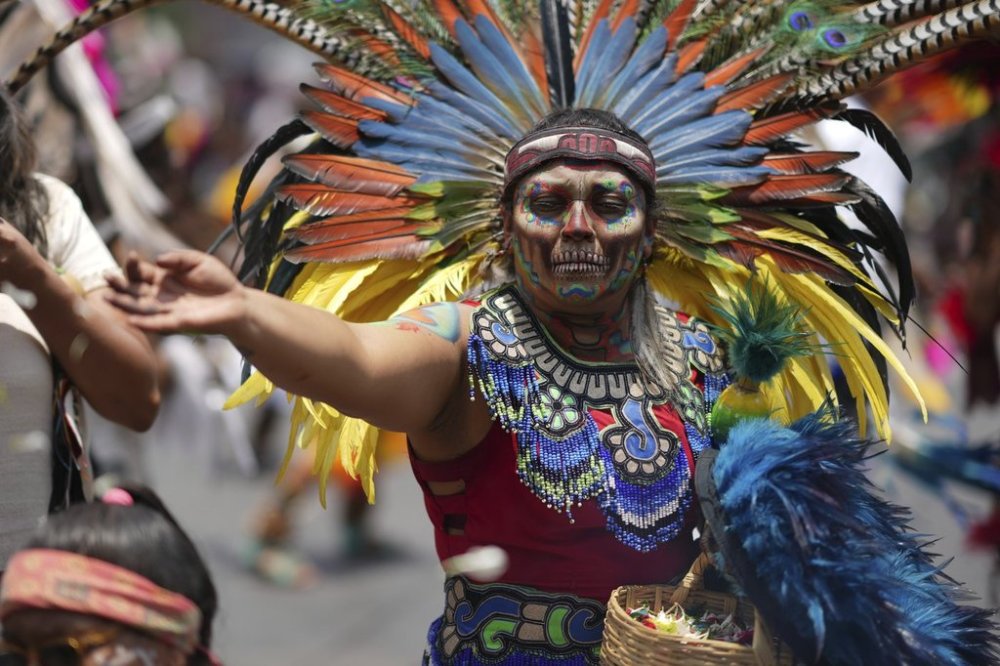
Artists in Indigenous clothing reenacted the founding of the Aztec capital in front of the country’s top officials in Mexico City’s main square. Later, hundreds of dancers dressed in traditional clothing, feather headdresses, drums, and ankle rattles made of seeds performed sacred dances meant to connect with nature.
The anniversary commemorates the establishment of Tenochtitlan, the capital of the Mexica, a group also known as the Aztecs, who settled in the Valley of Mexico in 1325.
As recorded by early Spanish chroniclers, Mexica elders told of a divine sign from their patron god Huitzilopochtli: an eagle on a cactus, signaling where to settle. That place became Tenochtitlan, the center of Aztec civilization and the site of today’s Mexico City.
That symbol was later recorded in the Codex Mendoza, which contained historical accounts of the Aztec empire. It became central to Mexican identity and appears today on the national flag.
“Mexico was not born with the arrival of the Spanish; Mexico was born much earlier with the great civilizations,” said President Claudia Sheinbaum in a speech in which she urged the eradication of the racism that still persists in the country.
Tenochtitlan began as a village on an island in a lake ringed by volcanic peaks. But historians say many other details that have come down in history are based heavily on legend, and that the exact founding date is unknown.
By the time the Spanish arrived in the 16th century, they were awed by a city filled with palaces, bridges, canals and bustling trade, according to Spanish chronicler and conquistador Bernal Díaz del Castillo.
Historian Miguel Pastrana of the National Autonomous University of Mexico’s Historic Investigations Institute, an expert on Tenochtitlan, said the weekend’s festivities are “political and civic” and do not reflect the latest historical research.
The historical record describes the Mexica as a people who migrated from a place called Aztlan, supposedly an island whose exact location remains unknown. They knew how to fish, gather aquatic plants and hunt birds, as well as build dams, and they tried to settle in several places before arriving in the Valley of Mexico.
The main island in the lake was already populated by the Tepaneca people, but they allowed the Mexica to settle there in exchange for tribute payments and other services, Pastrana said.
Little by little, the Mexica’s power grew. They were strong warriors and commercially prosperous, and they were effective at making alliances with other peoples.
Tenochtitlan became a great city at the center of an empire until the Spanish conquered it in 1521.