

Republicans consider changing Senate rules to speed confirmation of Trump nominees
Advertisement
Read this article for free:
or
Already have an account? Log in here »
To continue reading, please subscribe:

Digital Subscription
One year of digital access for only $205*
- Enjoy unlimited reading on winnipegfreepress.com
- Read the E-Edition, our digital replica newspaper
- Access News Break, our award-winning app
- Play interactive puzzles
*First annual payment billed as $205.00 + GST for one year. This annual subscription will automatically renew at $233.00 + GST every 52 weeks (10% off the regular annual price of $259.35). Offer available to new and qualified returning subscribers only. Cancel any time.
To continue reading, please subscribe:
Add Free Press access to your Brandon Sun subscription for only an additional
$1 for the first 4 weeks*
- Enjoy unlimited reading on winnipegfreepress.com
- Read the E-Edition, our digital replica newspaper
- Access News Break, our award-winning app
- Play interactive puzzles
*Your next Brandon Sun subscription payment will increase by $1.00 and you will be charged $17.95 plus GST for four weeks. After four weeks, your payment will increase to $24.95 plus GST every four weeks.
Read unlimited articles for free today:
or
Already have an account? Log in here »
Hey there, time traveller!
This article was published 30/07/2025 (395 days ago), so information in it may no longer be current.
WASHINGTON (AP) — Senate Republicans are considering changing Senate rules to speed up confirmation of President Donald Trump’s executive branch nominees.
The move forces a possible clash with Democrats in the coming days as Trump pressures them to fill dozens of administration posts before they are scheduled to leave town for the monthlong August recess.
Senate Majority Leader John Thune has already more than doubled the number of executive branch and judicial confirmations from Trump’s first term by holding the Senate in session for more days and longer hours. Still, Trump says he wants more, and Democrats are delaying a vote on most every nominee, arguing that Trump’s picks are extreme.
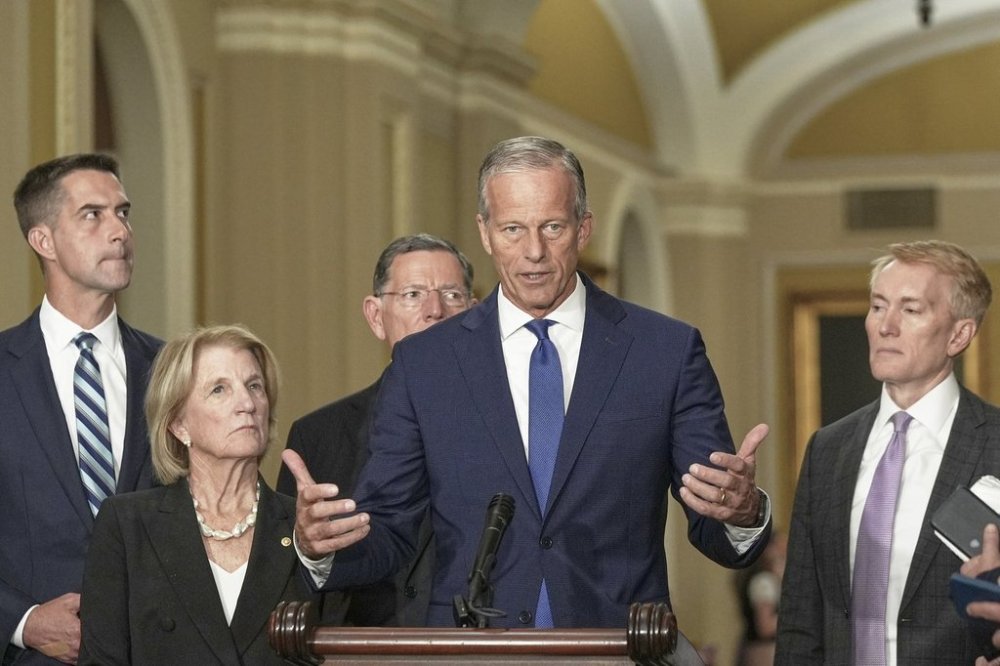
“We may need to look at doing things differently on nominees generally if the Democrats continue on this path of obstruction that they’re on right now,” Thune said Wednesday morning, adding that the number of willing votes to change Senate rules “is growing quickly on our side right now.”
The standoff between the two parties, with Trump encouraging Republicans to move even more swiftly or cancel their August recess, is likely to come to a head in the next week. Democrats have little desire to give in to Thune’s demand to confirm a tranche of nominees before they leave, even as senators in both parties are eager to skip town after several long months of work and bitter partisan fights over legislation.
The Senate clash over nominees is not new, though it has intensified over the last two decades as both parties have increasingly used stalling tactics to delay confirmations that were once quick, bipartisan and routine. In 2013, Democrats changed Senate rules for lower court judicial nominees to remove the 60-vote threshold for confirmations as Republicans blocked President Barack Obama’s judicial nominations. In 2017, Republicans did the same for Supreme Court nominees as Democrats tried to block Trump’s nomination of Justice Neil Gorsuch.
Still, Democrats have blocked more nominees than usual this year, denying any quick unanimous consent votes and forcing roll calls on each one, a lengthy process that takes several days per nominee and allows for debate time. It’s the first time in recent history that the minority party hasn’t allowed at least some quick confirmations.
Senate Democratic Leader Chuck Schumer said Democrats have blocked quick votes because “historically bad nominees deserved historic levels of scrutiny.”
But Thune said the rules are being “misused” by Democrats, and there is a lot of interest in the GOP conference in potentially speeding up the process. A rules change, in the end, “could benefit both parties when they have the presidency.”
It’s unclear how Republicans would change the rules, but they could potentially cut the number of procedural votes, reduce or eliminate the standard two hours of debate time or somehow force nominations to be bundled together, among other possible options. A rules change would require a simple majority vote, so almost all of the Senate’s 53 Republicans would have to be on board.
North Dakota Sen. John Hoeven said that in discussions among GOP senators, “all options are on the table.”
“We’d rather not have to,” Hoeven said. “If they would follow the same approach we gave them as recently as Biden, we wouldn’t be in this situation.”
Democrats have discussed similar changes in the past when Republicans were blocking their own nominees, but they would be unlikely to support any move to change the rules. Democratic Sen. Richard Blumenthal of Connecticut said that if Republicans propose to eliminate any debate time, they would be “resisting scrutiny” for a president’s nominations.
Sen. Tim Kaine, D-Va., has said in the past that he would be open to changing Senate rules to reduce the number of Senate-confirmed positions in government. But he said he would not be open to reducing debate time for nominees.
“There can be non-controversial nominees where you don’t need two hours, but there are some super important ones where that’s not enough time,” Kaine said.
The GOP leader is facing his own pressure from Trump, who has publicly called on Republicans to cancel the August recess to confirm more nominees. Trump also criticized Senate Republicans on social media this week for continuing with the so-called “blue slip” process that allows home state senators to approve or block some judicial nominees.
In a Tuesday post on Truth Social, Trump called on Senate Judiciary Committee Chairman Chuck Grassley, R-Iowa, to have the “courage” to stop honoring the blue slip forms that are submitted to the home state senators, regardless of party. Trump said as a result of this “custom” only Democrats or “a weak and ineffective Republican” can get nominated.
“Chuck Grassley, who I got re-elected to the U.S. Senate when he was down, by a lot, in the Great State of Iowa, could solve the ‘Blue Slip’ problem,” Trump posted.
Opening a committee hearing on Thursday, Grassley defended the practice and added that he was “offended by what the president said, and I’m disappointed that it would result in personal insults.”
Thune also backed the process Wednesday, noting that he used the blue slip process himself during former President Joe Biden’s administration when there was a judicial vacancy in South Dakota. “I don’t sense any rush to change it,” Thune said.