

Croatia holds military parade as it marks 30 years since a key war victory
Advertisement
Read this article for free:
or
Already have an account? Log in here »
To continue reading, please subscribe:

Digital Subscription
One year of digital access for only $205*
- Enjoy unlimited reading on winnipegfreepress.com
- Read the E-Edition, our digital replica newspaper
- Access News Break, our award-winning app
- Play interactive puzzles
*First annual payment billed as $205.00 + GST for one year. This annual subscription will automatically renew at $233.00 + GST every 52 weeks (10% off the regular annual price of $259.35). Offer available to new and qualified returning subscribers only. Cancel any time.
To continue reading, please subscribe:
Add Free Press access to your Brandon Sun subscription for only an additional
$1 for the first 4 weeks*
- Enjoy unlimited reading on winnipegfreepress.com
- Read the E-Edition, our digital replica newspaper
- Access News Break, our award-winning app
- Play interactive puzzles
*Your next Brandon Sun subscription payment will increase by $1.00 and you will be charged $17.95 plus GST for four weeks. After four weeks, your payment will increase to $24.95 plus GST every four weeks.
Read unlimited articles for free today:
or
Already have an account? Log in here »
Hey there, time traveller!
This article was published 31/07/2025 (386 days ago), so information in it may no longer be current.
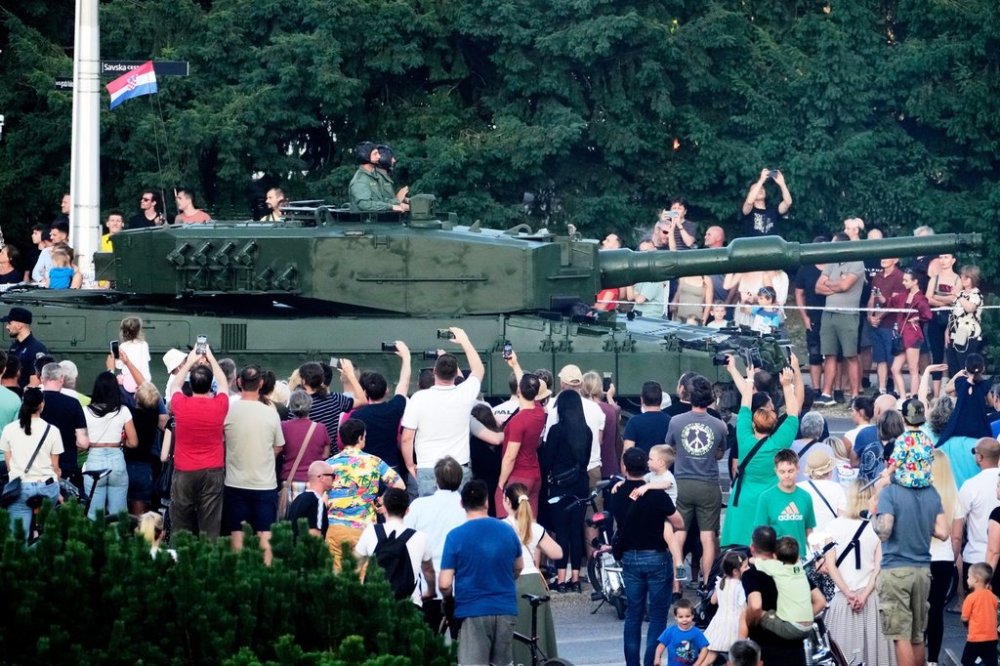
ZAGREB, Croatia (AP) — Thousands watched a military parade in Croatia’s capital on Thursday marking 30 years since a key war victory as the country looks to further boost its forces with a possible loan from a new European Union defense fund.
A flyover in Zagreb by French-made Rafale jets was a highlight of the show that included 3,400 army personnel along with police units, emergency service teams and war veterans. Navy battle ships sailed simultaneously by the Adriatic Sea port of Split.
Croatian Prime Minister Andrej Plenkovic said that “we have passed a big process of transition from eastern to western technology in order to be compatible with the capabilities of those armies who are our partners and allies.”
Croatia joined the EU in 2013, four years after becoming a member of NATO.
Back in August 1995, Croatia recaptured lands that had been held by minority Serbs since their rebellion in 1991 against the country’s independence from the former Communist-run Yugoslavia. The Operation Storm offensive presented a turning point in the war and also triggered a mass exodus of ethnic Serbs from Croatia.
Tensions persist in relations with Balkan rival Serbia, which backed the ethnic Serb rebellion in the 1990s’. Serbia plans to hold a commemoration ceremony for the Serb victims of the offensive, and Belgrade has cautioned Serbian citizens against traveling to Croatia in early August.
A military parade in Belgrade is planned for September.
Political analyst Zarko Puhovski said he believed the military parade was designed both to garner popular support for further defense spending amid security concerns in Europe fueled by Russia’s full-scale invasion of Ukraine in 2022, and as a message of strength in the region.
“It’s just putting on a show, to put military equipment on display,” Puhovski told The Associated Press. “This will be presented as Croatia’s effort to join the overall trend of increased militarization in Europe.”
Croatia is among eighteen EU countries that have applied for billions of euros from the bloc’s program of cheap loans aimed at helping Europe provide for its own security. Plenkovic has said that Croatia could seek 1.8 billion euros ($2 billion) from the fund.
The 150-billion-euro ($173 billion) Security Action for Europe (SAFE) program was launched after the administration of U.S. President Donald Trump signalled that Europe is no longer a U.S. security priority.
Some U.S. allies in Europe worry that President Vladimir Putin could target one of them if Russia wins its war on Ukraine.