

Colombian court frees former President Uribe from house arrest until it rules on bribery case
Advertisement
Read this article for free:
or
Already have an account? Log in here »
To continue reading, please subscribe:

Digital Subscription
One year of digital access for only $205*
- Enjoy unlimited reading on winnipegfreepress.com
- Read the E-Edition, our digital replica newspaper
- Access News Break, our award-winning app
- Play interactive puzzles
*First annual payment billed as $205.00 + GST for one year. This annual subscription will automatically renew at $233.00 + GST every 52 weeks (10% off the regular annual price of $259.35). Offer available to new and qualified returning subscribers only. Cancel any time.
To continue reading, please subscribe:
Add Free Press access to your Brandon Sun subscription for only an additional
$1 for the first 4 weeks*
- Enjoy unlimited reading on winnipegfreepress.com
- Read the E-Edition, our digital replica newspaper
- Access News Break, our award-winning app
- Play interactive puzzles
*Your next Brandon Sun subscription payment will increase by $1.00 and you will be charged $17.95 plus GST for four weeks. After four weeks, your payment will increase to $24.95 plus GST every four weeks.
Read unlimited articles for free today:
or
Already have an account? Log in here »
Hey there, time traveller!
This article was published 19/08/2025 (417 days ago), so information in it may no longer be current.
BOGOTA, Colombia (AP) — A Colombian appeals court ruled on Tuesday that the country’s former president, Álvaro Uribe, must be released from house arrest while he challenges his conviction for bribery and witness tampering.
The conservative leader was sentenced on Aug. 1 to 12 years of house arrest for threatening and trying to flip witnesses who had spoken to investigators about his alleged role in the formation of a right-wing paramilitary group in the 1990s.
Uribe denies the charges and has appealed the conviction to the Superior Tribunal in Bogota, the country’s capital. The court has until mid-October to issue a definitive ruling on the case, which has gripped Colombia and also provoked reactions from Uribe’s allies in the United States.
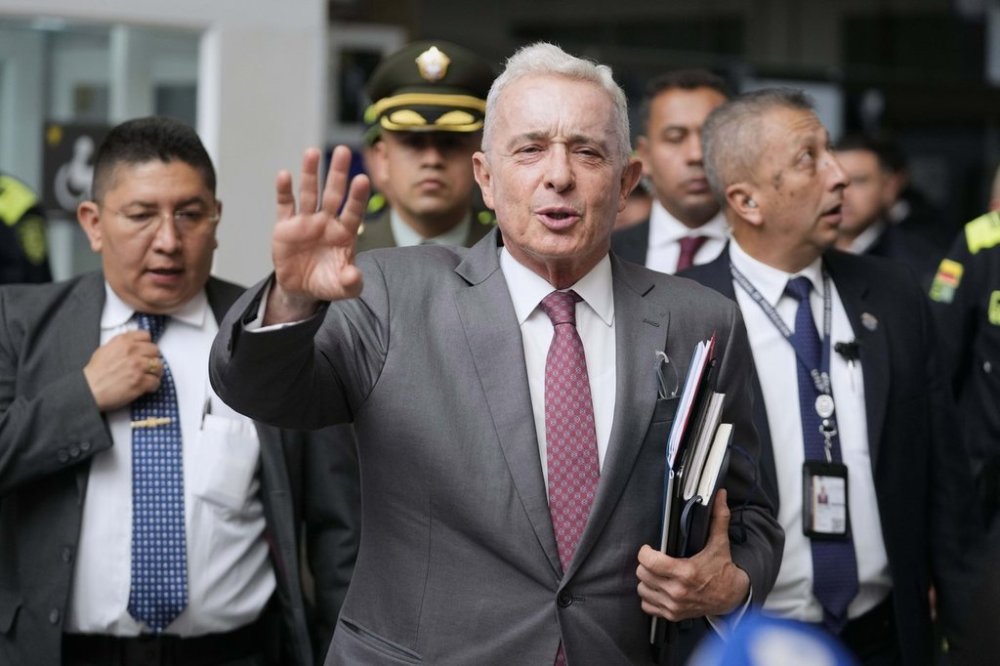
The Superior Tribunal said Tuesday it approved an injunction filed by Uribe’s defense team seeking his release from house arrest. Uribe’s lawyers argued his right to due process was violated by the arrest order against him, as well as his right to a presumption of innocence.
The former president, who governed from 2002 to 2010 with strong support from the U.S., is a polarizing figure in Colombia, where many credit him for saving the country from becoming a failed state, while others associate him with human rights violations and the rise of paramilitary groups in the 1990s.
During Uribe’s term, Colombia’ s military obtained crucial victories against the FARC rebels, which later forced the group into peace negotiations and turned Uribe into an icon of Latin America’s conservative movement.
But thousands of young people were also killed by the military and passed off as rebels by soldiers seeking promotions, as officers were pushed to augment their kill rates.
The case against Uribe dates back to 2012, when he filed a libel suit against Ivan Cepeda, a left-wing legislator who had gathered statements from former members of paramilitary groups accusing Uribe of being one of the founders of Bloque Metro, a paramilitary group that defended cattle ranchers from attacks by rebel groups.
In 2018, Colombia’s Supreme Court dismissed the suit and instead launched an investigation of Uribe, who was accused by prosecutors of trying to obstruct justice by flipping witnesses who had spoken to Cepeda about the former president’s alleged ties to the illegal group.
Judge Sandra Heredia said in July there was enough evidence to determine that Uribe conspired with a lawyer to coax three former members of paramilitary groups who were in prison into changing testimony they had provided to Cepeda, whose father was killed by paramilitaries in the 1980s.
Uribe’s defense said that the evidence was obtained illegally, and that Uribe had only sought meetings with the imprisoned paramilitary figures as part of his preparation for trial and to verify testimonies that were also being used in a murder trial against his brother, Santiago Uribe.
A few days after convicting Uribe, Judge Heredia sentenced the former president to 12 years of house arrest, arguing he should be detained immediately to “preserve the peaceful coexistence of citizens” by demonstrating that even a public figure could not walk free after being convicted.
Uribe is widely admired by conservatives in Latin America and the U.S., and the judge said his connections abroad would make it easy for him to flee the country if he was still free while appealing his case.
However, Bogota’s Superior Tribunal ruled Tuesday that Judge Heredia used “vague reasoning” to order Uribe’s detention and that the arrest warrant against him had violated his right to equal treatment under the law.
The court also dismissed arguments that Uribe would escape Colombia, saying he had left the country multiple times during his trial and had always returned to face justice.