

A decades-long peace vigil outside the White House is dismantled after Trump’s order
Advertisement
Read this article for free:
or
Already have an account? Log in here »
To continue reading, please subscribe:

Digital Subscription
One year of digital access for only $205*
- Enjoy unlimited reading on winnipegfreepress.com
- Read the E-Edition, our digital replica newspaper
- Access News Break, our award-winning app
- Play interactive puzzles
*First annual payment billed as $205.00 + GST for one year. This annual subscription will automatically renew at $233.00 + GST every 52 weeks (10% off the regular annual price of $259.35). Offer available to new and qualified returning subscribers only. Cancel any time.
To continue reading, please subscribe:
Add Free Press access to your Brandon Sun subscription for only an additional
$1 for the first 4 weeks*
- Enjoy unlimited reading on winnipegfreepress.com
- Read the E-Edition, our digital replica newspaper
- Access News Break, our award-winning app
- Play interactive puzzles
*Your next Brandon Sun subscription payment will increase by $1.00 and you will be charged $17.95 plus GST for four weeks. After four weeks, your payment will increase to $24.95 plus GST every four weeks.
Read unlimited articles for free today:
or
Already have an account? Log in here »
Hey there, time traveller!
This article was published 07/09/2025 (366 days ago), so information in it may no longer be current.
WASHINGTON (AP) — Law enforcement officials on Sunday removed a peace vigil that had stood outside the White House for more than four decades after President Donald Trump ordered it to be taken down as part of the clearing of homeless encampments in the nation’s capital.
Philipos Melaku-Bello, a volunteer who has manned the vigil for years, told The Associated Press that the Park Police removed it early Sunday morning. He said officials justified the removal by mislabeling the memorial as a shelter.
“The difference between an encampment and a vigil is that an encampment is where homeless people live,” Melaku-Bello said. “As you can see, I don’t have a bed. I have signs and it is covered by the First Amendment right to freedom of speech and freedom of expression.”
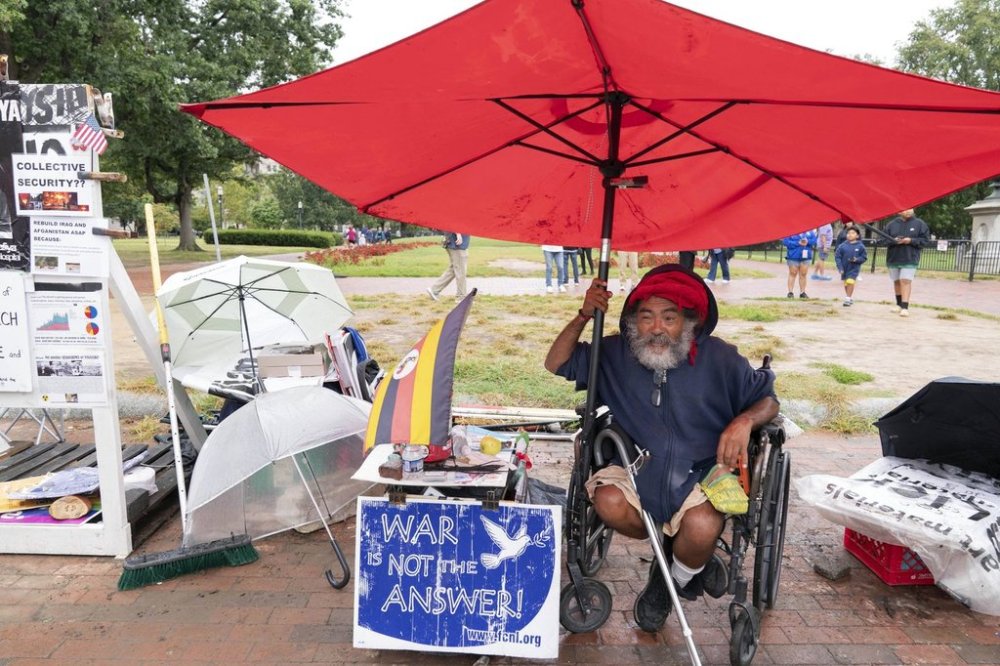
The White House confirmed the removal, telling AP in a statement that the vigil was a “hazard to those visiting the White House and the surrounding areas.”
Taking down the vigil is the latest in a series of actions the Trump administration has ordered as part of its federal takeover of policing in the city, which began last month. The White House has defended the intervention as needed to fulfill Trump’s executive order on the “beautification” of D.C.
Melaku-Bello said he’s in touch with attorneys about what he sees as a civil rights violation. “They’re choosing to call a place that is not an encampment an encampment just to fit what is in Trump’s agenda of removing the encampments,” he said.
The vigil was started in 1981 by activist William Thomas to promote nuclear disarmament and an end to global conflicts. It is believed to be the longest continuous anti-war protest in U.S. history. When Thomas died in 2009, other protesters like Melaku-Bello manned the tiny tent and the banner, which read “Live by the bomb, die by the bomb,” around the clock to avoid it being dismantled by authorities.
The small but persistent act of protest was brought to Trump’s attention during an event at the White House on Friday.
Brian Glenn, a correspondent for the conservative network Real America’s Voice, told Trump the blue tent was an “eyesore” for those who come to the White House.
“Just out front of the White House is a blue tent that originally was put there to be an anti-nuclear tent for nuclear arms,” Glenn said. “It’s kind of morphed into more of an anti-American, sometimes anti-Trump at many times.”
Trump, who said he was not aware of it, told his staff: “Take it down. Take it down today, right now.”
Melaku-Bello said that Glenn spread misinformation when he told the president that the tent had rats and “could be a national security risk” because people could hide weapons in there.
“No weapons were found,” he told AP. “He said that it was rat-infested. Not a single rat came out as they took down the cinder blocks.”
___
Amiri reported from New York. Will Weissert in New York contributed to this report.