

Divers recover artifacts from the Titanic’s sister ship Britannic for the first time
Advertisement
Read this article for free:
or
Already have an account? Log in here »
To continue reading, please subscribe:
Digital Subscription
One year of digital access for only $1.44 a week*
- Enjoy unlimited reading on winnipegfreepress.com
- Read the E-Edition, our digital replica newspaper
- Access News Break, our award-winning app
- Play interactive puzzles
*Billed as $5.77 plus GST every four weeks. After 52 weeks, price increases to the regular rate of $19.95 plus GST every four weeks. Offer available to new and qualified returning subscribers only. Cancel any time.
To continue reading, please subscribe:
Add Free Press access to your Brandon Sun subscription for only an additional
$1 for the first 4 weeks*
- Enjoy unlimited reading on winnipegfreepress.com
- Read the E-Edition, our digital replica newspaper
- Access News Break, our award-winning app
- Play interactive puzzles
*Your next Brandon Sun subscription payment will increase by $1.00 and you will be charged $17.95 plus GST for four weeks. After four weeks, your payment will increase to $24.95 plus GST every four weeks.
Read unlimited articles for free today:
or
Already have an account? Log in here »
Hey there, time traveller!
This article was published 16/09/2025 (397 days ago), so information in it may no longer be current.
ATHENS, Greece (AP) — Divers have recovered artifacts from the Titanic’s sister ship, the Britannic, for the first time since the ocean liner sank in the Aegean Sea more than a century ago after striking a mine during World War I.
The Culture Ministry in Greece said Monday that an 11-member deep-sea diving team conducted a weeklong operation in May to recover artifacts including the ship’s bell and the port-side navigation light.
The White Star Line’s Britannic, launched in 1914, was designed as a luxury cruise liner, but was requisitioned as a hospital ship during World War I. It was heading toward the island of Lemnos when it struck a mine and sank off the island of Kea, about 75 kilometers (45 miles) southeast of Athens, on Nov. 21, 1916.
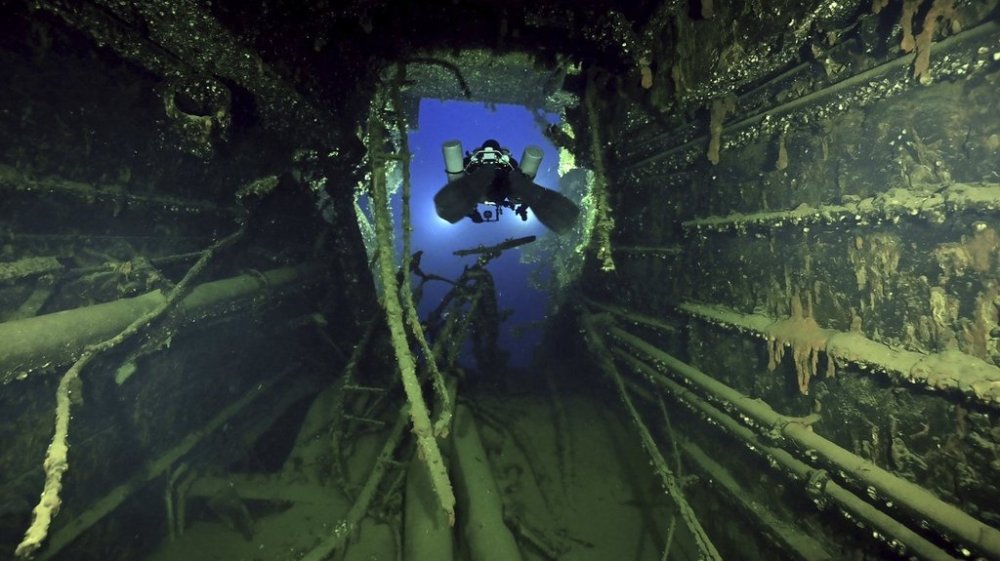
The vessel, the largest hospital ship at the time, sank in less than an hour. Thirty of the more than 1,060 people on board died when the lifeboats they were in were struck by the ship’s still turning propellers.
The wreck lies at a depth of 120 meters (nearly 400 feet), making it accessible only to technical divers. The dive team used closed-circuit rebreather equipment in a recovery operation organized by British historian Simon Mills, founder of the Britannic Foundation, the Culture Ministry said.
Conditions on the wreck were particularly tough because of currents and low visibility, the ministry said. Among the items raised to the surface were artifacts reflecting both the ship’s utilitarian role and its luxurious design: the lookout bell, the navigation lamp, silver-plated first-class trays, ceramic tiles from a Turkish bath, a pair of passenger binoculars and a porcelain sink from second-class cabins.
The artifacts are now undergoing conservation in Greek capital Athens and will be included in the permanent collection of a new Museum of Underwater Antiquities under development at the port of Piraeus. The museum will feature a dedicated World War I section, with the items from the Britannic as a centerpiece.