

Ancient spear-throwing tool brings fun and history to Vermont competition
Advertisement
Read this article for free:
or
Already have an account? Log in here »
To continue reading, please subscribe:

Digital Subscription
One year of digital access for only $205*
- Enjoy unlimited reading on winnipegfreepress.com
- Read the E-Edition, our digital replica newspaper
- Access News Break, our award-winning app
- Play interactive puzzles
*First annual payment billed as $205.00 + GST for one year. This annual subscription will automatically renew at $233.00 + GST every 52 weeks (10% off the regular annual price of $259.35). Offer available to new and qualified returning subscribers only. Cancel any time.
To continue reading, please subscribe:
Add Free Press access to your Brandon Sun subscription for only an additional
$1 for the first 4 weeks*
- Enjoy unlimited reading on winnipegfreepress.com
- Read the E-Edition, our digital replica newspaper
- Access News Break, our award-winning app
- Play interactive puzzles
*Your next Brandon Sun subscription payment will increase by $1.00 and you will be charged $17.95 plus GST for four weeks. After four weeks, your payment will increase to $24.95 plus GST every four weeks.
Read unlimited articles for free today:
or
Already have an account? Log in here »
Hey there, time traveller!
This article was published 20/09/2025 (303 days ago), so information in it may no longer be current.
ADDISON, Vt. (AP) — Celine Thouin learned a lot as a student at Franklin Pierce University, and one of the skills she has held onto the longest is how to use an ancient spear-throwing tool.
She got to share that skill with fellow Vermonters on Saturday. Thouin, 38 and a veteran of the Franklin Pierce atlatl team, was one of a few dozen participants in the Northeast Open Atlatl Championship in Addison, Vermont.
Humans invented the atlatl thousands of years ago for use as a spear-throwing hunting tool. They were used to hunt massive animals such as woolly mammoths in the days long before recorded history.
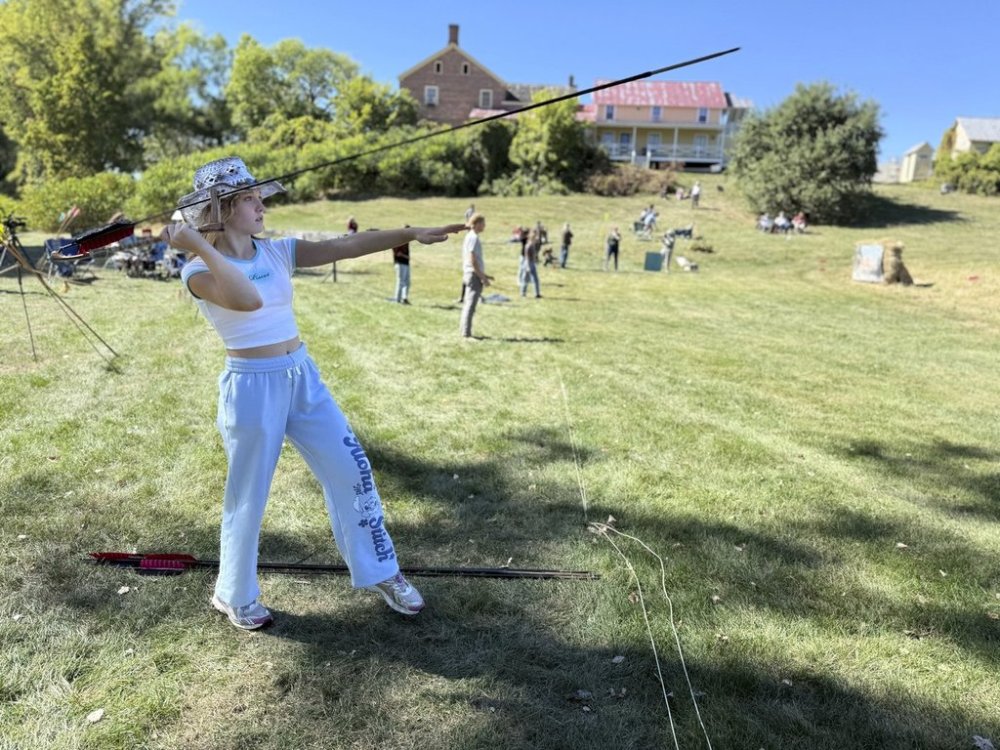
Now, they are the passion of a group of hobbyists and anthropology lovers who see the atlatl as a way to learn about history and have fun.
“I think it’s just a low-pressure sport. Really, really fun,” said Thouin, who won the 2020 competition and whose children are also atlatl enthusiasts. “It’s also experimental archaeology, which is incredibly fun. We get to use the same weapons that were used 15,000 years ago all over the world.”
The competition took place at Chimney Point State Historic Site in Addison, near Lake Champlain and the New York state border. It was the thirtieth annual event and a part of Vermont’s Archaeology Month, organizers said.
The contest was open to all ages and allowed participants to shoot for accuracy and distance. Throws of more than 800 feet (244 meters) have been recorded, though even a much shorter throw than that takes a good degree of skill.
For Douglas Bassett, a past president of the World Atlatl Association and another participant in Saturday’s event, the history of the atlatl is as interesting as its use. He described it as “a stick by which you can throw another stick,” and he said it was used all over the ancient world.
Bassett confessed to having no idea how to pronounce the name of the tool. Most sources say it is aht-LAHT-l, but the exact pronunciation might be lost to the mists of time, he said.
“The language is gone as the people are gone, so I don’t know much about the pronunciations,” Bassett said. “But all kinds of languages, all around the world. It may pretty much have been on every continent. Even when Antarctica melts, maybe we’ll find evidence of people throwing spears there, too, with the atlatl.”