

Japan says it plans to tell Trump it will build up military and upgrade security strategy
Advertisement
Read this article for free:
or
Already have an account? Log in here »
To continue reading, please subscribe:

Digital Subscription
One year of digital access for only $205*
- Enjoy unlimited reading on winnipegfreepress.com
- Read the E-Edition, our digital replica newspaper
- Access News Break, our award-winning app
- Play interactive puzzles
*First annual payment billed as $205.00 + GST for one year. This annual subscription will automatically renew at $233.00 + GST every 52 weeks (10% off the regular annual price of $259.35). Offer available to new and qualified returning subscribers only. Cancel any time.
To continue reading, please subscribe:
Add Free Press access to your Brandon Sun subscription for only an additional
$1 for the first 4 weeks*
- Enjoy unlimited reading on winnipegfreepress.com
- Read the E-Edition, our digital replica newspaper
- Access News Break, our award-winning app
- Play interactive puzzles
*Your next Brandon Sun subscription payment will increase by $1.00 and you will be charged $17.95 plus GST for four weeks. After four weeks, your payment will increase to $24.95 plus GST every four weeks.
Read unlimited articles for free today:
or
Already have an account? Log in here »
Hey there, time traveller!
This article was published 22/10/2025 (343 days ago), so information in it may no longer be current.
TOKYO (AP) — Japan’s new foreign minister said Wednesday his country plans to show its determination to further build up its defense to rapidly adapt to changing warfare realities and growing tension in the region when U.S. President Donald Trump visits Tokyo next week.
Trump is expected to hold talks next Tuesday with Japan’s Prime Minister Sanae Takaichi, who took office Tuesday after being elected Japan’s first female leader.
Takaichi, who had spent much of past few weeks embroiled in internal political wrangling, has to face major diplomatic tests within days of taking office — Trump’s visit and two regional summits.
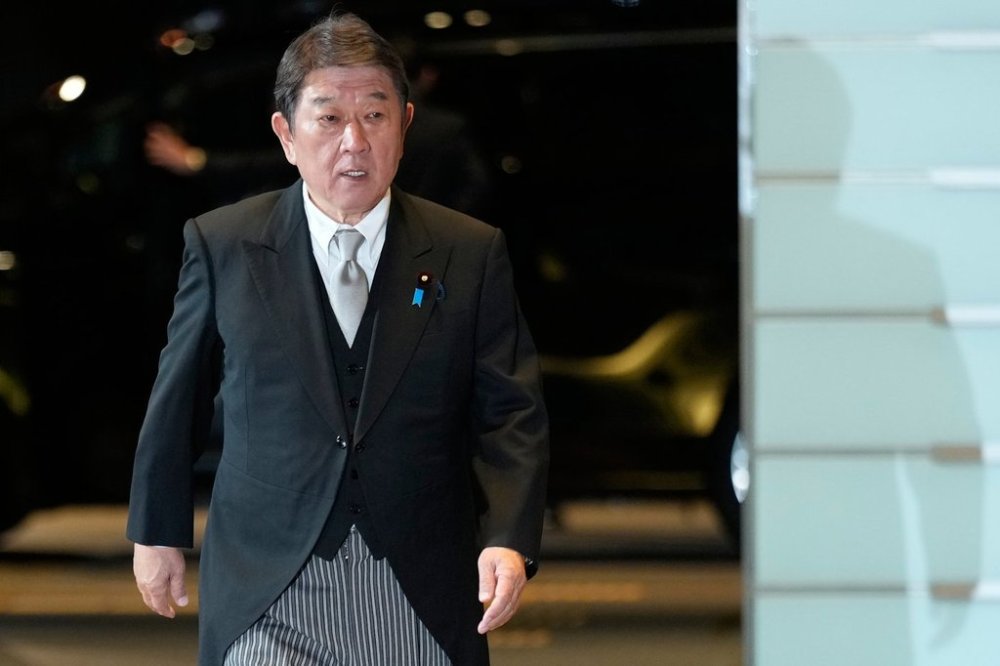
“We are firmly preparing for President Trump’s visit,” Foreign Minister Toshimitsu Motegi said.
Motegi said he hoped Trump’s first meeting with Takaichi during his Oct. 27-29 visit would serve as an opportunity for the two leaders to discuss further strengthening of the Japan-U.S. alliance while fostering their personal relationship of trust.
He said Japan also hopes to further cooperate with South Korea, along with other regional partners including Australia and the Philippines, while seeking stable and constructive relations with China.
Japan is currently undergoing a five-year military buildup through 2027 as part of its national security strategy, including doubling its annual defense spending to 2% of gross domestic product. The strategy, which also promotes Japan’s strike-back capability with long-range missiles, marks a major break from Japan’s defense-only principle under its postwar pacifist constitution.
Takaichi’s government wants to move up a review for its post-2027 strategy which may involve larger military spending.
The ruling party’s alliance with the right-wing Japan Innovation Party — which replaces an alliance with the dovish centrist Komeito party — has raised concerns that a revised strategy may involve further offensive roles for Japan under Takaichi, a security hawk.
Motegi said Japan’s further strengthening of its military capability is essential to adapt to emerging new warfare such as drone swarms in the war against Ukraine, as well as responses to cyberattacks. While firmly pursuing the ongoing five-year military buildup, the government will also review it, “and we hope to firmly convey our plans to the U.S. side,” Motegi said.
Japan is expected to face tough demands from Trump to further increase its defense spending to NATO levels of 5% of GDP, more purchases of costly American weapons and additional spending for some 50,000 U.S. troops in Japan under the bilateral security pact.
“Our national defense should be based on our own independent decision,” Motegi said. “What’s important is not the amount or the GDP ratio but what’s in it.”
He also said he hopes to meet with his counterpart, U.S. Secretary of State Marco Rubio, at the earliest time possible to discuss further strengthening of the deterrence and response capability of the Japan-U.S. alliance.
Motegi returns to the post for the second time after serving in 2019-2021, during Trump’s first term, when he earned a reputation as a tough negotiator. He is also tasked with following up on the Japan-U.S. tariffs agreement.
He said he hoped to work toward “sincere and steady implementation of the agreement” to promote and ensure mutual benefits, economic security and growth.