

Pakistan warns Afghanistan of a stern response to any new militant attacks
Advertisement
Read this article for free:
or
Already have an account? Log in here »
To continue reading, please subscribe:
Monthly Digital Subscription
$1 per week for 24 weeks*
- Enjoy unlimited reading on winnipegfreepress.com
- Read the E-Edition, our digital replica newspaper
- Access News Break, our award-winning app
- Play interactive puzzles
*Billed as $4.00 plus GST every four weeks. After 24 weeks, price increases to the regular rate of $19.95 plus GST every four weeks. Offer available to new and qualified returning subscribers only. Cancel any time.
Monthly Digital Subscription
$4.99/week*
- Enjoy unlimited reading on winnipegfreepress.com
- Read the E-Edition, our digital replica newspaper
- Access News Break, our award-winning app
- Play interactive puzzles
*Billed as $19.95 plus GST every four weeks. Cancel any time.
To continue reading, please subscribe:
Add Free Press access to your Brandon Sun subscription for only an additional
$1 for the first 4 weeks*
*Your next subscription payment will increase by $1.00 and you will be charged $16.99 plus GST for four weeks. After four weeks, your payment will increase to $23.99 plus GST every four weeks.
Read unlimited articles for free today:
or
Already have an account? Log in here »
ISLAMABAD (AP) — Pakistan’s defense minister warned Afghanistan on Wednesday that any new “terrorist or suicide attack” by militants on Pakistani soil would draw a stern response, hours after talks between the two countries in Istanbul failed to secure a peace agreement.
Earlier this month, Pakistan’s military launched attacks on what it said were hideouts of the Pakistani Taliban in Afghanistan, killing dozens of people whom it described as insurgents. Afghanistan said that the people killed were civilians and struck Pakistani military posts in response, claiming 58 Pakistani soldiers were killed.
Pakistan’s military said the border fighting left 23 soldiers dead.
The two sides agreed to a ceasefire brokered in the Qatari capital, Doha, on Oct. 19, followed by four days of talks this week in Istanbul that ended inconclusively.
Stalled talks
In a post on X, Pakistan’s Defense Minister Khawaja Mohammad Asif told Afghanistan’s Taliban government that “any terrorist attack or suicide bombing inside Pakistan shall give you the bitter taste of such misadventures.”
There was no immediate comment from Kabul on the collapse of peace talks or on Asif’s remarks, but Afghanistan’s state broadcaster RTA reported that the negotiations stalled because of what it called “irrational demands” from Pakistan.
According to RTA, Islamabad sought assurances that no attacks would be launched from Afghan territory, while the Taliban delegation said the Pakistani Taliban, also known as Tehrik-e-Taliban Pakistan, was an internal issue for Islamabad.
Pakistan has long accused Afghanistan’s Taliban government of turning a blind eye to Pakistani Taliban and other militants operating from its territory. Kabul denies the charge.
The Pakistani military said Wednesday it killed seven Pakistani Taliban militants in an operation in Kurram, a district in the Khyber Pakhtunkhwa province. Six soldiers were also killed, the statement said, adding that a search was underway for runaway gunmen.
Pakistan has witnessed a surge in militant attacks, most claimed by the Pakistani Taliban, which is a separate group from the Afghan Taliban but has been emboldened since the latter returned to power in Kabul in 2021. Many Pakistani Taliban leaders and fighters have been living in Afghanistan since then.
Asif, in a strongly worded post on X, also accused Kabul of “blindly pushing Afghanistan into yet another conflict” to preserve what he described as its “usurped rule and war economy.”
“Let me assure them that Pakistan does not require to employ even a fraction of its full arsenal to completely obliterate the Taliban regime and push them back to the caves for hiding,” he said.
A ceasefire in place, but border crossings closed
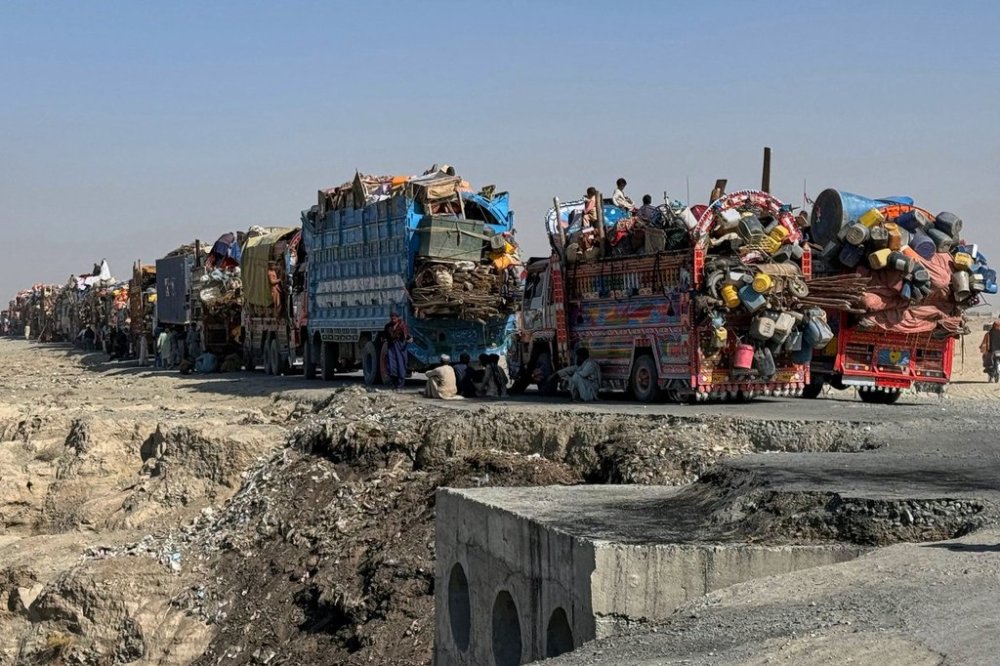
Despite the failure of the talks, a ceasefire remained in place, and no new clashes were reported along the border. Both countries have shut all major crossings, leaving hundreds of trucks carrying goods and refugees stranded on each side.
Asif told reporters in Islamabad that reopening the border for bilateral and transit trade with Afghanistan was conditional on Kabul’s assurance that Afghan territory would not be used for militant attacks against Pakistan.
He said Pakistan had evidence showing that Afghan soil was used to stage violence in Pakistan, and that information was shared with the Afghan delegation during the Istanbul talks.
Asif said that “terrorists who come from across the border to attack Pakistan will be pursued there, even if they have come from Afghanistan,” and that Pakistan could go deep inside Afghanistan to hit such militants.
At the Chaman border crossing in southwestern Balochistan province in Pakistan, hundreds of Afghan refugee families and traders voiced frustration and anxiety over the failed talks.
“We came to know that the talks failed,” said Ajab Khan, an Afghan refugee waiting in a long queue of trucks loaded with household goods. “Now we are going back to Afghanistan, but it’s a scary situation. We don’t know how we will survive there.”
___
Associated Press writers Abdul Qahar in Jalalabad, Afghanistan, Javed Hussain in Kurram, Pakistan and Riaz Khan in Peshawar, Pakistan, contributed to this report.