

Florida starts redistricting talks in a growing battle for House control in 2026 elections
Advertisement
Read this article for free:
or
Already have an account? Log in here »
To continue reading, please subscribe:
Monthly Digital Subscription
$1 per week for 24 weeks*
- Enjoy unlimited reading on winnipegfreepress.com
- Read the E-Edition, our digital replica newspaper
- Access News Break, our award-winning app
- Play interactive puzzles
*Billed as $4.00 plus GST every four weeks. After 24 weeks, price increases to the regular rate of $19.95 plus GST every four weeks. Offer available to new and qualified returning subscribers only. Cancel any time.
Monthly Digital Subscription
$4.99/week*
- Enjoy unlimited reading on winnipegfreepress.com
- Read the E-Edition, our digital replica newspaper
- Access News Break, our award-winning app
- Play interactive puzzles
*Billed as $19.95 plus GST every four weeks. Cancel any time.
To continue reading, please subscribe:
Add Free Press access to your Brandon Sun subscription for only an additional
$1 for the first 4 weeks*
*Your next subscription payment will increase by $1.00 and you will be charged $16.99 plus GST for four weeks. After four weeks, your payment will increase to $23.99 plus GST every four weeks.
Read unlimited articles for free today:
or
Already have an account? Log in here »
TALLAHASSEE, Fla. (AP) — Florida’s Republican-controlled House officially kicked off the first meeting of its select committee on congressional redistricting Thursday, as the state becomes the latest to consider redrawing electoral maps amid a partisan battle for every edge in next year’s midterm elections.
But the prospect of mid-decade redistricting in President Donald Trump’s adopted home state remains uncertain, with the top Republican on the committee stopping short of committing to draft new maps and appearing to draw a deeper divide among his party’s leaders on how the process should move forward.
Republican state Rep. Mike Redondo, who chairs the committee, cemented his chamber’s commitment to consider redistricting during Florida’s regular session, which runs from Jan. 13 to March 13 — saying it would be “irresponsible” to wait until next spring, as the GOP-controlled state Senate and Republican Gov. Ron DeSantis have called for.
“It would be irresponsible to the citizens of Florida,” to delay the process, Redondo said.
The national wave of redistricting efforts was instigated by Trump, who hopes to buck the historical trend of the president’s party losing seats in midterms, and his allies are wagering that Florida could yield three to five more seats for Republicans. Each seat is crucial, because Democrats need a net gain of just three to control the chamber.
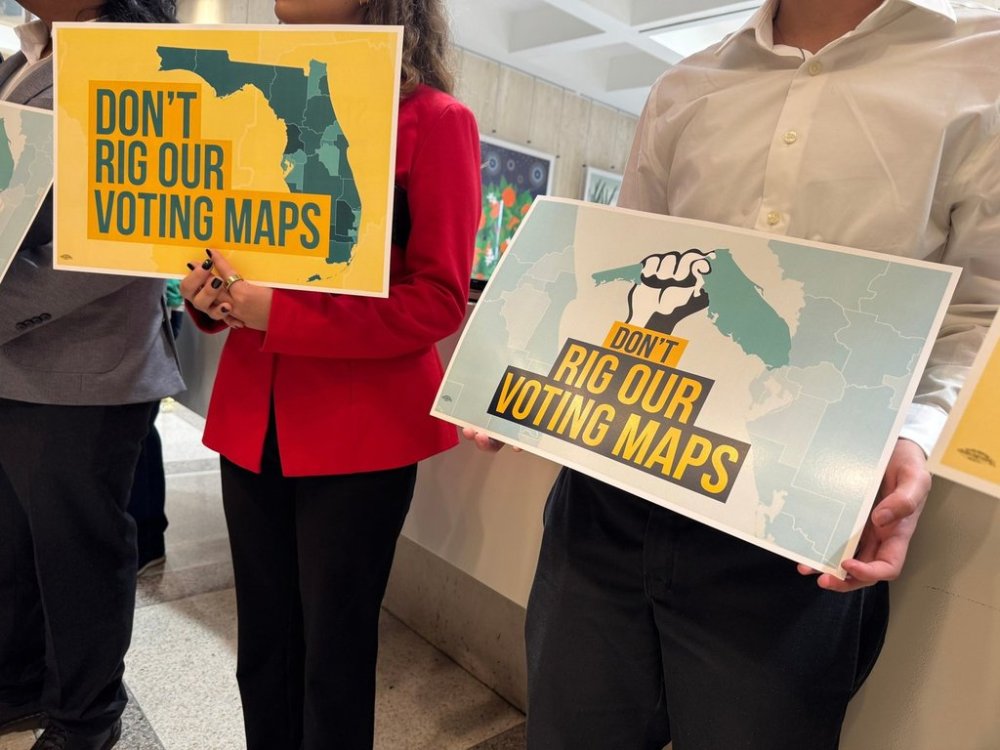
At Thursday’s meeting, Redondo declared that any map drawing in Florida would not be done for partisan gain, a pledge that drew loud laughs from the crowd largely made up of progressive protesters and voting rights advocates.
“Our work as a committee and as a legislative body is not directed by the work of other states or partisan gamesmanship,” Redondo said, his words temporarily drowned out by laughter.
Opponents of the effort had crowded the meeting room in the bowels of the House office building on Thursday, only to be told lawmakers would not be hearing the testimony they had traveled hours to give. Instead, the committee got a slideshow presentation on the basics of redistricting, before gaveling out more than 30 minutes before the hourlong meeting was slated to end.
Donna Gillroy, who traveled more than 300 miles (482 kilometers) from Naples, Florida, to attend the meeting, described the proceedings as “death by PowerPoint.”
Infighting in Florida GOP
The push for redistricting faces still major challenges in Florida because of bitter infighting between DeSantis and leaders in the GOP-dominated Legislature, along with a provision in the state Constitution that explicitly bars redrawing maps with the intent to “favor or disfavor a political party or an incumbent.”
DeSantis has voiced support for redistricting and even called for a redo of the 2020 U.S. census, claiming that Florida was shortchanged in the count, which determines how many congressional seats each state gets. Florida currently has 28 congressional seats, with a Republican-Democratic split of 20-8.
“We are going to press this issue,” DeSantis said in August.
This week, in an interview with online outlet The Floridian, DeSantis floated the possibility of calling lawmakers back in a special session if they do not get redistricting done in the regular session.
The state Senate has declined to wade into the fray so far.
Senate President Ben Albritton, also a Republican, has said there is “no ongoing work” on the matter in his chamber, citing the governor’s desire to address it in the spring.
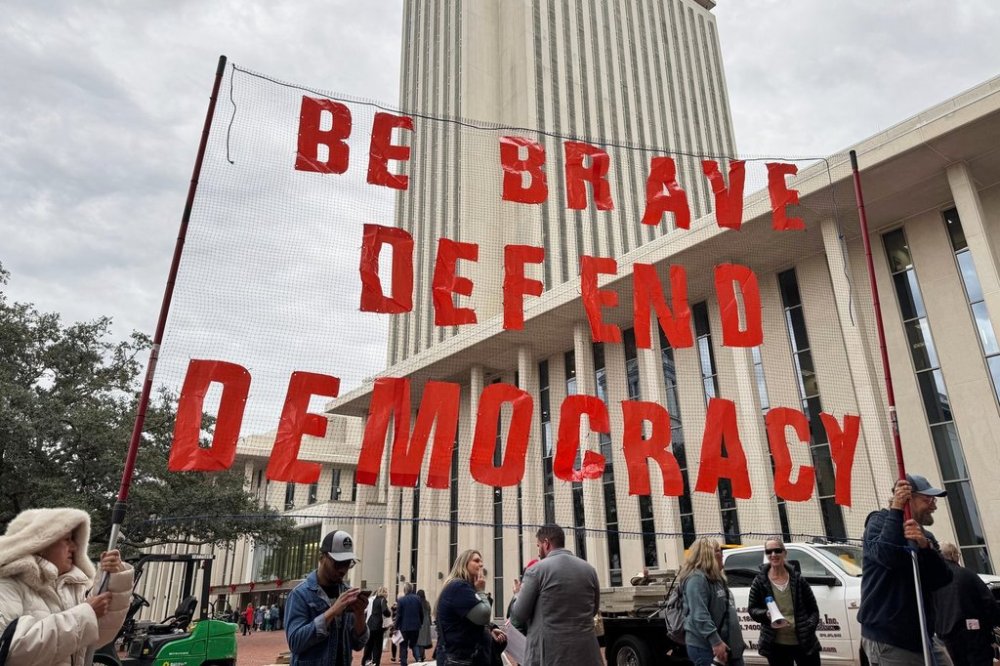
Civil liberties and voting rights organizations have maintained that any redistricting for partisan gain in Florida is unconstitutional.
“To redraw the lines for partisan reasons is illegal. Period, full stop,” said Genesis Robinson, executive director of the voter engagement organization Equal Ground.
Redistricting battle goes nationwide
Nationwide, midcycle redistricting has resulted in nine more congressional seats that Republicans believe they can win and six that Democrats think they can win. The redistricting is being litigated in several states, however, and there is also no guarantee that the parties will win the remapped seats.
The last time Florida redrew its maps in 2022, DeSantis took over what is typically a legislature-led process, vetoing the maps drawn by lawmakers and muscling through his own, which dismantled two traditionally Black districts. Black lawmakers staged a sit-in on the House floor in protest of what they declared an overreach of executive power.
DeSantis argued that the previous maps — which kept the districts of Black representatives largely intact — represented racial gerrymandering. Earlier this year, the Florida Supreme Court upheld the maps pushed by DeSantis, finding that restoring the previously united Black communities in Florida’s Panhandle region would amount to impermissible racial gerrymandering in violation of the U.S. Constitution’s equal protection guarantees.
The ruling had weakened a provision in the state Constitution barring racial gerrymandering, but it left intact the ban against partisan mapmaking, citizen-led amendments that Florida voters approved in 2010.
___
Kate Payne is a corps member for The Associated Press/Report for America Statehouse News Initiative. Report for America is a nonprofit national service program that places journalists in local newsrooms to report on undercovered issues.