

US and Japan hold joint flight drills as China ups military activity near Japan
Advertisement
Read this article for free:
or
Already have an account? Log in here »
To continue reading, please subscribe:

Digital Subscription
One year of digital access for only $205*
- Enjoy unlimited reading on winnipegfreepress.com
- Read the E-Edition, our digital replica newspaper
- Access News Break, our award-winning app
- Play interactive puzzles
*First annual payment billed as $205.00 + GST for one year. This annual subscription will automatically renew at $233.00 + GST every 52 weeks (10% off the regular annual price of $259.35). Offer available to new and qualified returning subscribers only. Cancel any time.
To continue reading, please subscribe:
Add Free Press access to your Brandon Sun subscription for only an additional
$1 for the first 4 weeks*
- Enjoy unlimited reading on winnipegfreepress.com
- Read the E-Edition, our digital replica newspaper
- Access News Break, our award-winning app
- Play interactive puzzles
*Your next Brandon Sun subscription payment will increase by $1.00 and you will be charged $17.95 plus GST for four weeks. After four weeks, your payment will increase to $24.95 plus GST every four weeks.
Read unlimited articles for free today:
or
Already have an account? Log in here »
Hey there, time traveller!
This article was published 11/12/2025 (280 days ago), so information in it may no longer be current.
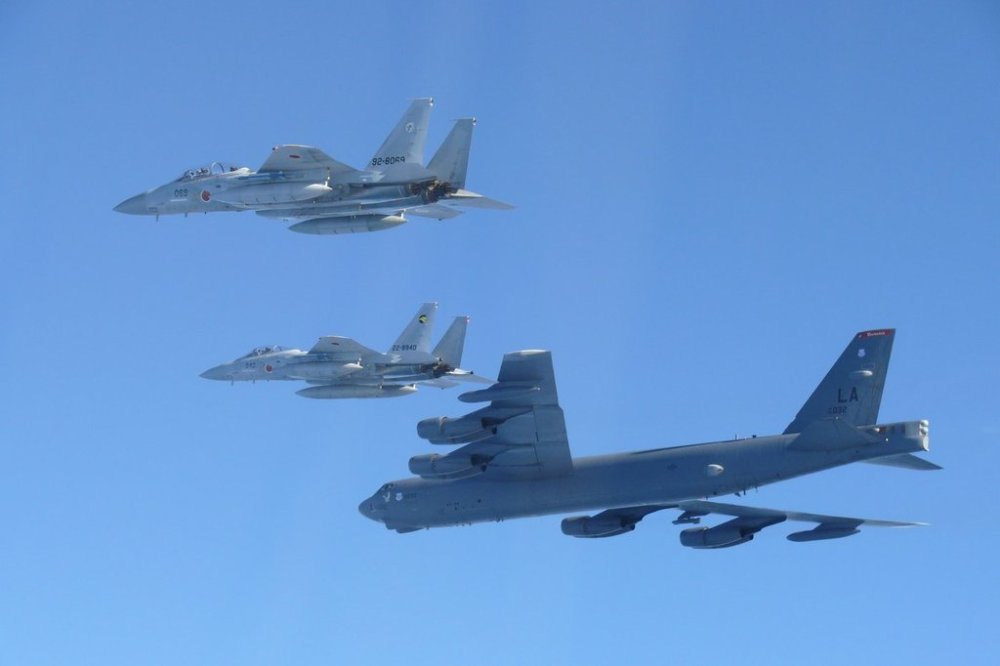
TOKYO (AP) — U.S. strategic bombers joined a fleet of Japanese fighter jets in a joint military exercise meant to demonstrate their military cooperation around Japan’s airspace, defense officials said Thursday, as tensions with China escalate.
The exercise showcasing joint Japanese-U.S. air power came a day after Chinese and Russian bombers flew together around western Japan, prompting Tokyo to scramble fighter jets, though there was no airspace violation. It also follows China’s military aircraft locking radar on Japanese jets Saturday, another incident that has caused Tokyo-Beijing relations to further deteriorate.
Early Friday, Japanese Defense Minister Shinjiro Koizumi and his U.S counterpart, Pete Hegseth, held telephone talks on “increasingly severe security situation in the Indo-Pacific region, including the radar incident,” the Japanese defense ministry said in a statement. It did not mention the flight drills.
It said the ministers expressed serious concern over any actions to increase regional tensions, as “China’s actions are not conducive to regional peace and stability.” Koizumi reiterated that Japan will firmly and steadily continue surveillance and monitoring activities in the airspace and waters surrounding the country.
Japan’s Air Self Defense-Force and the U.S. military conducted the joint exercise Wednesday as “the security environment surrounding our country is becoming even severer,” the Japanese Joint Staff said.
It said the allies “reaffirmed the strong resolve to prevent unilateral attempts to change the status quo by force and the readiness between the SDF and the U.S. forces.”
Two U.S. B-52 strategic bombers and three Japanese F-35 stealth fighter jets and three F-15 jets conducted their joint flight drills near Japan’s western airspace, above the waters between the country and South Korea, officials said.
Exercises held as the security environment grows more tense
The Joint Staff denied that the exercise was conducted in response to a specific incident, but acknowledged Chinese military aircraft’s recent radar-locking on Japanese jets and the China-Russia joint bomber exercises Tuesday as examples of a worsening security environment around Japan.
Relations between Japan and China have deteriorated after Japan’s Prime Minister Sanae Takaichi said in early November that Japan’s military could get involved if China were to take action against Taiwan, the self-governing island that Beijing claims as its own.
The row escalated over the weekend when separate Chinese drills involving a carrier near southern Japan prompted Tokyo to scramble jets and to protest that Japanese aircraft were targeted by repeated radar-locking — a move considered as possible preparation for firing.
Tokyo protested to Beijing, asking for an explanation and preventive measures. China denied the allegation and accused Japanese jets of interfering and endangering the Chinese exercise.
Washington stressed its “unwavering” alliance with Japan, saying the incident was not “conducive to regional peace and stability.”
The exercise came one day after Chinese and Russian strategic bombers conducted joint long-distance flight from the waters between Japan and South Korea down to the Pacific, the Joint Staff said.
Two Russian strategic bombers Tu-95 that flew down from the airspace east of the Korean Peninsula joined a pair of Chinese H-6 bombers over the East China Sea for a joint flight down to the Pacific off the southern coast of Japan’s Shikoku island.
The four bombers were also joined by four Chinese J-16 fighters as they flew back and forth between two Japanese southwestern islands Okinawa and Miyako, the area where China is expanding its military presence.