

The Latest: Trump officials give nearly two-hour briefing to top lawmakers on Venezuela
Advertisement
Read this article for free:
or
Already have an account? Log in here »
To continue reading, please subscribe:

Digital Subscription
One year of digital access for only $205*
- Enjoy unlimited reading on winnipegfreepress.com
- Read the E-Edition, our digital replica newspaper
- Access News Break, our award-winning app
- Play interactive puzzles
*First annual payment billed as $205.00 + GST for one year. This annual subscription will automatically renew at $233.00 + GST every 52 weeks (10% off the regular annual price of $259.35). Offer available to new and qualified returning subscribers only. Cancel any time.
To continue reading, please subscribe:
Add Free Press access to your Brandon Sun subscription for only an additional
$1 for the first 4 weeks*
- Enjoy unlimited reading on winnipegfreepress.com
- Read the E-Edition, our digital replica newspaper
- Access News Break, our award-winning app
- Play interactive puzzles
*Your next Brandon Sun subscription payment will increase by $1.00 and you will be charged $17.95 plus GST for four weeks. After four weeks, your payment will increase to $24.95 plus GST every four weeks.
Read unlimited articles for free today:
or
Already have an account? Log in here »
Hey there, time traveller!
This article was published 05/01/2026 (256 days ago), so information in it may no longer be current.
Top officials from President Donald Trump’s administration briefed congressional leaders on the U.S. government’s plans for the future of Venezuela in a Monday evening meeting on Capitol Hill.
Secretary of State Marco Rubio, Defense Secretary Pete Hegseth and other officials discussed Venezuela with House and Senate leadership, as well as top members of the intelligence committees and national security committees.
House Speaker Mike Johnson said after receiving the briefing he does not expect the United States to deploy troops to Venezuela, and Senate Democratic Leader Chuck Schumer said the session “posed far more questions than it answered.”
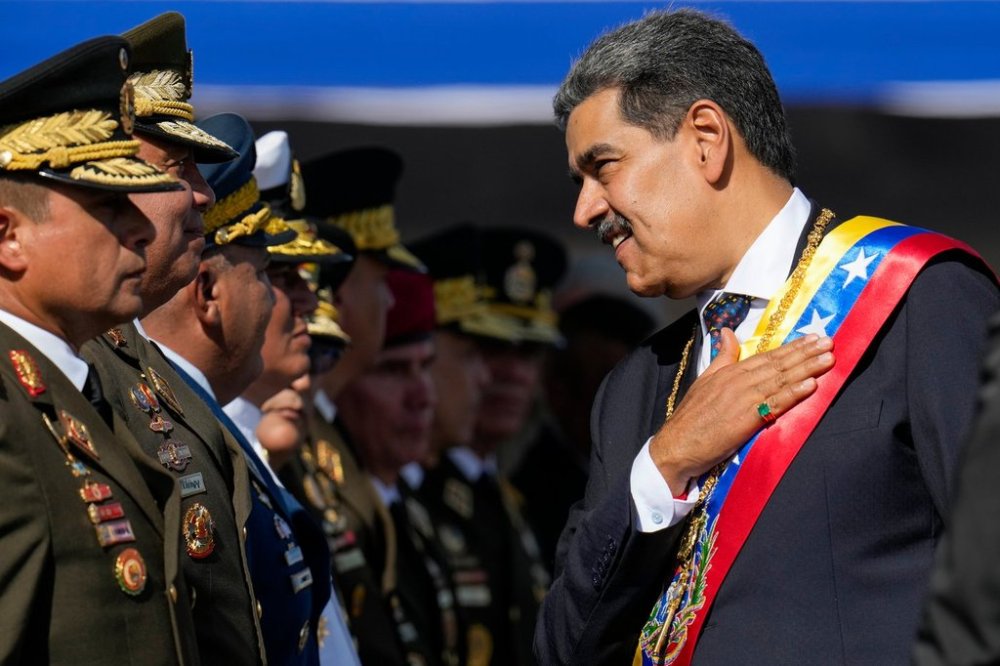
Deposed Venezuelan leader Nicolás Maduro declared himself “innocent” and a “decent man” as he pleaded not guilty to federal drug trafficking charges in a U.S. courtroom on Monday, his first court appearance for what is likely to be a prolonged legal fight.
Maduro appeared in court on the narco-terrorism charges the Trump administration used to justify capturing him and bringing him to New York.
Here’s the latest:
Republicans praise Venezuela operation but decline to outline timeline on future US actions
“I think those are all questions I think will be more sufficiently answered,” said Senate Majority Leader John Thune, R-S.D., about whether the Trump administration gave a timeline for reaching operational control of Venezuela.
Thune added that the prospect of American troops in Venezuela was raised during the briefing but that he did not “have any sense that that is going to happen.”
Rep. Brian Mast, chair of the House Foreign Relations Committee, said the administration intended for acting Venezuelan President Delcy Rodriguez to be in place until potential free and fair elections could be held.
“That’s why she’s in place, to work to maintain stability in there. And there’s an expectation that stability will be maintained,” Mast said.
He declined to say if the administration had shared any timeline.
Democrats say they received little clarification in Venezuela briefing
Senate Democratic Leader Chuck Schumer said the briefing “posed far more questions than it answered.”
Democratic Sens. Jeanne Shaheen and Mark Warner echoed those concerns, saying the meeting lacked clarity. Shaheen said that “there are a significant number of questions that still need to be answered.”
Rep. Gregory Meeks, the ranking member of the House Foreign Affairs Committee, said the briefing was “not good” and offered little clarity about the administration’s next steps in Venezuela. Meeks added his takeaway was that Trump “has the option of putting troops on the ground” and is “not going to take anything off the table.”
Speaker Johnson says after briefing that he does not expect ‘troops on the ground’ in Venezuela
House Speaker Mike Johnson said that he does not expect the United States to deploy troops to Venezuela, emphasizing that U.S. actions there are “not a regime change” operation.
Johnson made the remarks after emerging from a nearly two-hour briefing with top congressional leaders, Secretary of State Marco Rubio and other senior Trump administration officials.
“We don’t expect direct involvement in any other way beyond just coercing the new interim government to get that going,” Johnson said.
Trump denies Nobel Prize influenced his rejection of Venezuela’s opposition leader as Maduro’s successor
Trump told NBC News in an interview that María Corina Machado, the Venezuelan opposition leader who was recognized last year with the Nobel Peace Prize, should not have won the award, which he long has coveted and has openly campaigned for since he returned to office.
But Trump denied basing his decision about Machado’s ability to lead Venezuela on the prize as had been reported by the Washington Post.
“She should not have won it,” the president told NBC News. “But no, that has nothing to do with my decision.”
A top adviser to Trump, Stephen Miller, spoke about Machado in a separate interview with CNN and said, “All Venezuelan experts agree that it would be absurd and preposterous for us to suddenly fly her into the country and put her in a charge, and then the military would follow her and the security forces would follow her. … It’s not even a serious question.”
Trump says Venezuela’s oil infrastructure can be rebuilt in less than 18 months with US government support
Trump told NBC News in an interview that the U.S. government could reimburse oil companies making investments in Venezuela to maintain and increase oil production in that country.
He suggested that the necessary rebuilding of the country’s neglected infrastructure for extracting and shipping oil could happen in less than 18 months.
“I think we can do it in less time than that, but it’ll be a lot of money,” Trump said. “A tremendous amount of money will have to be spent and the oil companies will spend it, and then they’ll get reimbursed by us or through revenue.”
It still remains unclear how quickly the investment could occur given the uncertainties about Venezuela’s political stability and the billions of dollars needed to be spent.
Venezuela produces on average about 1.1 million barrels of oil a day, down from the 3.5 million barrels a day produced in 1999 before a government takeover of the majority of oil interests and a mix of corruption, mismanagement and U.S. economic sanctions led output to fall.
Republican senator criticizes US actions in Venezuela
Sen. Rand Paul, R-Ky., said there are probably a dozen leaders around the world that the U.S. could say is a violation of an international law or human rights law.
“And we have never gone in and plucked them out the country. So it sets a very bad precedent for doing this and it’s unconstitutional,” Paul told reporters. “There’s no way you can say bombing a capital and removing the president of a foreign country is not an initiation of war.”
Paul was a rare Republican critic of the administration’s actions in Venezuela as lawmakers returned to the Capitol on Monday.
Top members of Senate Judiciary Committee say they should be briefed on Maduro operation
The top Republican and Democrat on the Senate Judiciary Committee say they should have been included in a classified briefing Monday evening on the Maduro operation.
The briefing Monday, led by Secretary of State Marco Rubio, is for members of the “gang of eight,” which include the four congressional leaders and the heads of the House and Senate Intelligence Committees. It also will include leaders from the various national security committees.
But the Judiciary Committee, which oversees the Justice Department, is not among those committees, said Sen. Chuck Grassley, R-Iowa, and Illinois Sen. Dick Durbin, the top Democrat on the committee. That is not OK, they say, because the administration has said this was a law enforcement operation involving key DOJ entities.
“There is no legitimate basis for excluding the Senate Judiciary Committee from this briefing,” Grassley and Durbin said in the joint statement. “The administration’s refusal to acknowledge our Committee’s indisputable jurisdiction in this matter is unacceptable and we are following up to ensure the Committee receives warranted information regarding Maduro’s arrest.”
China has first claim on Venezuela’s oil, complicating Trump’s plans
One complication to getting U.S. oil companies to invest in Venezuela: China has first dibs on much of what comes out of the ground.
China has lent tens of billions of dollars to Venezuela in recent years under contracts that require cash proceeds from oil sales to go to Beijing first.
It’s unclear how much China is still owed because Venezuela stopped reporting figures years ago, but the IOU could be as much as $10 billion, says Brad Parks, head of William and Mary’s research group AidData.
Chinese lending could frustrate Trump elsewhere in Latin America, too, as he seeks to shape the region’s politics under a new Monroe Doctrine. Parks says every dollar donated or lent by Washington to the region in the ten years through 2023 has been matched by three dollars from Beijing.
Danish PM warns US takeover of Greenland would end NATO
Danish Prime Minister Mette Frederiksen says an American takeover of Greenland would amount to the end of the NATO military alliance. Her comments came in response to Trump’s renewed call for the strategic, mineral-rich Arctic island to come under U.S. control in the aftermath of the weekend military operation in Venezuela.
The dead-of-night operation by U.S. forces in Caracas left the world stunned, and heightened concerns in Denmark and Greenland, which is a semiautonomous territory of the Danish kingdom and thus part of NATO.
Frederiksen and her Greenlandic counterpart, Jens Frederik Nielsen, blasted the president’s comments and warned of catastrophic consequences. Numerous European leaders expressed solidarity with them.
“If the United States chooses to attack another NATO country militarily, then everything stops,” Frederiksen told Danish broadcaster TV2 on Monday. “That is, including our NATO and thus the security that has been provided since the end of the Second World War.”
Rubio and Hegseth to brief lawmakers on plans in Venezuela
Senate Majority Leader John Thune says he expects to “find out more” about what Trump means by saying his administration will run Venezuela.
Thune says he and other lawmakers overseeing national security will be briefed later today by Secretary of State Marco Rubio, Defense Secretary Pete Hegseth and others.
The South Dakota Republican said he was comfortable with the notification he received about the U.S. operation to capture Maduro, even though he was not informed in advance.
“But I think there’s a reason why, like I said before, notification of Congress in advance of really critical and hyper-sensitive missions, to me, it seems ill-advised,” Thune said. “I felt the notification considering the scope of the mission was sufficient.”
Schumer says Americans didn’t sign up for ‘endless wars’
Senate Democratic Leader Chuck Schumer warned that Trump’s action in Venezuela is only the beginning of a dangerous approach to foreign policy as the president publicly signals U.S. interests in Greenland and other countries.
Whenever the U.S. gets involved in regime change efforts, Schumer said, “American families pay the price in blood and treasure.”
Schumer said, “The American people did not sign up for another round of endless wars.”
‘Nearly 200’ Americans took part in Venezuela raid, Hegseth says
Defense Secretary Pete Hegseth suggested that forces that participated in the raid on Venezuela’s capital city on Saturday morning numbered less than 200.
Hegseth told a crowd of sailors and shipbuilders in Newport News, Virginia, that “nearly 200 of our greatest Americans went downtown in Caracas” and they “grabbed an indicted individual wanted by American Justice in support of law enforcement without a single American killed.”
It was not immediately clear whether this figure was for just the forces who set foot on the ground in Caracas or if it also included others who worked to support those troops.
Pentagon officials said they had nothing to add to Hegseth’s remarks.
UN says nearly 8 million Venezuelans need aid
As the U.N. Security Council discussed the implications of the U.S. raid, the world body also spotlighted the profound humanitarian needs in Venezuela. Its people have endured a yearslong, complex economic crisis.
Nearly 8 million Venezuelans — about a quarter of the population — urgently need help, U.N. chief spokesperson Stéphane Dujarric said at a news briefing. Resources are slim: The U.N. appealed to member countries last year for $606 million for humanitarian aid to Venezuela but got about $102 million.
Dujarric said the organization is continuing to provide food, health care and other things to needy Venezuelans but needs more support quickly.
Maduro’s vice president has been sworn in as interim president of Venezuela
Delcy Rodríguez was sworn in by her brother, National Assembly leader Jorge Rodríguez.
“I come with sorrow for the suffering inflicted upon the Venezuelan people following an illegitimate military aggression against our homeland,” she said with her right hand up. “I come with sorrow for the kidnapping of two heroes.”
Erdogan warns of global risks, says Venezuela must not be dragged into chaos
Turkish President Recep Tayyip Erdogan said he told Trump during a telephone call Monday that Venezuela must not be dragged into instability.
In a televised address, Erdogan also stressed that Turkey does not condone any action violating political legitimacy or international law, warning that such steps “are risky steps that can lead to serious complications on a global level.”
Turkey has cultivated close ties with Venezuela, and Maduro has visited Turkey several times.
Erdogan continued: “Turkey and the Turkish people will continue to stand by the friendly Venezuelan people in their struggle for prosperity, peace, and development.”
Maduro allowed to keep notes he took in court
Writing on a yellow legal pad placed next to a copy of the indictment in his spot on the defense table, Maduro asked that his notes “be respected” and that he be allowed to keep them.
Hellerstein directed prosecutors to work with the U.S. Marshals to abide by that request.
Maduro wished reporters ‘Happy New Year’ in court
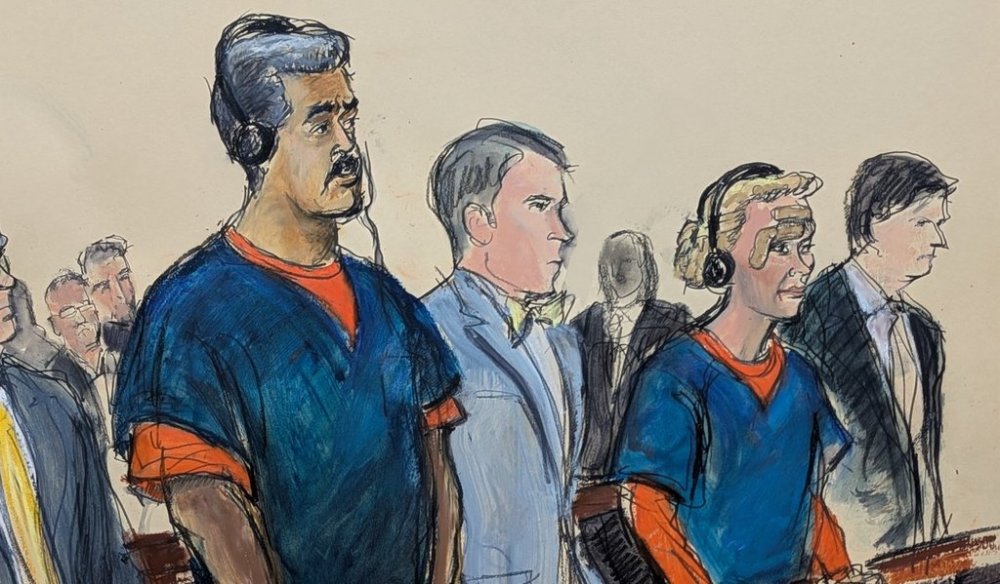
Wearing jail-issued khaki pants and a blue, short-sleeved shirt over an orange shirt, Maduro issued the greeting several times as he looked at reporters sitting in the jury box, before turning to the packed courtroom gallery.
Respectful of court decorum throughout the proceeding, Maduro took copious notes and repeatedly pressed his case that he had been unlawfully abducted.
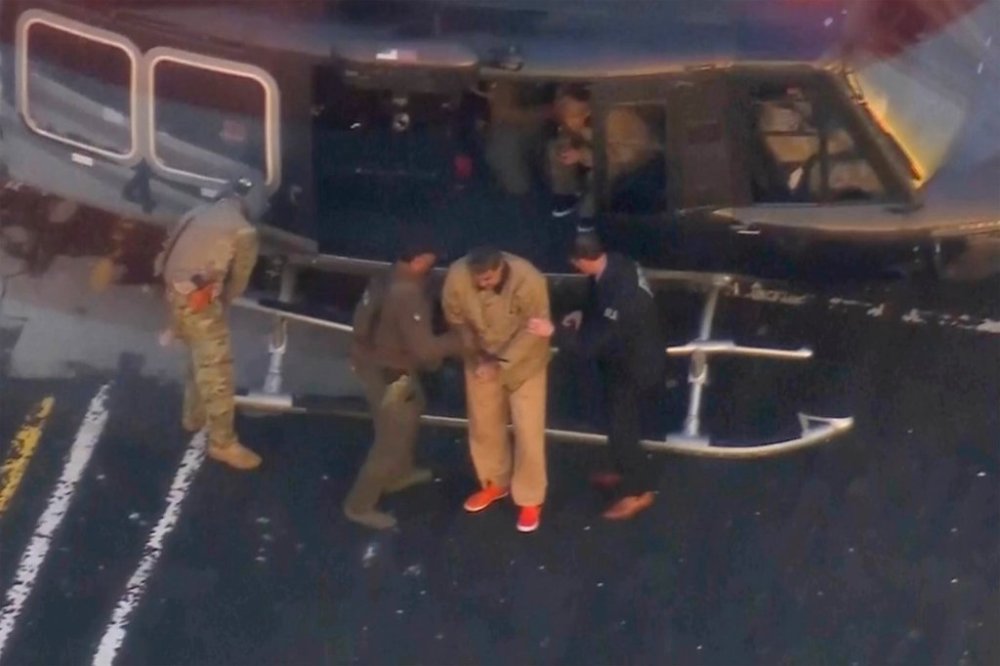
Among the spectators in the courtroom were agents from the Drug Enforcement Administration and the special agent in charge of the agency’s New York Division, Frank Tarentino.
US eyes reopening its closed embassy in Caracas
The Trump administration is making preliminary plans to reopen the U.S. embassy in Venezuela following Maduro’s ouster, a State Department official said.
The official, who spoke on condition of anonymity to discuss internal administration deliberations, said early preparations “to allow for a reopening” of the embassy in Caracas had begun in the event President Donald Trump decides to return American diplomats to the country.
The official cautioned, however, that no decision had yet been made to resume operations at the facility, which was shuttered in 2019 during Trump’s first term in office. Re-opening a closed embassy requires a great deal of logistics, security and staffing preparation that can take months to complete.
– By Matthew Lee
Flores’ temple and eyelid were bandaged in court
Mark E. Donnelly, her lawyer, said that Cilia Flores had suffered “significant injuries” during her capture and that he believes she has a fracture or severe bruising on her ribs.
The judge directed prosecutors to ensure that she gets the proper care.
Maduro has a confrontation with a protester as he leaves the courtroom
As Maduro stood to leave with federal officers, a man in the audience stood and began speaking forcefully at him in Spanish, calling him an “illegitimate” president.
The man, 33-year-old Pedro Rojas, said later that he had been imprisoned by the Venezuelan regime.
As deputy U.S. Marshals led Maduro from the courtroom, the deposed leader looked directly at the man and shot back in Spanish: “I am a kidnapped president. I am a prisoner of war.”
Maduro’s next court date is set for March 17
As the hearing came to an end, Maduro and his wife were escorted from the courtroom.
Maduro’s attorney raises ‘questions about the legality’ of the arrest
At one point near the end of the hearing, attorney Barry J. Pollack said his client “is head of a sovereign state and entitled to the privilege” that the status ensures.
Pollack said there were “questions about the legality of his military abduction” and that there would be “voluminous” pretrial filings to address those legal challenges.
The hearing has ended
Court proceedings ended at 12:31 p.m. after attorney Mark Donnelly, on behalf of Cilia Flores, said that his client sustained “health and medical issues that will require attention.”
Donnelly said that Flores, 69, may have a fracture or severe bruising on her ribs and may need a full X-ray.
Both Maduro and Flores agreed to remain detained for now. Their attorneys could revisit a bail application at a later date.
Prosecutor lays out the custody timeline
In court, a government attorney said Maduro and Flores were officially taken into law enforcement custody at 11:30 a.m. on Saturday and that their plane landed in New York at 4:31 p.m. that day.
Flores also asserts her role as Venezuela’s first lady
Following Maduro’s plea, Hellerstein turned to Maduro’s wife and asked her to confirm her identity.
After confirming her name, Cilia Flores said in Spanish, through an interpreter: “I am first lady of the Republic of Venezuela.”
Asked to enter a plea, she responded: “Not guilty. Completely innocent.”
Maduro repeatedly asserts he is still the leader of Venezuela
At one point, Maduro said he had not yet read the indictment against him and had not been informed of his rights.
“I did not know of these rights,” he said through the interpreter. “Your honor is informing me of them now.”
Lawyer says Maduro’s not guilty plea applies to all charges
The judge responded to Maduro: “A plea of not guilty will be entered on behalf of Mr. Maduro.”
A second time, Maduro was asked for his plea and he said: “I am innocent. I am not guilty of anything that is mentioned here.”
Hellerstein reads the summary of charges against Maduro
The allegations Hellerstein listed included a “narco-terrorism conspiracy.”
The judge referred to Maduro’s wife, Cilia Adela Flores de Maduro, as “Mrs. Flores.”
Hearing getting underway
Defense attorneys and prosecutors announced their appearances.
The judge, who could not be seen on courtroom monitors shown in overflow rooms, quipped: “Modern electronic equipment hides the judge.”
Once the proceeding began, Hellerstein, a Clinton appointee, announced that he had been assigned to the case.
“It’s my job to assure this is a fair trial,” Hellerstein said, “That’s my job, and that’s what I intend.”
No television cameras or recording devices are allowed inside the courtroom itself, but reporters and members of the public are allowed to watch in overflow rooms.
Maduro makes his first appearance in a US courtroom following his capture
Maduro was led into the courtroom at 12:01 p.m. He shook hands with his lawyer and sat down. He wore his prison blue uniform.
Maduro’s wife was led to her seat immediately afterward. Both put on headsets to hear the proceeding as it is translated.
Judge Alvin K. Hellerstein took the bench at 12:03 p.m.
Maduro’s son warns that his father’s capture sets a dangerous international precedent
Maduro’s son and Venezuelan congressman Nicolás Maduro Guerra railed on the Trump administration on Monday and warned that the capture of his father in an American operation could set a dangerous precedent globally.
The speech in front of Venezuela’s parliament, his first appearance since the Saturday escalation, comes as the Trump administration has pushed Venezuela’s government to fall in line with its vision for the oil-rich nation.
Maduro Guerra, also known as “Nicolasito,” demanded that his parents be returned by American authorities and called on international support.
Maduro Guerra also denounced his name appearing in the New York indictment of his parents, in which he was named as a co-conspirator.
“If we normalize the kidnapping of a head of state, no country is safe. Today it’s Venezuela. Tomorrow it could be any nation that refuses to submit. This is not a regional problem. It is a direct threat to global political stability,” Maduro Guerra said.
Danish ambassador pushes back on US prospects of Greenland
Christina Markus Lassen, Danish ambassador to the U.N., carefully denounced U.S. prospects for taking over Greenland without mentioning the fellow NATO ally by name. “The inviolability of borders is not up for negotiation,” she said during a Security Council meeting on Venezuela.
The U.S. operation in Venezuela to seize Maduro, as well as Trump’s repeated threats to annex Greenland heightened concerns in Denmark, which has jurisdiction over the vast mineral-rich island of Greenland.
Lassen also defended Venezuela’s sovereignty, saying “no state should seek to influence political outcomes in Venezuela through the use of threat of force or through other means inconsistent with international law.”
Orderly calm in the courtroom as Maduro is set to appear
Security was as tight as it has ever been outside the Manhattan federal courthouse in the hours before Nicolás Maduro was to be arraigned.
But inside the courthouse, it was relaxed and orderly and seemingly a day like any other.
There were nearly twice as many journalists as the three-dozen members of the public who were kept in a line in the hallway prior to the opening of the courtroom where Maduro and his wife were to make their initial appearance.
Five “overflow” courtrooms where spectators would be able to watch the proceedings on large screens were set up to be filled as needed after the actual courtroom was filled.
Panama expresses ‘concern’ to UN but emphasizes Maduro’s conduct
Speaking for Panama — where strongman Manuel Noriega was ousted by a U.S. invasion and drug trafficking arrest in 1989 — U.N. Ambassador Eloy Alfaro de Alba expressed “concern” about the events in Venezuela.
But the envoy focused on criticizing Maduro’s government, which Panama doesn’t recognize as legitimate. Maduro was widely accused of stealing last year’s election.
“As a country that recovered its democracy and sovereignty, Panama can state clearly that there can be no peace without legitimacy,” the ambassador told the Security Council.
Colombian president Gustavo Petro rejects Trump’s accusations that he’s sending cocaine to the US
And Petro said he firmly rejects any plans by the U.S. to launch strikes against drug traffickers in the South American country.
In a message on X, Petro said his government has conducted record amounts of cocaine seizures and warned the Trump administration that it would kill children if it conducts strikes against drug trafficking groups and rebels in Colombia.
Petro, who was a member of a left wing guerrilla group in his youth, said he will “return to arms” if the U.S. government stages attacks in Colombian territory. The Colombian leader said he recently fired Colombian intelligence officers who are feeding the U.S. administration with “false information” on his government.
US envoy defends Venezuela action as UN questions legality
As U.N. officials and U.S. adversaries criticized America’s intervention in Venezuela, U.S. ambassador Mike Waltz defended the military action as a justified “surgical law enforcement operation.”
“If the United Nations in this body confers legitimacy on an illegitimate narco-terrorist with the same treatment in this charter of a democratically elected president or head of state, what kind of organization is this?” Waltz said.
Son of Nicolás Maduro reappears
The son of deposed Venezuelan President Nicolás Maduro appeared in Venezuela’s National Assembly on Monday where the country’s lawmakers elected in parliamentary elections last May are set to be sworn in.
His son and congressman Nicolás Maduro Guerra, also known as “Nicolasito”, had not been seen publicly since his father was captured Saturday in an American military operation.
Colombian ambassador also criticizes US raid at the UN Security Council meeting
At the emergency U.N. Security Council meeting, Colombian Ambassador Leonor Zalabata said the raid in Venezuela was reminiscent of “the worst interference in our area in the past.”
“Democracy cannot be defended or promoted through violence and coercion, and it cannot be superseded, either, by economic interests,” said Zalabata, whose country requested the meeting.
But her carefully calibrated remarks mentioned the U.S. only obliquely and shied from the type of fiery criticism Colombian President Gustavo Petro lobbed at the U.S. last fall during the U.N.’s biggest annual meeting.
‘A turn back to the era of lawlessness,’ Russian ambassador says
Vasily Nebenzya, the Russian ambassador to the U.N., blasted the U.S. military action in Venezuela, saying the intervention and capture of Maduro is “a turn back to the era of lawlessness” by America. During the U.N. Security Council’s emergency meeting, he called on the 15-member panel to “unite and to definitively reject the methods and tools of U.S. military foreign policy.”
“We cannot allow the United States to proclaim itself as some kind of a supreme judge, which alone bears the right to invade any country, to label culprits, to hand down and to enforce punishments irrespective of notions of international law, sovereignty and nonintervention,” Nebenzya said.
Maduro’s lawyer helped free Wikileaks founder Julian Assange
Maduro has retained Barry J. Pollack, a Washington, D.C.-based lawyer known for securing Assange’s release from prison and winning an acquittal for former Enron accountant Michael Krautz.
Pollack, a partner at the law firm Harris, St. Laurent & Wechsler, negotiated Assange’s 2024 plea agreement — allowing him to go free immediately after he pleaded guilty to an Espionage Act charge for obtaining and publishing U.S. military secrets.
Krautz, acquitted of federal fraud charges in 2006 after a hung jury the year before, was one of the only Enron executives whose case ended in a not guilty verdict. Nearly two-dozen other executives were convicted of wrongdoing in connection with the energy trading giant’s collapse.
Pollack also helped secure the exoneration of Martin Tankleff, a Long Island man who spent 17 years in prison for the murders of his parents before his conviction was overturned.
UN Security Council held an emergency meeting Monday after the US raid in Venezuela
The top United Nations official warns America may have violated international law with its unilateral action.
In a statement, U.N. Secretary General Antonio Guterres said he remains “deeply concerned that rules of international law have not been respected with regard to the 3 January military action.”
He added that that the “grave” action by the U.S. could set a precedent for how future relations between and among states are conducted.
‘Good news’ for Hungary
Hungarian Prime Minister Viktor Orbán on Monday said he believes the U.S. military operation in Venezuela would lead to the country’s vast oil reserves becoming available on global energy markets, something he said was “good news” for Hungary.
Speaking at a news conference in Hungary’s capital Budapest, Orbán, a close Trump ally, said he sees “a serious chance that as a result of Venezuela being brought under (U.S.) control, a more favorable position for Hungary will be created on the world energy market.”
“We think the Americans will be able to bring Venezuelan oil wealth into world trade,” he continued. “That means that supply will increase, and the increase in supply will lead to cheaper prices.”
When asked about the implications of the U.S. action for international legal frameworks, Orbán spoke disparagingly about the role international law plays in regulating countries’ behavior, saying such rules “do not govern the decisions of many great powers, this is completely obvious.”
Protesters have begun gathering outside the courthouse
The small but growing group of about 50 protesters across the street from Manhattan federal court were separated by New York Police Department community service officers from about a dozen pro-intervention demonstrators.
The officers used bicycle rack-style metal barricades to separate the two groups.
“No War For Venezuelan Oil,” “No To Criminal Trump Invasion” and “No Blood For Oil” were among the signs. One man among a small group of about a dozen pro-intervention individuals pulled a Venezuelan flag away from those protesting the U.S. action.
Demonstrators were observed, recorded and interviewed by some of the more than 100 members of the media who had reserved their places outside hours earlier.
Crude prices rise and oil company shares jump after the US raid on Venezuela
U.S. stocks are rising at the open led by technology and energy stocks.
The S&P 500 rose 0.6% early Monday and the Nasdaq composite added 0.7%. The Dow gained 330 points, or 0.7%.
The price of U.S. crude oil gained 1% after U.S. forces captured Venezuelan President Nicolás Maduro in a weekend raid. Shares of Chevron and ConocoPhillips jumped after President Trump floated a plan for U.S. oil companies to help rebuild Venezuela’s oil industry.
Gold gained 2.4% and the price of silver soared 7.6%. Nvidia, Intel and other tech shares rose as the industry kicks off its annual CES trade show in Las Vegas.
Mexico’s president rejects US intervention and defends efforts against drug trafficking
Mexico President Claudia Sheinbaum restated her opposition to the U.S. military intervention in Venezuela and defended her administration’s efforts to address drug trafficking from Mexico to the United States.
“We categorically reject the intervention in the internal affairs of other countries,” Sheinbaum said during her daily news briefing Monday. “Latin American history is clear and overwhelming. Intervention has never brought democracy, never has generated wellbeing, nor lasting stability.”
The president noted 300 tons of drugs seized by Mexican authorities and a drop in homicides during her presidency, but added that the U.S. has a responsibility to address its demand for drugs.
Sheinbaum said her administration had previously agreed with the Trump administration to collaborate and coordinate while respecting each country’s sovereignty. She said regional economic integration was the path forward.
US Secretary of State Marco Rubio will head to Capitol Hill to brief congressional leaders
Rubio and other top Trump administration officials will be discussing the Venezuela situation Monday evening with House and Senate leadership of the “gang of eight,” which includes top members of the Intelligence committees. The chairmen and ranking leaders of the other national security committees are also invited.
The Democratic leaders in Congress, Sen. Chuck Schumer and Rep. Hakeem Jeffries, had publicly called for the briefing after leadership was largely kept in the dark about the surprise weekend operation capturing Maduro — despite Congress’s role in approving or rejecting certain military actions.
A war powers resolution that would prohibit further U.S. military involvement in Venezuela without congressional approval is headed toward a vote this week in the Senate.
As a defendant in the US legal system, Maduro will have the same rights as anyone else
That includes the right to a trial by a jury of regular New Yorkers. But he’ll also be nearly — but not quite — unique.
Maduro’s lawyers are expected to contest the legality of his arrest, arguing that he’s immune from prosecution as a sovereign head of state.
Panamanian strongman Manuel Noriega
unsuccessfully tried the same defense after the U.S. captured him in a similar military invasion in 1990. But the U.S. doesn’t recognize Maduro as Venezuela’s legitimate head of state — particularly after a much-disputed 2024 reelection.
British Prime Minister Keir Starmer calls for a peaceful transition to democracy in Venezuela
But he declined to criticize the American raid that seized President Nicolas Maduro and his wife.
Starmer, who’s worked hard to forge a strong relationship with U.S. President Donald Trump, said Monday that the U.K. supports international law. But he wouldn’t say whether he thought the U.S. strike on Caracas had breached it.
“It’s for the U.S. to set out its justifications for the actions that it’s taken,” Starmer said. “But it is a complicated situation. It remains a complicated situation. The most important thing is stability and that peaceful transition to democracy.”
Starmer did, however, join calls for Trump to cease his threats to take over Greenland.
Starmer told British broadcasters that Danish Prime Minister Mette Frederiksen was right to say Trump has no claim on the Arctic island, which is Danish territory, and “I stand with her.” Starmer added that “Greenland and the Kingdom of Denmark are to decide the future of Greenland — and only Greenland and the Kingdom of Denmark.”
FBI Director Kash Patel says ‘We’re not done’
Patel said in an interview on “Fox & Friends” on Monday morning that the FBI is going to continue its “law enforcement mission” to find “anyone responsible or part of” drug-related activities he said are linked to the Tren de Aragua gang, which U.S. authorities allege worked with the Venezuelan government.
A U.S. intelligence assessment last year found no coordination between the gang and the Venezuelan government.
Patel said the FBI’s hostage rescue team, a tactical unit, was embedded with the U.S. forces in the mission to capture Maduro.
Who is the judge who’ll be presiding over Maduro’s court appearance?
U.S. District Judge Alvin Hellerstein has handled numerous weighty cases in his nearly three decades on the bench, including matters involving Trump, the 9/11 attacks and Sudanese genocide.
Now, the 92-year-old Manhattan jurist is presiding over what could be his biggest case yet. Hellerstein is set to arraign Maduro and Maduro’s wife, Cilia Flores, at noon Monday, kickstarting a judicial assignment that was on hold for six years as Maduro eluded arrest after U.S. prosecutors first indicted him.
In the meantime, Hellerstein has been presiding over cases involving some of Maduro’s co-defendants.
In April 2024, the judge sentenced retired Venezuelan army general Cliver Alcalá to more than 21 years in prison. On Feb. 23, he’s scheduled to sentence a former Venezuelan spymaster, Retired Maj. Gen. Hugo Carvajal.
Maduro arrives at courthouse
The trip across Lower Manhattan to the courthouse was swift. The vehicle carrying Maduro backed into a garage in the courthouse complex at around 7:40 a.m. From there, he will be out of public view until he appears in court, which is expected at around noon.
Extra security measures are in place around the Manhattan courthouse
Bicycle-rack style barricades are lining both sides of the street for several blocks around the main entrance on Worth Street, while police officers on foot and in marked cars patrol the area.
Behind the courthouse, near where inmates are brought in, Pearl Street is closed to foot traffic.
Inside the courthouse, men in U.S. Marshals Service windbreakers and tactical gear roamed the lobby. Outside, dozens of people are lined up, including reporters and paid line-sitters, looking to get a spot inside the courtroom. Some people have tents, seats and hand warmers to deal with the long wait and bitter cold.
A stand is set up with microphones from various news outlets in anticipation that someone connected to the case will speak.
Across the street, more than a dozen TV crews are set up to broadcast live, while all around, a few citizen journalists deliver their own updates into cell phones via YouTube and TikTok.
Maduro’s arraignment is set for noon before U.S. District Judge Alvin Hellerstein at the federal courthouse in Manhattan.
Who is Delcy Rodriguez, Venezuela’s new leader after Maduro’s capture?
As uncertainty simmers in Venezuela, interim President Delcy Rodríguez has taken the place of her ally Maduro, captured by the United States in a nighttime military operation, and offered “to collaborate” with the Trump administration in what could be a seismic shift in relations between the adversary governments.
Rodríguez served as Maduro’s vice president since 2018, overseeing much of Venezuela’s oil-dependent economy and its feared intelligence service, and was next in the presidential line of succession.
She’s part of a band of senior officials in Maduro’s administration that now appears to control Venezuela, even as U.S. President Donald Trump and other officials say they will pressure the government to fall in line with its vision for the oil-rich nation.
On Saturday, Venezuela’s high court ordered her to assume the role of interim president, and the leader was backed by Venezuela’s military.
US capture of Maduro divides a changed region, thrilling Trump’s allies and threatening his foes
In his celebratory news conference, Trump set out an extraordinarily forthright view of the use of U.S. power in Latin America that exposed political divisions from Mexico to Argentina as Trump-friendly leaders rise across the region.
“American dominance in the Western Hemisphere will never be questioned again,” Trump proclaimed just hours before Maduro was perp-walked through the offices of the U.S. Drug Enforcement Administration in New York.
The scene marked a stunning culmination of months of escalation in Washington’s confrontation with Caracas that has reawakened memories of a past era of blatant U.S. interventionism in the region.
The new, aggressive foreign policy — which Trump now calls the “Donroe Doctrine,” in reference to 19th-century President James Monroe’s belief that the U.S. should dominate its sphere of influence — has carved the hemisphere into allies and foes.
Saturday’s dramatic events — including Trump’s vow that Washington would “run” Venezuela and seize control of its oil sector — galvanized opposite sides of the polarized continent.