

Marine Le Pen admits ‘mistake’ in EU embezzlement trial as she fights to save political career
Advertisement
Read this article for free:
or
Already have an account? Log in here »
To continue reading, please subscribe:

Digital Subscription
One year of digital access for only $205*
- Enjoy unlimited reading on winnipegfreepress.com
- Read the E-Edition, our digital replica newspaper
- Access News Break, our award-winning app
- Play interactive puzzles
*First annual payment billed as $205.00 + GST for one year. This annual subscription will automatically renew at $233.00 + GST every 52 weeks (10% off the regular annual price of $259.35). Offer available to new and qualified returning subscribers only. Cancel any time.
To continue reading, please subscribe:
Add Free Press access to your Brandon Sun subscription for only an additional
$1 for the first 4 weeks*
- Enjoy unlimited reading on winnipegfreepress.com
- Read the E-Edition, our digital replica newspaper
- Access News Break, our award-winning app
- Play interactive puzzles
*Your next Brandon Sun subscription payment will increase by $1.00 and you will be charged $17.95 plus GST for four weeks. After four weeks, your payment will increase to $24.95 plus GST every four weeks.
Read unlimited articles for free today:
or
Already have an account? Log in here »
Hey there, time traveller!
This article was published 21/01/2026 (239 days ago), so information in it may no longer be current.
PARIS (AP) — French far-right leader Marine Le Pen acknowledged “a mistake” on Wednesday at an appeals trial hearing in Paris that could derail her presidential ambitions, but firmly denied accusations she was at the center of a fraudulent system to siphon off European Union funds.
Le Pen, 57, is seeking to overturn a March 2025 ruling that found her guilty of misusing EU Parliament funds in the hiring of aides from 2004 to 2016.
She acknowledged some people paid as EU parliamentary aides performed work for her party, then known as the National Front, during that period.
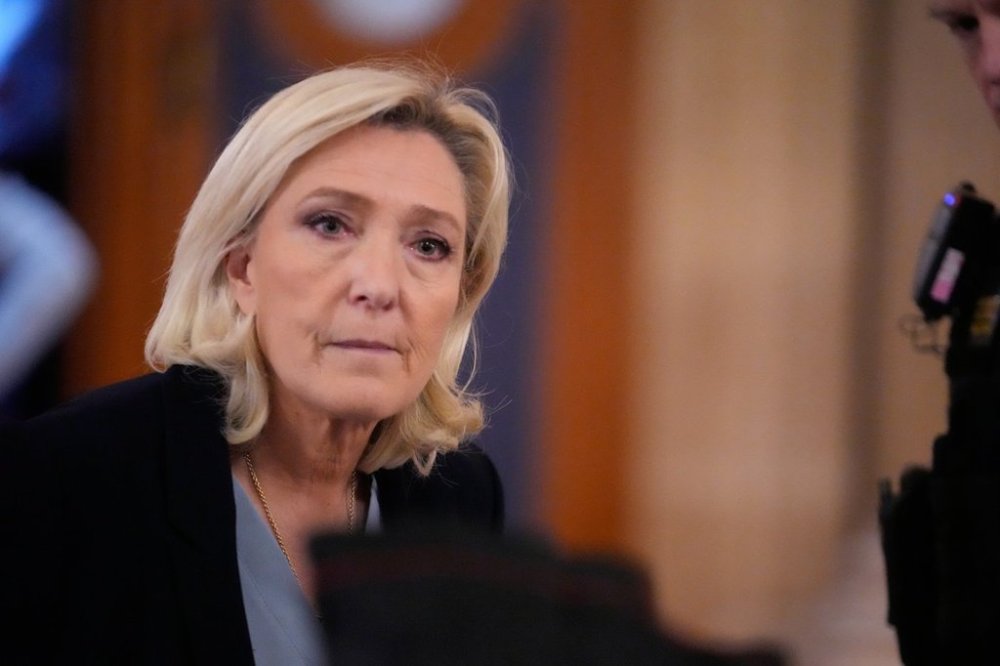
“The mistake lies here: there were certainly some aides, on a case-by-case basis, who must have worked either marginally, more substantially, or entirely … for the benefit of the party. And voilà,” Le Pen told the three-judge panel.
The five-week trial that started last week could significantly impact France’s political landscape. The appeals court is expected to issue its ruling before the summer.
Last March, Le Pen was given a five-year ban from holding elected office, two years of house arrest with an electronic bracelet and a further two-year suspended sentence for having violated the 27-nation bloc’s regulations.
A Paris court ruled that she was at the heart of “a fraudulent system” that her party used to siphon off EU Parliament funds worth 2.9 million euros ($3.4 million). The ruling described the embezzlement as “a democratic bypass” unfair to competitors.
If she’s ruled able to run, Le Pen is expected to be among the top contenders in the 2027 presidential election. If she’s ineligible, she has designated her 30-year-old protégé, Jordan Bardella, as her successor in the presidential bid.
During intense questioning on Wednesday, Le Pen firmly denied the existence of “a system” meant to hire party workers with EU funds. Calm and steady, she insisted her party never committed any illegal move on purpose.
“I wouldn’t say we did everything perfectly. Some criticism can be made about us,” Le Pen said. “But we acted in complete good faith.”
Quizzed about the decision-making process for each hiring, Le Pen acknowledged “ambiguity” in some aides’ assignment. Her personal assistant, who had a contract as EU parliamentary aide, “may have bought some flight tickets for me as president of the party, I admit it, yes,” she said.
The chief judge, Michèle Agi, noted that as an MEP from 2004 and president of her party from 2011, Le Pen had approved those hirings.
“You are a lawyer, you know the law — inevitably, a signature, a contract are notions that have a meaning for you,” Agi told Le Pen.
Le Pen instead blamed European parliament for at the time not tell her party that the way it was hiring people was potentially against any rules.
Asked about her bodyguard, she said she believed the European parliament accepted he had a contract as an aide because his case was “a bit special.”
“There are not many MEPs who need to be protected… and one can also think the European parliament takes that exceptional situation into account. I think we did not committed any irregularities,” she said.