

Cuba’s Santeros offer gifts and ask deities for peace as tensions rise with US
Advertisement
Read this article for free:
or
Already have an account? Log in here »
To continue reading, please subscribe:

Digital Subscription
One year of digital access for only $205*
- Enjoy unlimited reading on winnipegfreepress.com
- Read the E-Edition, our digital replica newspaper
- Access News Break, our award-winning app
- Play interactive puzzles
*First annual payment billed as $205.00 + GST for one year. This annual subscription will automatically renew at $233.00 + GST every 52 weeks (10% off the regular annual price of $259.35). Offer available to new and qualified returning subscribers only. Cancel any time.
To continue reading, please subscribe:
Add Free Press access to your Brandon Sun subscription for only an additional
$1 for the first 4 weeks*
- Enjoy unlimited reading on winnipegfreepress.com
- Read the E-Edition, our digital replica newspaper
- Access News Break, our award-winning app
- Play interactive puzzles
*Your next Brandon Sun subscription payment will increase by $1.00 and you will be charged $17.95 plus GST for four weeks. After four weeks, your payment will increase to $24.95 plus GST every four weeks.
Read unlimited articles for free today:
or
Already have an account? Log in here »
Hey there, time traveller!
This article was published 25/01/2026 (233 days ago), so information in it may no longer be current.
HAVANA (AP) — As tensions rise between the United States and Cuba and the island braces for more economic difficulties, priests and priestesses of the Afro-Cuban religion known as Santería held several ceremonies on Sunday, offering gifts to deities and asking for peace.
Several leading figures in the Santería community prayed for the “spiritual healing” of the Cuban people and an end to the violence and conflicts that, according to their predictions in late December, would characterize this year.
They chanted in ancient Yoruba, brought to the island by enslaved Africans and passed down orally. African and Spanish traditions syncretized, giving rise to Cuba’s strong Afro-Cuban identity.
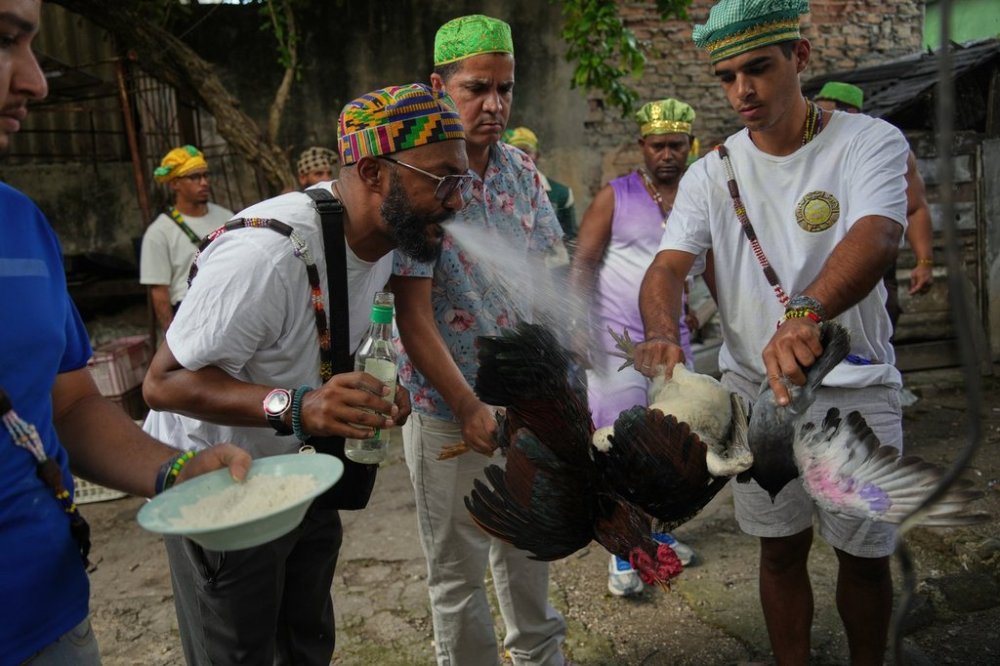
“We…believe that through sacrifices and prayers we can alleviate the impact of harmful issues,” said Lázaro Cuesta, a renowned priest who organized the ceremony in the courtyard of an old house.
On Jan. 2, Cuban Santería priests known as babalawos predicted the possibility of war and violence that would affect Cuba and the world using traditional divining methods.
A day later, on Jan. 3, the United States struck Venezuela’s capital, Caracas, and arrested then-President Nicolás Maduro. Thirty-two Cuban soldiers from Maduro’s personal security detail died in the operation.
Venezuela is one of Cuba’s main political, ideological and commercial allies, and the attack shocked the island’s population.
Cuba is currently experiencing a radical tightening of U.S. sanctions, strangling its economy to pressure for a change in its political system, and U.S. President Donald Trump has directly threatened the island.
“As religious people, we always try to distance ourselves from anything negative that comes into our lives,” said Yusmina Hernández, a 49-year-old homemaker, as she participated in the ceremony.
At the foot of a leafy mango tree swaying in the breeze, a hen, a rooster and a dove were sacrificed. Around them, several dozen babalawos raised their voices in prayer, repeatedly asking Eggun, the deity of the ancestors, for permission to invoke his power and presence.
Then, the priests and parishioners moved to a large room in the house for the second part of the ceremony.
Dressed in white, wearing necklaces and headdresses, they made their offering to Azowano, one of the forms Saint Lazarus takes in their religion. They knelt before a large basket and bowls filled with beans, corn, and even two eggs, a generous offer since they are expensive in Cuba.
Afterward, several hundred people formed a single file, circled the basket and were finally “cleansed” after being swept with two live chickens while the attendees chanted in Yoruba.
“This is being done for the good of society, so that there is no conflict or violence, so that there is harmony and health,” said Eraimy León, a 43-year-old babalawo.
___
Follow AP’s coverage of Latin America and the Caribbean at https://apnews.com/hub/latin-america