

US aircraft carrier arrives in the Middle East as tensions with Iran remain high
Advertisement
Read this article for free:
or
Already have an account? Log in here »
To continue reading, please subscribe:

Digital Subscription
One year of digital access for only $205*
- Enjoy unlimited reading on winnipegfreepress.com
- Read the E-Edition, our digital replica newspaper
- Access News Break, our award-winning app
- Play interactive puzzles
*First annual payment billed as $205.00 + GST for one year. This annual subscription will automatically renew at $233.00 + GST every 52 weeks (10% off the regular annual price of $259.35). Offer available to new and qualified returning subscribers only. Cancel any time.
To continue reading, please subscribe:
Add Free Press access to your Brandon Sun subscription for only an additional
$1 for the first 4 weeks*
- Enjoy unlimited reading on winnipegfreepress.com
- Read the E-Edition, our digital replica newspaper
- Access News Break, our award-winning app
- Play interactive puzzles
*Your next Brandon Sun subscription payment will increase by $1.00 and you will be charged $17.95 plus GST for four weeks. After four weeks, your payment will increase to $24.95 plus GST every four weeks.
Read unlimited articles for free today:
or
Already have an account? Log in here »
Hey there, time traveller!
This article was published 26/01/2026 (253 days ago), so information in it may no longer be current.
WASHINGTON (AP) — The aircraft carrier USS Abraham Lincoln and three accompanying warships have arrived in the Middle East, bringing a renewed potential that President Donald Trump could opt to order airstrikes on Iran over its crackdown on protesters.
The carrier, along with three destroyers, “is currently deployed to the Middle East to promote regional security and stability,” U.S. Central Command said Monday on social media.
The strike group was in the Indian Ocean, Central Command said, and not in the Arabian Sea, which borders Iran. It will bring thousands of additional service members to the region, which has not had a U.S. aircraft carrier since the USS Gerald R. Ford was ordered in October to sail to the Caribbean as part of a pressure campaign on then-Venezuelan President Nicolás Maduro.
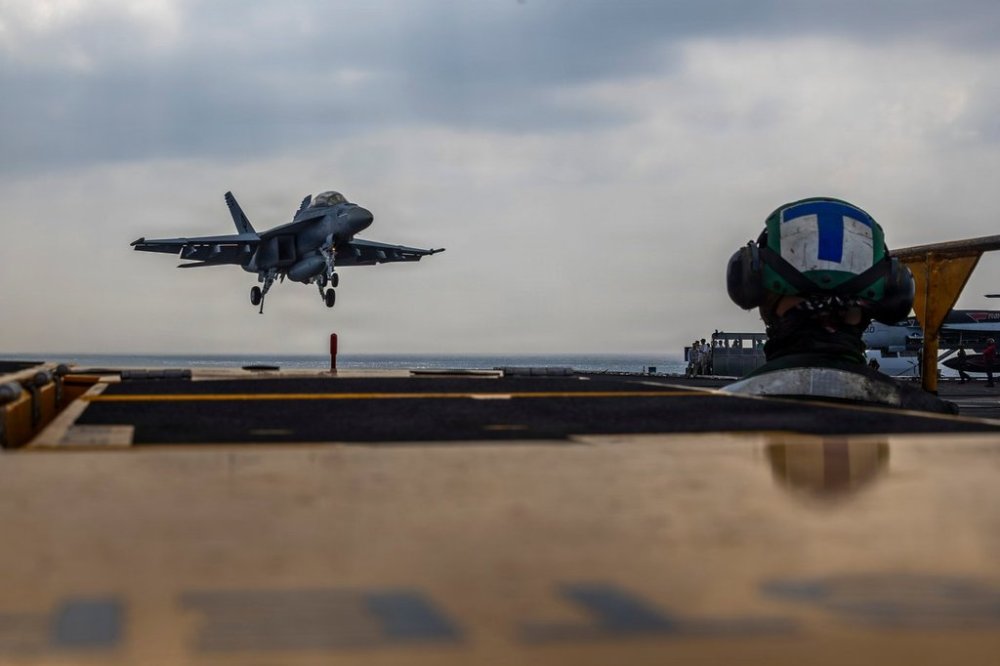
Trump told reporters last week that the ships were sent to the region “just in case.” “We have a massive fleet heading in that direction, and maybe we won’t have to use it,” he said.
Trump earlier had threatened military action if Iran carried out mass executions of prisoners or killed peaceful demonstrators during a crackdown on protests that began in late December. At least 5,973 people have been killed and more than 41,800 detained, according to activists. The official Iranian death toll is far lower, at 3,117 dead.
More recently, Trump appeared to have backed away from possible action, claiming Iran halted the hangings of 800 detained protesters. He has not elaborated on the source of the claim, which Iran’s top prosecutor called “completely false.”
However, Trump appears to be keeping his options open. On Thursday aboard Air Force One, he said his threatened military action would make last year’s U.S. strikes on Iranian nuclear sites “look like peanuts” if the government proceeded with planned executions of some protesters.
The aircraft carrier hosts multiple squadrons of aircraft, including F-35 Lightning II fighter jets and F/A-18 Super Hornet fighter jets. Meanwhile, the destroyers bring with them hundreds of missiles, which could include dozens of Tomahawk land attack cruise missiles.
In addition to the aircraft carrier and its hardware, the U.S. military said the Air Force F-15E Strike Eagle fighter jet now has a presence in the region.
Analysts who follow flight-tracking data have noticed dozens of U.S. military cargo planes also heading to the region.
The activity is similar to last year when the U.S. moved in air defense hardware, including a Patriot missile system, in anticipation of an Iranian counterattack following the bombing of three key nuclear sites. Iran launched over a dozen missiles at Al Udeid Air Base days after the strikes.