

Syria’s president and 2 top ministers were targets of 5 foiled assassination attempts, UN says
Advertisement
Read this article for free:
or
Already have an account? Log in here »
To continue reading, please subscribe:

Digital Subscription
One year of digital access for only $205*
- Enjoy unlimited reading on winnipegfreepress.com
- Read the E-Edition, our digital replica newspaper
- Access News Break, our award-winning app
- Play interactive puzzles
*First annual payment billed as $205.00 + GST for one year. This annual subscription will automatically renew at $233.00 + GST every 52 weeks (10% off the regular annual price of $259.35). Offer available to new and qualified returning subscribers only. Cancel any time.
To continue reading, please subscribe:
Add Free Press access to your Brandon Sun subscription for only an additional
$1 for the first 4 weeks*
- Enjoy unlimited reading on winnipegfreepress.com
- Read the E-Edition, our digital replica newspaper
- Access News Break, our award-winning app
- Play interactive puzzles
*Your next Brandon Sun subscription payment will increase by $1.00 and you will be charged $17.95 plus GST for four weeks. After four weeks, your payment will increase to $24.95 plus GST every four weeks.
Read unlimited articles for free today:
or
Already have an account? Log in here »
Hey there, time traveller!
This article was published 11/02/2026 (240 days ago), so information in it may no longer be current.
UNITED NATIONS (AP) — Syria’s president, interior minister and foreign minister were the targets of five foiled assassination attempts last year, the U.N. chief said in a report on threats posed by Islamic State militants released Wednesday.
The report said President Ahmad al-Sharaa was targeted in northern Aleppo, the country’s most populous province, and southern Daraa by a group called Saraya Ansar al-Sunnah, which was assessed to be a front for the Islamic State group.
The report, issued by Secretary-General António Guterres and prepared by the U.N. Office of Counter-Terrorism, gave no dates or details of the attempts against al-Sharaa or Syrian Interior Minister Anas Hasan Khattab and Foreign Minister Asaad al-Shibani.
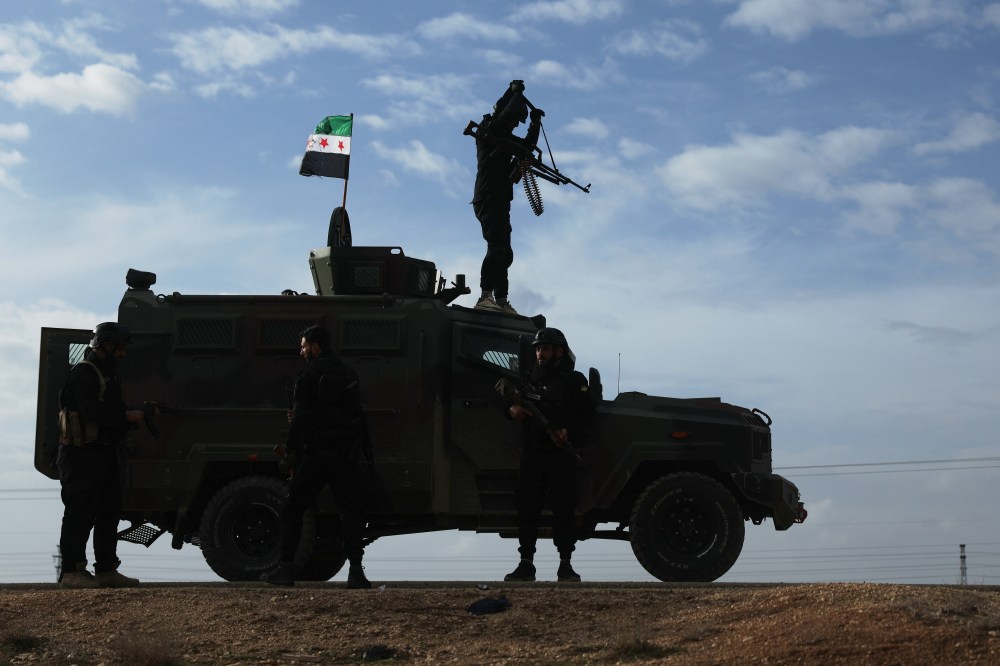
The assassination attempts are more evidence that the militant group remains intent on undermining the new Syrian government and “actively exploiting security vacuums and uncertainty” in Syria, the report said.
It said al-Sharaa was “assessed to be a primary target” of the Islamic State. And it said the front group provided IS with plausible deniability and “improved operational capacity.”
Al-Sharaa has led Syria since his rebel forces ousted longtime Syrian President Bashar Assad in December 2024, ending a 14-year civil war.
Al-Sharaa was previously the leader of Hayar Tahrir al-Sham, a militant group that was once affiliated with al-Qaida, although it later cut ties.
In November, his government joined the international coalition formed to counter the Islamic State group, which once controlled a large part of Syria.
The U.N. counter-terrorism experts said the militant group still operates across the country, primarily attacking security forces, particularly in the north and northeast.
In one ambush attack on Dec. 13 on U.S. and Syrian forces near Palmyra, two U.S. servicemen and an American civilian were killed and three Americans and three members of Syria’s security forces were wounded. President Donald Trump retaliated, launching military operations to eliminate IS fighters.
According to the U.N. counter-terrorism experts, the Islamic State group maintains an estimated 3,000 fighters across Iraq and Syria, the majority of them based in Syria.
The U.S. military in late January began transferring IS detainees who were held in northeastern Syria to Iraq to ensure they remain in secure facilities. Iraq has said it will prosecute the militants.
Syrian government forces had taken control of a sprawling camp housing thousands of IS detainees following the withdrawal of the U.S.-backed Syrian Democratic Forces as part of a ceasefire with the Kurdish fighters.
The report released Wednesday to the U.N. Security Council said as of December, before the ceasefire deal, more than 25,740 people remained in the al-Hol and Roj camps in the northeast, more than 60% of them children, with thousands more in other detention centers.