

NORAD intercepts 5 Russian aircraft near Alaska, though military says there was no threat
Advertisement
Read this article for free:
or
Already have an account? Log in here »
To continue reading, please subscribe:

Digital Subscription
One year of digital access for only $205*
- Enjoy unlimited reading on winnipegfreepress.com
- Read the E-Edition, our digital replica newspaper
- Access News Break, our award-winning app
- Play interactive puzzles
*First annual payment billed as $205.00 + GST for one year. This annual subscription will automatically renew at $233.00 + GST every 52 weeks (10% off the regular annual price of $259.35). Offer available to new and qualified returning subscribers only. Cancel any time.
To continue reading, please subscribe:
Add Free Press access to your Brandon Sun subscription for only an additional
$1 for the first 4 weeks*
- Enjoy unlimited reading on winnipegfreepress.com
- Read the E-Edition, our digital replica newspaper
- Access News Break, our award-winning app
- Play interactive puzzles
*Your next Brandon Sun subscription payment will increase by $1.00 and you will be charged $17.95 plus GST for four weeks. After four weeks, your payment will increase to $24.95 plus GST every four weeks.
Read unlimited articles for free today:
or
Already have an account? Log in here »
Hey there, time traveller!
This article was published 20/02/2026 (232 days ago), so information in it may no longer be current.
ANCHORAGE, Alaska (AP) — Military jets were launched to intercept five Russian aircraft that were flying in international airspace off Alaska’s western coast, but military officials said Friday the Russian aircraft were not seen as provocative.
The North American Aerospace Defense Command said it detected and tracked two Russian Tu-95s, two Su-35s and one A-50 operating near the Bering Strait on Thursday.
In response, NORAD launched two F-16s, two F-35s, one E-3 and four KC-135 refueling tankers to intercept, identify and escort the Russian aircraft until they departed the area, according to a release from the command.
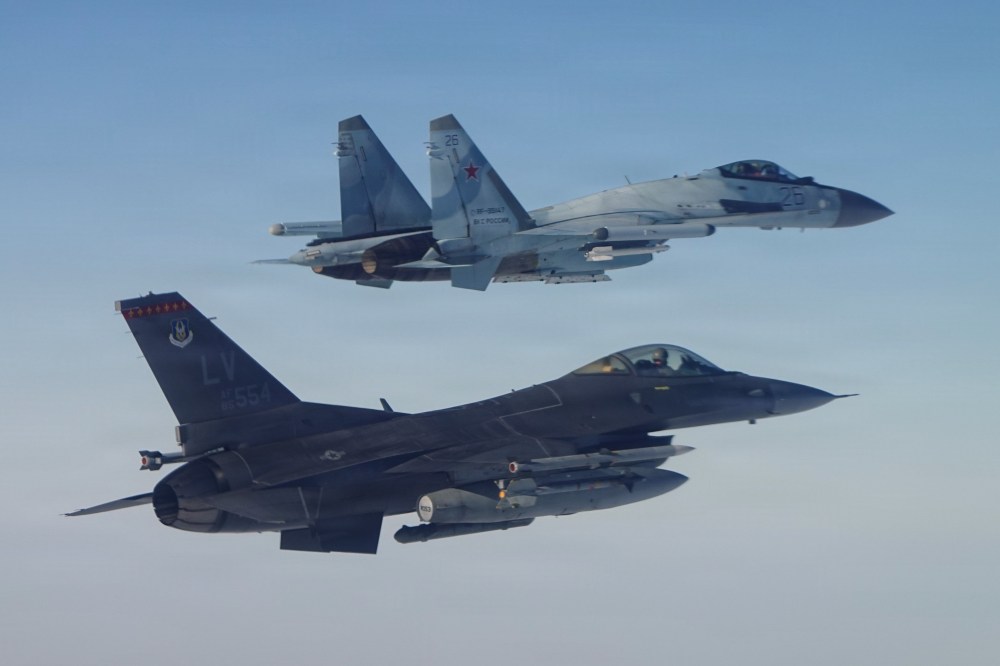
“The Russian military aircraft remained in international airspace and did not enter American or Canadian sovereign airspace,” according to the NORAD statement. It also noted this kind of activity “occurs regularly and is not seen as a threat.”
The Russian aircraft were operating in an area near the Bering Strait, a narrow body of water about 50 miles (80 kilometers) wide separating the Pacific and Arctic oceans, called the Alaskan Air Defense Identification Zone.
Such zones begin where sovereign airspace ends. While it’s international airspace, all aircraft are required to identify themselves when entering zones in the interest of national security, NORAD said.
The command used satellites, ground and airborne radars and aircraft to detect and track aircraft
NORAD is headquartered at Peterson Space Force Base, Colorado, but has its Alaska operations based at Joint Base Elmendorf-Richardson in Anchorage.