

Mexico’s Supreme Court holds its first session outside Mexico City, in Chiapas
Advertisement
Read this article for free:
or
Already have an account? Log in here »
To continue reading, please subscribe:

Digital Subscription
One year of digital access for only $205*
- Enjoy unlimited reading on winnipegfreepress.com
- Read the E-Edition, our digital replica newspaper
- Access News Break, our award-winning app
- Play interactive puzzles
*First annual payment billed as $205.00 + GST for one year. This annual subscription will automatically renew at $233.00 + GST every 52 weeks (10% off the regular annual price of $259.35). Offer available to new and qualified returning subscribers only. Cancel any time.
To continue reading, please subscribe:
Add Free Press access to your Brandon Sun subscription for only an additional
$1 for the first 4 weeks*
- Enjoy unlimited reading on winnipegfreepress.com
- Read the E-Edition, our digital replica newspaper
- Access News Break, our award-winning app
- Play interactive puzzles
*Your next Brandon Sun subscription payment will increase by $1.00 and you will be charged $17.95 plus GST for four weeks. After four weeks, your payment will increase to $24.95 plus GST every four weeks.
Read unlimited articles for free today:
or
Already have an account? Log in here »
Hey there, time traveller!
This article was published 26/02/2026 (205 days ago), so information in it may no longer be current.
TENEJAPA, Mexico (AP) — Mexico’s Supreme Court held its first session outside its neoclassical building in Mexico City Thursday in a mountain town in the southern state of Chiapas, the start of its plan to bring the country’s highest court to far-flung corners of the country.
Under a tent in the central square of Tenejapa, some 2,000 people listened to the court’s deliberations.
Under a constitutional reform, the court’s justices were popularly elected last year for the first time. Its chief justice is Hugo Aguilar, an Indigenous lawyer from the neighboring state of Oaxaca.
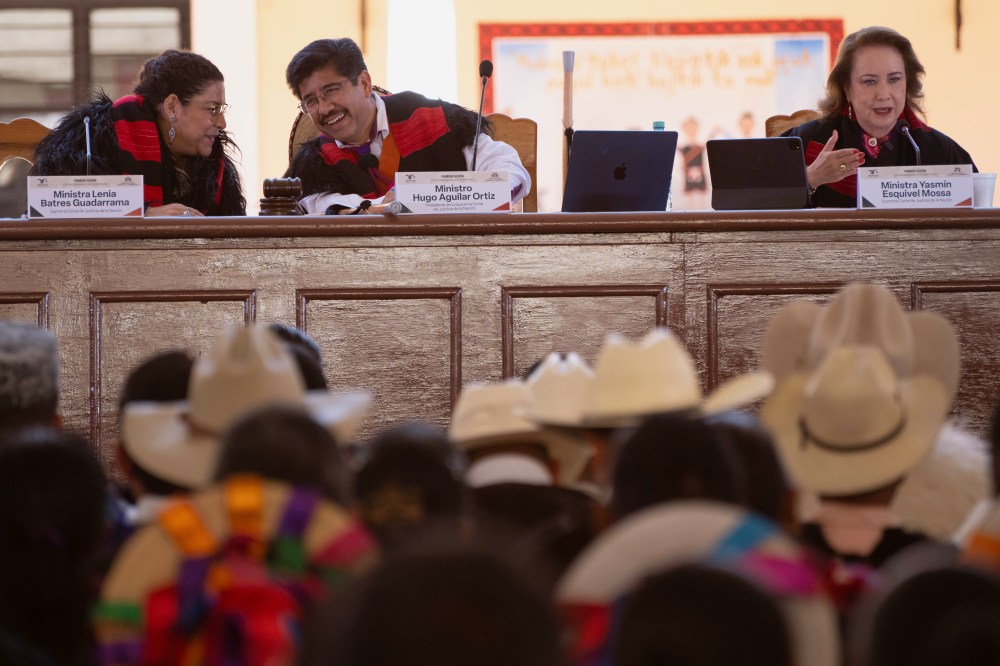
“Often in our communities we only feel the effects of a decision” taken far away, Aguilar said Thursday. Now, the goal is “that you see how we deliberate, that you know what we say, how we consider and make a decision.”
Some of those present, Indigenous leaders and authorities, held signs that said “right to self-determination.” Others just came to listen and be part of a historic moment.
“It makes me happy that this new minister (Aguilar) comes out to the towns, to cities to carry out justice because we really need to listen to the people,” said María de la Cruz Velasco, president of a foundation that helps victims of femicide.
Among those present were members of the community La Candelaria, in the municipality of San Cristobal de las Casas, which has been demanding self-rule for years. The case made it to the Supreme Court and was one of the issues discussed Thursday.
The court’s sessions can often be tedious and difficult for anyone outside the legal profession to follow, but Indigenous people and victims of violence have traditionally had an ally in the court. It has usually defended human rights with a progressive perspective even though some of the sentences handed down have not always been carried out.
Velasco recalled that when her daughter was killed, local courts did not want to classify the crime as a femicide, but the Supreme Court finally decided that it was not a normal homicide because it had a gender dimension. “Today my daughter’s (killer) is serving 55 years in prison,” she said.
This court is the first elected by the people and the argument for doing so was in part to make it more responsive and accountable. The idea was widely criticized for politicizing Mexico’s highest court. The turnout for the election was extremely low and the candidates tied to the governing party overwhelmingly won seats.
But on Thursday in Tenejapa, nestled in the mountains of Chiapas, that controversy was not discussed. There was gratitude that the court had come to them.