

Trump administration ends protections for rare dancing prairie bird
Advertisement
Read this article for free:
or
Already have an account? Log in here »
To continue reading, please subscribe:
Monthly Digital Subscription
$1 per week for 24 weeks*
- Enjoy unlimited reading on winnipegfreepress.com
- Read the E-Edition, our digital replica newspaper
- Access News Break, our award-winning app
- Play interactive puzzles
*Billed as $4.00 plus GST every four weeks. After 24 weeks, price increases to the regular rate of $19.95 plus GST every four weeks. Offer available to new and qualified returning subscribers only. Cancel any time.
Monthly Digital Subscription
$4.99/week*
- Enjoy unlimited reading on winnipegfreepress.com
- Read the E-Edition, our digital replica newspaper
- Access News Break, our award-winning app
- Play interactive puzzles
*Billed as $19.95 plus GST every four weeks. Cancel any time.
To continue reading, please subscribe:
Add Free Press access to your Brandon Sun subscription for only an additional
$1 for the first 4 weeks*
*Your next subscription payment will increase by $1.00 and you will be charged $16.99 plus GST for four weeks. After four weeks, your payment will increase to $23.99 plus GST every four weeks.
Read unlimited articles for free today:
or
Already have an account? Log in here »
FORT COLLINS, Colo. (AP) — A ground-dwelling bird known for elaborate mating dances on the southern Great Plains will no longer be federally protected after the Trump administration agreed with arguments by three states and the beef and petroleum industries that the species was listed improperly.
Thursday’s delisting by the U.S. Fish and Wildlife Service formalized a recent court ruling that acknowledged the federal agency has now sided with opponents of federal protections for the lesser prairie chicken.
The ruling by a federal judge in Midland, Texas, in effect ended Endangered Species Act protections for the bird last summer. The protections required the energy industry and ranchers to take steps to avoid disrupting the birds’ habitat and especially their mating areas, called leks.
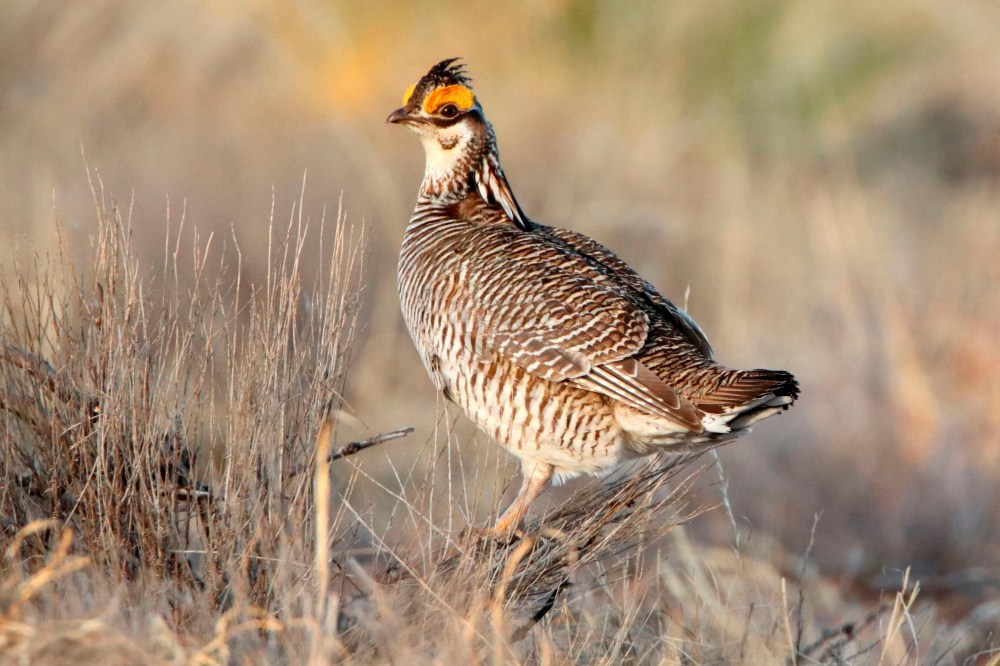
The crow-sized birds once numbered in the millions. Habitat loss from energy and agriculture development has shrunk their population to about 30,000 across parts of Colorado, Kansas, New Mexico, Oklahoma and Texas.
Wildlife watchers delight in the male birds’ spring dances and their warbling, clucking and stomping ruckus to attract mates. Native American tribes mimic the flamboyant displays — also a behavior of the more common greater prairie chicken — in some of their dances.
The lesser prairie chicken has been federally protected twice in recent years. In 2015, a federal judge in U.S. District Court in Midland reversed the bird’s listing as a threatened species the year before, siding with petroleum developers who argued that sufficient protections were already in place.
In 2022, President Joe Biden’s administration listed the lesser prairie chicken as threatened in the northern part of its range in Colorado, Kansas, Oklahoma and Texas, and as endangered in a “distinct population segment” to the south in New Mexico and Texas.
The listing prompted a lawsuit filed by Kansas, Oklahoma and Texas and groups including the Permian Basin Petroleum Association and National Cattlemen’s Beef Association.
After President Donald Trump took office last year, the Fish and Wildlife Service reevaluated the bird and agreed with the states and groups that it lacked justification to classify the lesser prairie chicken into two distinctly different populations.
Last August, another judge in U.S. District Court in Midland granted a Fish and Wildlife Service motion to reverse its Biden-era listings for the lesser prairie chicken.
“Fish and Wildlife’s concession points to serious error at the very foundation of its rule,” District Judge David Counts wrote in his Aug. 12 ruling praised by Texas officials.
Texas oil and gas regulatory officials including Texas Railroad Commission spokesperson Bryce Dubee and Texas Land Commissioner Dawn Buckingham welcomed the delisting.
“It will ensure American oil and gas production in the Permian Basin remains robust and our economy steadfast,” Buckingham said in an emailed statement.
Environmentalists vowed to fight on in court.
“It’s shameful that the Trump administration sees fit to sacrifice these magnificent birds for oil and gas industry profit,” Jason Rylander, legal director at the Center for Biological Diversity’s Climate Law Institute, said in a statement. “Lesser prairie chickens may be lost forever without Endangered Species Act protections.”