

Umberto Bossi, the League’s populist founder and a pivotal figure in Italian politics, dies aged 84
Advertisement
Read this article for free:
or
Already have an account? Log in here »
To continue reading, please subscribe:
Monthly Digital Subscription
$1 per week for 24 weeks*
- Enjoy unlimited reading on winnipegfreepress.com
- Read the E-Edition, our digital replica newspaper
- Access News Break, our award-winning app
- Play interactive puzzles
*Billed as $4.00 plus GST every four weeks. After 24 weeks, price increases to the regular rate of $19.95 plus GST every four weeks. Offer available to new and qualified returning subscribers only. Cancel any time.
Monthly Digital Subscription
$4.99/week*
- Enjoy unlimited reading on winnipegfreepress.com
- Read the E-Edition, our digital replica newspaper
- Access News Break, our award-winning app
- Play interactive puzzles
*Billed as $19.95 plus GST every four weeks. Cancel any time.
To continue reading, please subscribe:
Add Free Press access to your Brandon Sun subscription for only an additional
$1 for the first 4 weeks*
*Your next subscription payment will increase by $1.00 and you will be charged $16.99 plus GST for four weeks. After four weeks, your payment will increase to $23.99 plus GST every four weeks.
Read unlimited articles for free today:
or
Already have an account? Log in here »
ROME (AP) — Umberto Bossi, the founder of Italy’s populist Northern League and one of the most influential — and polarizing — figures of Italian politics, died on Thursday aged 84, his party said.
His death prompted swift reactions across the political spectrum. President Sergio Mattarella praised him as “a passionate political leader and sincere democrat,” while Premier Giorgia Meloni acknowledged his “fundamental contribution” to the formation of Italy’s first modern center‑right coalition.
Bossi rose from modest origins to become the architect of a political movement that reshaped Italy’s post‑war landscape. From the late 1980s onward, he gave voice to the growing frustrations of northern taxpayers, channeling regional grievances into a populist project centered on autonomy and, sometimes, outright secession.
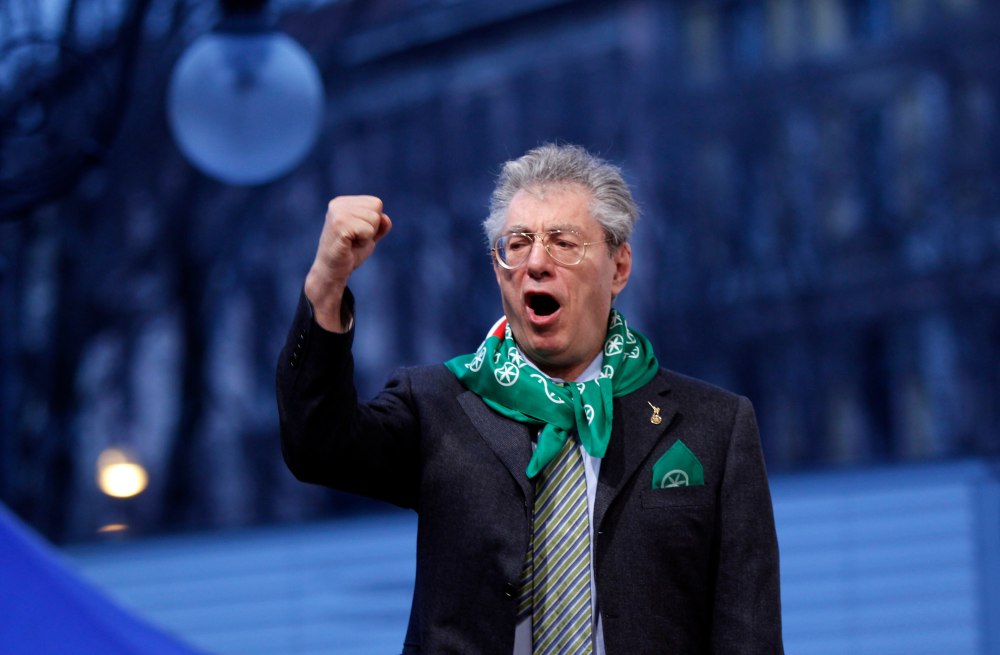
His populist slogan “Roma ladrona” (Thieving Rome) crystallized his critique of the central, corrupted state and became a rallying cry for a generation of disenchanted voters.
Born on Sept. 19, 1941, in Cassano Magnago, a small manufacturing town in the industrial heartland of northern Italy, Bossi officially entered national politics in 1987, earning the nickname “Il Senatùr” (the Senator in Lombard dialect) as he ascended to Italy’s upper house.
Over the following decades, he successfully transformed the Northern League from a tiny regional party into a key national force, forging alliances — and unexpected ruptures — with the late center-right leader Silvio Berlusconi.
He served twice as a minister under Berlusconi, overseeing institutional reform and promoting his lifelong project of national federalism.
Bossi leaves behind a complex legacy: a visionary for his supporters, a divisive populist for critics, but for all a towering figure whose ideas and confrontational style left an indelible mark on modern Italian politics.
His image in a white tank top in the summer of 1994 remains an iconic moment in Italian political history, marking a deliberate contrast to the formal image of his political ally-turned-rival Berlusconi. It became an enduring symbol of his direct, “man of the people” style.
A serious stroke in 2004 significantly affected Bossi’s health, but he remained an active presence in the political world for years afterward.
In 2012, he stepped down as party leader following a scandal over the misuse of party funds, though he continued to exert influence as a founding father of the movement, despite a stormy relationship with the party’s current leader Matteo Salvini.
Salvini recalled Bossi in an emotional post on X: “I was 17 when I met you and you changed my life … Ciao, Capo (Bye, Boss).”
Bossi is survived by his wife, Sicilian-born Manuela Marrone, and his four sons: Riccardo — from his first wife Gigliola Guidali — Renzo, Roberto and Sirio.