

Slovenia’s president urges talks on future government after tight election outcome
Advertisement
Read this article for free:
or
Already have an account? Log in here »
To continue reading, please subscribe:

Digital Subscription
One year of digital access for only $205*
- Enjoy unlimited reading on winnipegfreepress.com
- Read the E-Edition, our digital replica newspaper
- Access News Break, our award-winning app
- Play interactive puzzles
*First annual payment billed as $205.00 + GST for one year. This annual subscription will automatically renew at $233.00 + GST every 52 weeks (10% off the regular annual price of $259.35). Offer available to new and qualified returning subscribers only. Cancel any time.
To continue reading, please subscribe:
Add Free Press access to your Brandon Sun subscription for only an additional
$1 for the first 4 weeks*
- Enjoy unlimited reading on winnipegfreepress.com
- Read the E-Edition, our digital replica newspaper
- Access News Break, our award-winning app
- Play interactive puzzles
*Your next Brandon Sun subscription payment will increase by $1.00 and you will be charged $17.95 plus GST for four weeks. After four weeks, your payment will increase to $24.95 plus GST every four weeks.
Read unlimited articles for free today:
or
Already have an account? Log in here »
LJUBLJANA, Slovenia (AP) — Slovenia ‘s president on Monday urged the country’s political parties to start talks on forming a new government as soon as possible after a parliamentary election on the weekend in the European Union country ended with no clear winner and the main players practically tied.
Prime Minister Robert Golob’s liberal Freedom Movement won 29 seats in the 90-member assembly while the opposition right-wing Slovenian Democratic Party, or SDS, won 28, according to preliminary results of 99.85% of votes counted by the state election authorities.
The outcome means that no party has a clear majority of 46 seats and that a future government will depend on smaller parties that emerged as kingmakers following the vote. It was not immediately clear what shape potential future alliances might take.
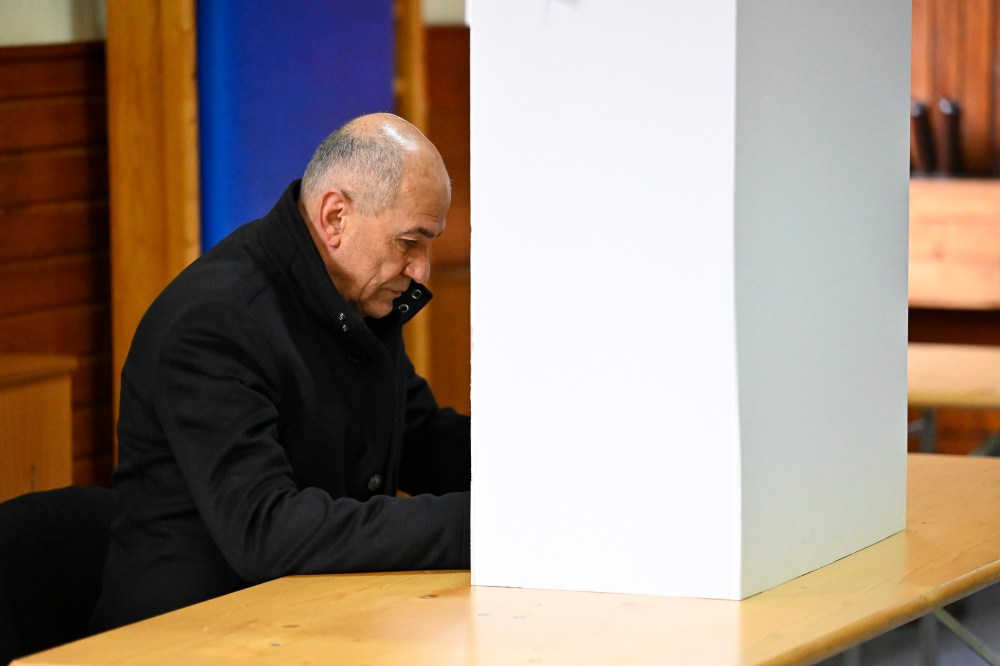
“I urge them to sit down at the negotiating table as soon as possible,” President Natasa Pirc Musar said on X. She congratulated the pro-EU ruling Freedom Movement party, which had a lead of less than 1%, describing it as “the relative winner” of the election.
Sunday’s vote was seen as a key test of whether the EU member nation stays on its liberal course or sways toward the right. The undecided outcome also reflects deep divisions among Slovenia’s 1.7 million eligible voters.
Golob’s government has been a strong liberal voice in the 27-nation EU. SDS leader Janez Jansa is a populist-style politician and a close ally of nationalist Hungarian Prime Minister Viktor Orbán. His return to power would be a boost to Europe’s right-wing blocs.
Golob on Sunday evening thanked the voters on the relative victory, saying that “we have remained the leading party.” He predicted “tough weeks ahead” when he will meet with parliamentary parties to try to find common ground.
Jansa, an admirer of U.S. President Donald Trump, said his party would not want to form a weak coalition government. He said a “balance of political powers … based on what we see now, will not provide much stability.”
The vote was held after a heated campaign that featured allegations of foreign interference and corruption, further whipping already heightened political tensions between the two opposed blocs.
Pensioner Rajko Campa, from the capital Ljubljana, said he was surprised by the election results and that he supported Jansa’s conservatives, arguing that it is healthy to change those in power every few years.
Slovenia routinely has switched between the right and left-leaning blocks since it broke away from the former Yugoslavia in 1991. The Alpine nation of 2 million people became a member of NATO and the EU in 2004.