

Tracking where Israel bombed central Beirut on the war’s deadliest day
Advertisement
Read this article for free:
or
Already have an account? Log in here »
To continue reading, please subscribe:

Digital Subscription
One year of digital access for only $205*
- Enjoy unlimited reading on winnipegfreepress.com
- Read the E-Edition, our digital replica newspaper
- Access News Break, our award-winning app
- Play interactive puzzles
*First annual payment billed as $205.00 + GST for one year. This annual subscription will automatically renew at $233.00 + GST every 52 weeks (10% off the regular annual price of $259.35). Offer available to new and qualified returning subscribers only. Cancel any time.
To continue reading, please subscribe:
Add Free Press access to your Brandon Sun subscription for only an additional
$1 for the first 4 weeks*
- Enjoy unlimited reading on winnipegfreepress.com
- Read the E-Edition, our digital replica newspaper
- Access News Break, our award-winning app
- Play interactive puzzles
*Your next Brandon Sun subscription payment will increase by $1.00 and you will be charged $17.95 plus GST for four weeks. After four weeks, your payment will increase to $24.95 plus GST every four weeks.
Read unlimited articles for free today:
or
Already have an account? Log in here »
BEIRUT (AP) — Israel’s intense barrage of airstrikes on Wednesday hit without warning deep inside the Lebanese capital of Beirut, blowing buildings open to the elements and reducing apartment blocks to rubble in parts of the city that have traditionally escaped attack.
It was not immediately clear what was targeted. The Israeli military later claimed that Iran-backed Hezbollah had repositioned to residential and commercial areas far from the Shiite militia’s usual sphere of influence on the city’s southern outskirts, where the group’s yellow flags appear on lampposts and Israeli evacuation orders have been in place for weeks.
The bombardment killed more than 300 people and wounded over 1,800 others, according to the Lebanese Health Ministry, with most of the casualties in Beirut and its southern suburbs. It marked the deadliest day in the past five weeks of the Israel-Hezbollah war.
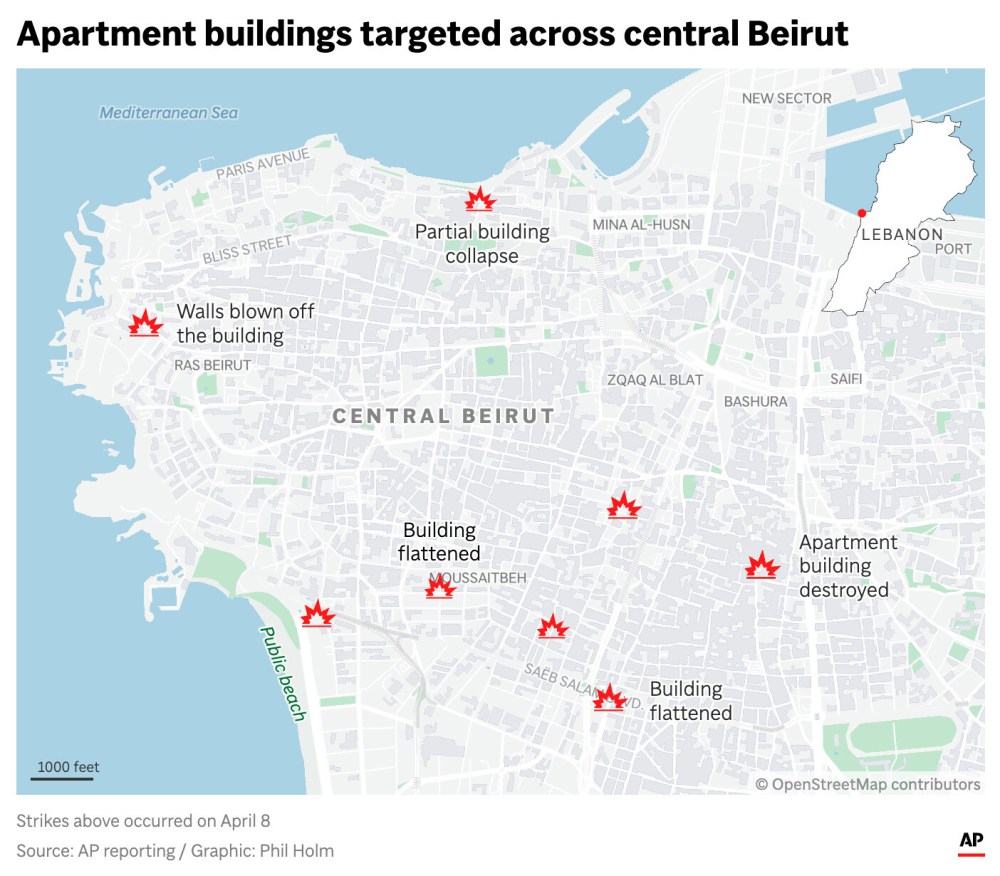
The areas targeted in this wave of Israeli strikes included busy commercial strips, crowded residential neighborhoods and upscale districts along the city’s seafront — places that had felt somewhat removed from the violence of the war, save for the incessant buzz of Israeli drones and thunder of occasional explosions.
One deadly strike hit along Corniche al-Mazraa, a main artery of the city, razing an apartment building near a popular shop selling nuts and dried fruit and setting parked cars ablaze, some with drivers inside.
Another crashed into the hilly residential district of Tallet El Khayat, flattening a multi-story building near an upscale mall — among those killed, residents said, was an award-winning Arabic poet and her husband.
Yet another struck the seaside district of Ain el Tineh, pulverizing an apartment building also home to an exotic plant shop right near the speaker of parliament’s residence and overlooking the city’s only public beach.
Further strikes blew up apartments near a well-known chocolate shop in the mixed commercial and residential area of Mar Elias, wiped out part of a building that housed a snack shop and hair salon in the Caracas district, destroyed the lower floors of a building along Beirut’s coastal corniche and left smoldering ruins in the densely populated neighborhood of Basta near a school sheltering displaced people in an attack that killed, among others, a young mother and her two sons.