

New Hawaii law targets corporate influence in politics after Citizens United ruling
Advertisement
Read this article for free:
or
Already have an account? Log in here »
To continue reading, please subscribe:

Digital Subscription
One year of digital access for only $205*
- Enjoy unlimited reading on winnipegfreepress.com
- Read the E-Edition, our digital replica newspaper
- Access News Break, our award-winning app
- Play interactive puzzles
*First annual payment billed as $205.00 + GST for one year. This annual subscription will automatically renew at $233.00 + GST every 52 weeks (10% off the regular annual price of $259.35). Offer available to new and qualified returning subscribers only. Cancel any time.
To continue reading, please subscribe:
Add Free Press access to your Brandon Sun subscription for only an additional
$1 for the first 4 weeks*
- Enjoy unlimited reading on winnipegfreepress.com
- Read the E-Edition, our digital replica newspaper
- Access News Break, our award-winning app
- Play interactive puzzles
*Your next Brandon Sun subscription payment will increase by $1.00 and you will be charged $17.95 plus GST for four weeks. After four weeks, your payment will increase to $24.95 plus GST every four weeks.
Read unlimited articles for free today:
or
Already have an account? Log in here »
HONOLULU (AP) — Hawaii’s Democratic governor on Thursday signed into law a bill that uses a novel approach to reduce the influence of corporations and hard-to-track “dark money” groups that have been able to spend unlimited amounts on politics since a 2010 U.S. Supreme Court ruling.
The law, which takes effect July 1, 2027, redefines corporations in a way that precludes spending on elections. A volunteer group in Montana is gathering signatures in hopes of putting a similar issue to voters in November.
The high court ruling in Citizens United v. Federal Election Commission struck down a ban on corporate and union election spending as long as they don’t donate directly to any campaigns. The case stemmed from Citizens United, a conservative group, wanting to run TV commercials promoting its anti-Hillary Clinton movie when she was running for president in 2008.
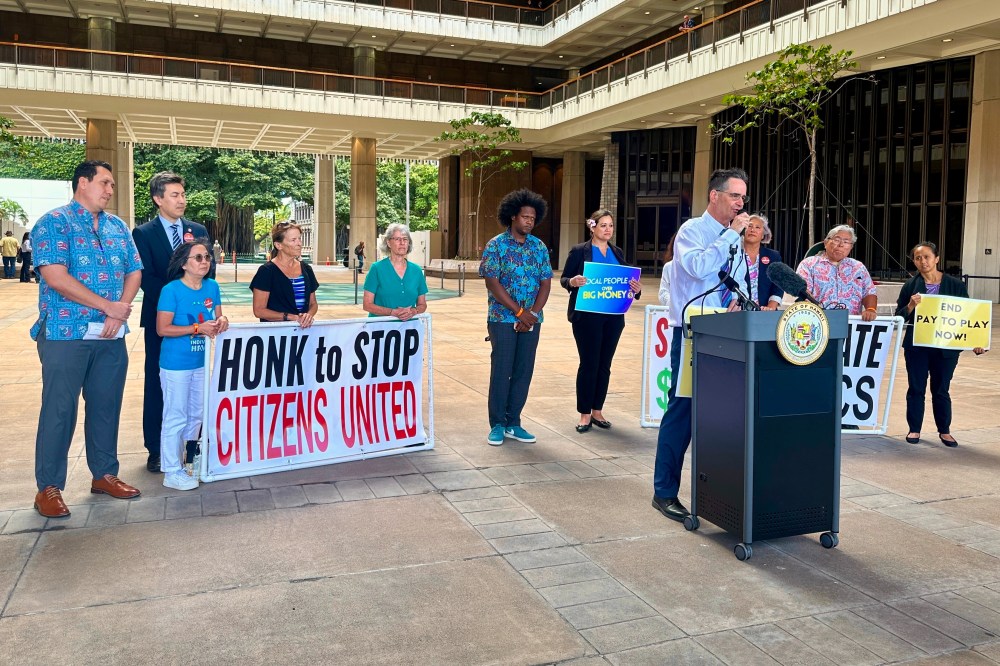
The ruling has benefitted Democrats and Republicans. The campaign finance watchdog group OpenSecrets tracked more than $4 billion in outside political spending in the 2024 federal elections — almost 12 times as much as in 2008.
Some of that came from dark money groups that aren’t required to disclose donors, and the Brennan Center for Justice tallied a record $1.9 billion in that type of spending in 2024. Dark money has also played a part in some state-level races.
The office of Hawaii Attorney General Anne Lopez, a Democrat, opposed Hawaii’s measure, arguing in part that it will be difficult and costly to defend in court.
“Hawaii is taking a brave and bold step to get corporate and dark money out of America’s politics,” said Tom Moore, senior fellow at the Center for American Progress, which crafted the legal strategy the law is based upon. “It will send a powerful message that will be heard loud and clear across the Pacific and across the mainland.”