

Kyiv holds a funeral for 2 young sisters killed by a Russian missile strike
Advertisement
Read this article for free:
or
Already have an account? Log in here »
To continue reading, please subscribe:

Digital Subscription
One year of digital access for only $205*
- Enjoy unlimited reading on winnipegfreepress.com
- Read the E-Edition, our digital replica newspaper
- Access News Break, our award-winning app
- Play interactive puzzles
*First annual payment billed as $205.00 + GST for one year. This annual subscription will automatically renew at $233.00 + GST every 52 weeks (10% off the regular annual price of $259.35). Offer available to new and qualified returning subscribers only. Cancel any time.
To continue reading, please subscribe:
Add Free Press access to your Brandon Sun subscription for only an additional
$1 for the first 4 weeks*
- Enjoy unlimited reading on winnipegfreepress.com
- Read the E-Edition, our digital replica newspaper
- Access News Break, our award-winning app
- Play interactive puzzles
*Your next Brandon Sun subscription payment will increase by $1.00 and you will be charged $17.95 plus GST for four weeks. After four weeks, your payment will increase to $24.95 plus GST every four weeks.
Read unlimited articles for free today:
or
Already have an account? Log in here »
KYIV, Ukraine (AP) — The St. Michael’s Golden-Domed Monastery in the heart of the Ukrainian capital is where Kyiv mourns its soldiers and its prominent dead, the casualties of a war Russia began more than four years ago. On Tuesday, it held two white coffins, side by side, bearing the bodies of two girls.
Liubava Yakovlieva was 12. Her sister, Vira, was 17. They were killed when a Russian missile tore through their Kyiv apartment building on May 14, burying them under rubble. Twenty-four people were killed in the strike.
The girls’ mother, Tetiana, sat beside the coffins, the family’s sole surviving member. The father, Yevhen, was killed on the front line as a soldier three years ago.
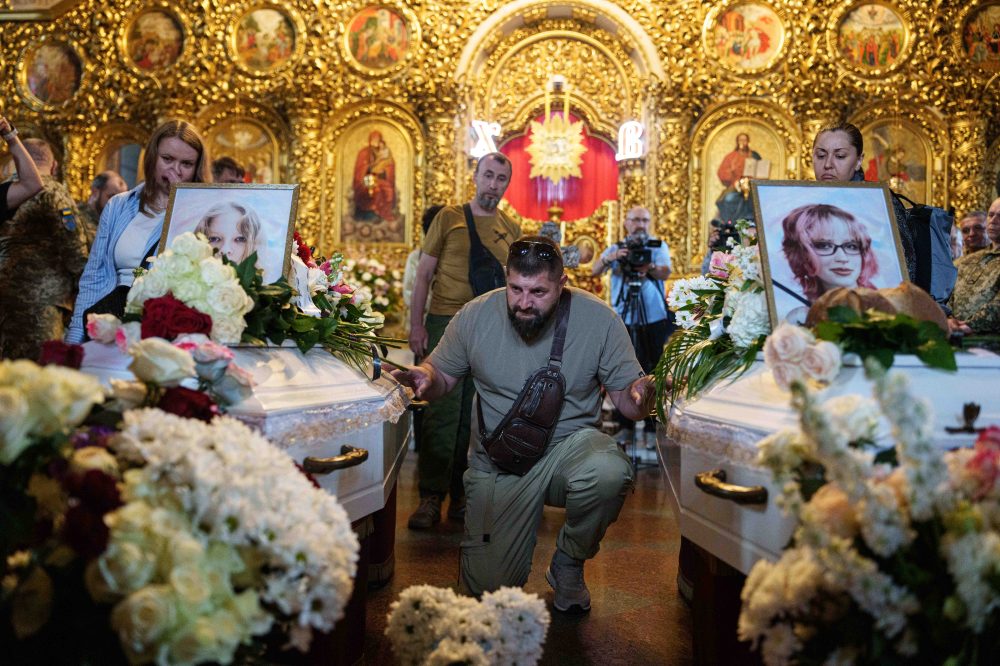
Dozens of children came to say goodbye. Classmates of the sisters, dressed in black, supported each other. Buckets at the foot of the coffins overflowed with flowers, and bouquets lay across the floor.
Photographs on the coffins showed the blond Liubava and Vira, wearing glasses.
Adults and children wept. Among the mourners stood several of Yevhen Yakovliev’s fellow soldiers.
Before the war, he was known as a talented cook, fisherman and handyman. When Russia launched its full-scale invasion in 2022, he enlisted. He was killed in action on April 7, 2023, near the village of Dibrova in the Luhansk region.
The war has now reached his family.
After the Russian missile struck, footage recorded by Current Time, a Radio Liberty project, captured the girls’ mother speaking as rescuers looked through the debris.
“I lost their father, my husband, a defender of Ukraine. I don’t know if they are alive or if they have already gone to be with their father,” Tetiana said. “That it is very painful — those words will tell you nothing until you feel it yourself.”
Among those who came to mourn was Dmytro Koval, who taught Vira painting and drawing at a Kyiv art college. He described her as a student who stood out, strong-willed, unafraid to speak her mind but also kind and attentive to others.
When word of her death reached the college, he said, the shock was profound.
“When death is sown among those you saw and knew just yesterday, it is always very hard, unspeakably hard,” Koval said. “We must not live on illusions, on empty dreams, on hopes for some negotiations, because our neighbors are not oriented toward peace.”
The younger Liubava was a contradiction, small and seemingly fragile but inwardly strong, remembered Tetiana Osipova, a family friend who had served alongside the girls’ father. She had accompanied his body home and became friends with Tetiana and her daughters.
“The children had a very hard time coping with the loss of their father,” Osipova said.
On the day rescuers searched the rubble for Liubava and Vira, she stood beside their mother.
Now, Osipova said, Tetiana faced a new kind of grief — no longer a wife, no longer a mother. She said her friend was determined to find strength in carrying forward the memory of her children and her husband, and to act in their name.
“This is an unnatural order of things, when parents bury their children,” Efrem Khomiak, the priest presiding over the service, told the audience. ”This funeral, this grief, this tragedy, it is not only your family’s. It belongs to all of Ukraine. Because we are all bound together in this war.”
Related Articles
Residents of Lithuania's capital told to shelter as drone alarm underlines NATO's eastern jitters
Advertisement Advertise With Us
Advertisement Advertise With Us