

Brazilian players from a Rio de Janeiro favela find hope and opportunities thanks to soccer
Advertisement
Read this article for free:
or
Already have an account? Log in here »
To continue reading, please subscribe:

Digital Subscription
One year of digital access for only $205*
- Enjoy unlimited reading on winnipegfreepress.com
- Read the E-Edition, our digital replica newspaper
- Access News Break, our award-winning app
- Play interactive puzzles
*First annual payment billed as $205.00 + GST for one year. This annual subscription will automatically renew at $233.00 + GST every 52 weeks (10% off the regular annual price of $259.35). Offer available to new and qualified returning subscribers only. Cancel any time.
To continue reading, please subscribe:
Add Free Press access to your Brandon Sun subscription for only an additional
$1 for the first 4 weeks*
- Enjoy unlimited reading on winnipegfreepress.com
- Read the E-Edition, our digital replica newspaper
- Access News Break, our award-winning app
- Play interactive puzzles
*Your next Brandon Sun subscription payment will increase by $1.00 and you will be charged $17.95 plus GST for four weeks. After four weeks, your payment will increase to $24.95 plus GST every four weeks.
Read unlimited articles for free today:
or
Already have an account? Log in here »
RIO DE JANEIRO (AP) — When Brazilian João Victor Gonçalves began playing soccer in one of Rio de Janeiro ’s poorest and most violent favelas, little did he know the game would one day allow him to travel abroad and play in an international competition.
Last month, along with nine other young boys, he flew to Mexico to represent Brazil in the Street Child World Cup, a tournament with teams from 30 countries composed of boys from impoverished backgrounds, organized ahead of this year’s FIFA World Cup.
“I never could have imagined that one day this would happen, that I would represent my country, doing what I most love — playing soccer — in another country,” said Gonçalves, who is 18. The Brazil team went undefeated and won the tournament, enhancing the thrill of the experience.
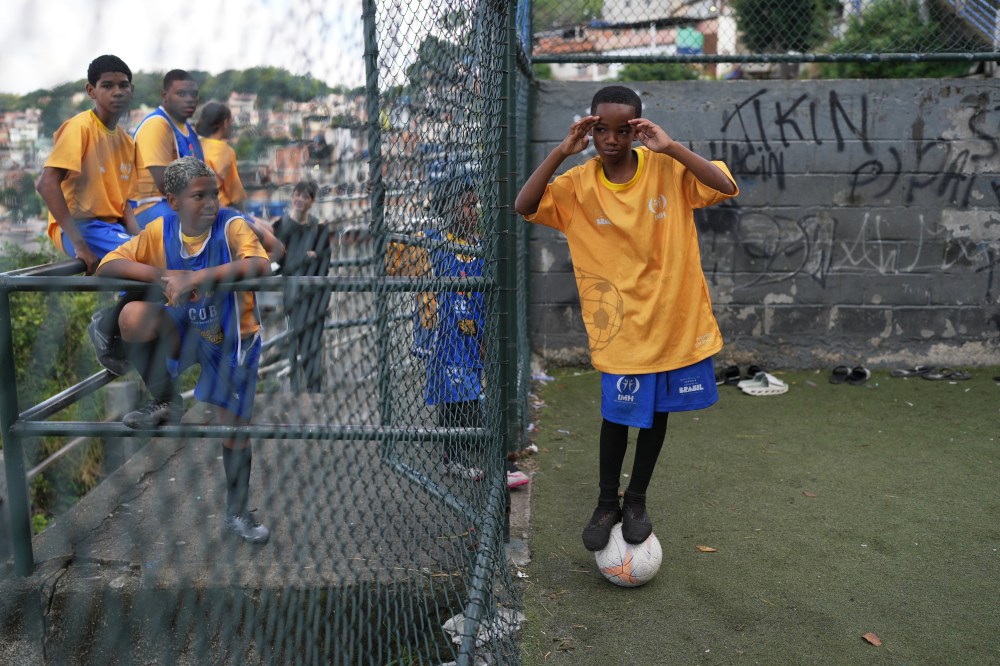
Like many Brazilians, Gonçalves and his teammates grew up kicking a ball around and closely following members of the Seleção, Brazil’s national soccer team. They dream of one day becoming professional soccer players like their heroes.
The project has already changed their lives, they say.
Beyond being the gateway to climatic moments, the Street Child United Brazil project in the Penha complex of favelas allows participants to at least momentarily escape from everyday life marked by deprivation and violence, fostering a sense of safety, belonging and hope.
The initiative began in 2014, when Brazil hosted the FIFA World Cup. Today, some 100 youths take part in the year-round training sessions that take place four days a week. The project welcomes girls and boys aged 6 and above.
Playing soccer represents “love, passion, the realization of dreams,” said Ryan Mercedes, a 17-year-old who also went to Mexico. “When we enter the field, it’s time for us to have fun and be happy.”
But soccer enthusiast Rafael Gomes says that the reality of life in the favela has sometimes caught up with them. The soccer fans have had to at least once interrupt a game due to a police operation in the favela.
“We were training when all of a sudden there were shots, we had to run and stay in the corners,” said Gomes.
Last year, more than 120 people died in a deadly police operation in Penha and the neighboring Alemao complex of favelas targeting members of the criminal group Red Command.
The drug-trafficking group — which the Trump administration recently decided to classify as a foreign terrorist organization — controls parts of the favela. It represents a temptation for minors who might be drawn to crime as a quick way of making cash.
Drica Santos, a coordinator for the project, says that the organization aims to offer an alternative to that way of life.
“If the project didn’t exist, we would have lost a lot of lives,” said Santos. “We’re not going to save everyone, but the greatest number of children that we manage to save — that don’t get involved in drug-trafficking — that will already be our victory.”
Carlos Cassiano da Silva, a community leader in the favela, says that parents are grateful for the project because they know that their children will be occupied for a certain amount of time and stay out of trouble.
The initiative also casts Penha in a good light, da Silva added. “Many people aren’t used to seeing Penha in a positive manner, they don’t know of the good things we have here too,” he said.
As the World Cup approaches, Gonçalves said he hoped that the Seleção would follow in his teammates’ footsteps and bring back the trophy.
“We did our part. Now it’s up to the Brazilian national team,” Gonçalves said.
___
Follow AP’s coverage of Latin America and the Caribbean at https://apnews.com/hub/latin-america