

Cuba to open hotel sector to management by Cubans at home and abroad after chains leave island
Advertisement
Read this article for free:
or
Already have an account? Log in here »
To continue reading, please subscribe:

Digital Subscription
One year of digital access for only $205*
- Enjoy unlimited reading on winnipegfreepress.com
- Read the E-Edition, our digital replica newspaper
- Access News Break, our award-winning app
- Play interactive puzzles
*First annual payment billed as $205.00 + GST for one year. This annual subscription will automatically renew at $233.00 + GST every 52 weeks (10% off the regular annual price of $259.35). Offer available to new and qualified returning subscribers only. Cancel any time.
To continue reading, please subscribe:
Add Free Press access to your Brandon Sun subscription for only an additional
$1 for the first 4 weeks*
- Enjoy unlimited reading on winnipegfreepress.com
- Read the E-Edition, our digital replica newspaper
- Access News Break, our award-winning app
- Play interactive puzzles
*Your next Brandon Sun subscription payment will increase by $1.00 and you will be charged $17.95 plus GST for four weeks. After four weeks, your payment will increase to $24.95 plus GST every four weeks.
Read unlimited articles for free today:
or
Already have an account? Log in here »
HAVANA (AP) — Cuba’s government said it is open to offering the management of its hotels to Cuban investors, both residents and those living abroad, following decisions by Spanish hotel chain Melia and other companies to withdraw or limit their operations on the island.
Meliá announced May 26 that it will cease operations at 15 of the 34 hotels it manages in Cuba after the U.S. announced new sanctions while upholding an energy embargo that has deepened an economic crisis on the island. Cuba’s government has blamed the U.S. blockade for prolonged blackouts, water shortages, supply problems, deficiencies in the healthcare system and disruptions in all aspects of daily life.
The company’s decision follows similar moves by hotel chains including Canadian-owned Royalton and Spain’s Iberostar to limit or suspend operations in Cuba, dealing blows to the vital tourism sector that has plummeted since its 2018 peak.
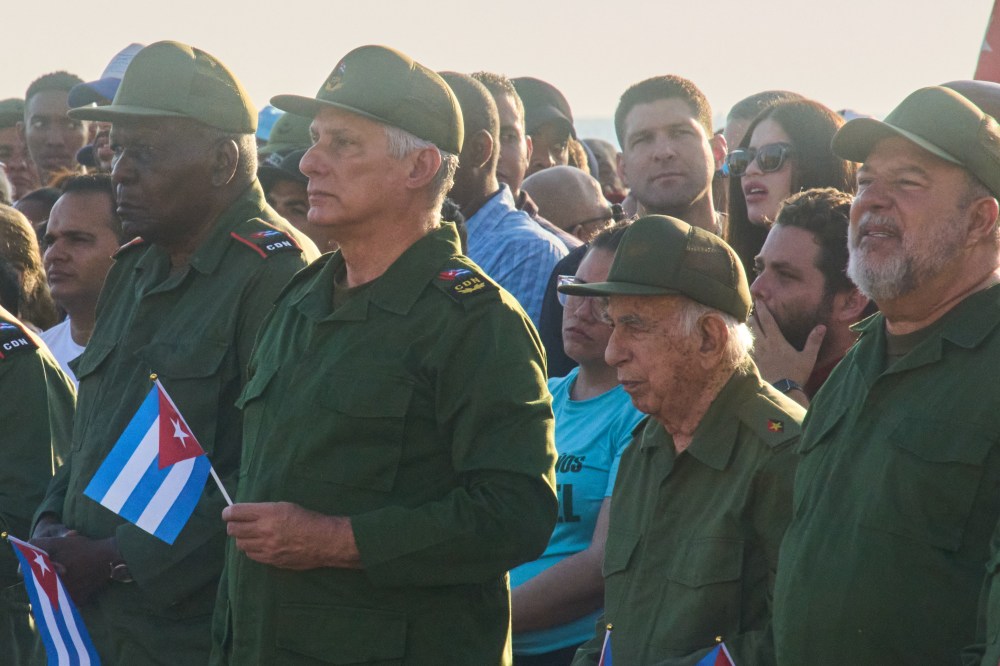
President Miguel Díaz-Canel announced the new management policy in an interview with a Spanish journalist that was broadcast Friday on the official presidential channel.
“There will be hotels that we will have to operate more with Cuban management than with shared management with foreign entities,” Díaz-Canel said. “We are proposing different business models. We are open to Cubans who want to invest and manage hotels,”
“We have also offered these business opportunities to Cubans residing abroad,” he added.
Melia’s decision came weeks after U.S. President Donald Trump signed an executive order expanding sanctions against the island. Most of the sanctions targeted Grupo de Administración Empresarial S.A., a business conglomerate operated by the Cuban Revolutionary Armed Forces, with the assertion it was a threat to U.S. national security.
The order also freezes the assets of other foreign companies, seizes accounts in the United States and prohibits travel by shareholders, investors and employees, virtually eliminating activity in the U.S. financial system.
GAESA, a Cuban conglomerate created in the 1990s, owns a wide range of businesses from car rentals and retail stores to transportation companies. The company is Meliá’s partner in hotel management through one of its subsidiaries, Gaviota.
Meliá is one of Cuba’s most important partners in the tourism sector, operating some 14,000 rooms until its partial withdrawal.
Tourism in Cuba, which reached a peak of 4.3 million visitors in 2019, saw a significant drop in the number of tourists arriving in the first quarter of this year, 48% lower than in the same period in 2025.
Only 298,000 tourists arrived in Cuba during January, February and March compared to 573,300 international visitors during the same period last year, according to government data.
In the interview, Díaz-Canel said it was “cynical” for Trump and U.S. Secretary of State Marco Rubio to promote a narrative that Cuba’s government is ineffectual while intensifying an already harsh embargo.
The U.S. moves could be aimed at strangling Cuba to “provoke a social explosion that would give (Trump) a pretext for humanitarian aid to intervene in the country,” Díaz-Canel said.
Or they could be intended to “pursue a coercive dialogue with Cuba, employing maximum pressure to economically occupy the country.” Or they could be a prelude to a military intervention, he said.
While U.S. and Cuban officials held talks earlier this year, tensions have risen. In late May, former President Raúl Castro was charged in a U.S. indictment for his alleged role in the 1996 downing of two civilian aircraft operated by Miami-based exiles in Cuban waters.